
◎
Get clear
Get clarity on what matters most right now.

Search interest in perimenopause is climbing steeply, and the phrasing tells you who is doing the searching. Not clinicians. People trying to find the word for something. Riding the same wave, tied for the very top of the list, is a plant name most people have never said out loud: chaste tree berry.
"Symptoms perimenopause" sits at 100 on the relative interest scale. "What is perimenopause" sits at 45. Climbing alongside them: "when does perimenopause usually start" and "when does perimenopause begin," both up around 90 percent, "signs of low estrogen in women" up around 100 percent, "perimenopause symptoms age 40" up around 80 percent, and "pre menopausal age" up around 50 percent.
We are not going to answer any of those. Every one of them is a medical question about a physiological transition, and the honest place for them is a conversation with a qualified healthcare professional who knows your history. A supplement brand answering them would be doing something we think is genuinely inappropriate, and we are not going to do it.
What we can do is take the one term on that list that is not a medical question at all. Sitting right at the top with "symptoms perimenopause," tied at 100, is a plant name: chaste tree berry. That one we can tell you about properly, because it is botany and history rather than medicine.
Chaste tree berry is the dried fruit of Vitex agnus-castus, a shrub or small tree in the mint family that grows around the Mediterranean and across into central Asia. It has slender palmate leaves arranged like fingers on a hand, and it throws long spikes of small violet flowers in late summer. It is widely planted as an ornamental in warm climates, which means a great many people have walked past one without knowing it.
The fruit is a small dark drupe, roughly the size of a peppercorn, and this is where the plant's history gets interesting. Dried, the fruit looks and smells remarkably like black pepper, with a sharp aromatic bite. In parts of Europe it was used as a pepper substitute, and it is still occasionally sold that way.
Its common names are unusually loaded. "Chaste tree," "chasteberry" and the old monastic name "monk's pepper" all point at the same medieval association: the plant was grown in monastery gardens and its fruit was reputed to support a life of celibacy. The species name carries the idea twice over, since agnus castus translates roughly as "chaste lamb." Whether the reputation was ever deserved is not something we can speak to. What is certain is that the belief is old, that it attached itself to the name permanently, and that a modern shopper is reading a medieval claim every time they read the label.
That is a genuinely useful thing to know, because it explains something confusing about this ingredient. Its common name is not descriptive of the plant. It is a fossil of what people once believed about it. Most botanical names describe appearance, habitat or geography. This one describes a reputation.
Here is the connection, and we want to be careful about what kind of connection it is.
Chaste tree berry is not trending because anything new was discovered. It is trending because the conversation around perimenopause has moved from private to public in a very short space of time, and when a subject goes public, its whole vocabulary goes with it. Words that used to be exchanged between two people are now typed into a search bar, and traditional botanicals that were previously passed along by word of mouth surface in the results.
The search list captures that shift precisely. People are asking what the transition is called, when it happens, and what the words mean. Alongside those questions, one plant name is being typed at the same volume as the symptom queries themselves. That is a vocabulary event, not an evidence event, and it deserves to be described as one.
So the accurate statement is a narrow one. A very old plant with a very odd name has entered a very new conversation. What it does, whether it suits you, and whether it belongs anywhere near your particular situation are all questions this article is not qualified to touch. They belong to you and your clinician.
The thing worth saying here is not about a berry. It is about how badly this subject has been served.
People are turning up to search engines with basic vocabulary questions about a life stage that roughly half the population goes through, and that they were often never given language for. The volume on "what is perimenopause" is not a niche curiosity. It is evidence of a gap that should not exist.
Our view is that the gap gets closed by clinicians, by better information, and by the subject being discussed openly, and not by supplement companies rushing to fill the silence with promises. There is a strong commercial temptation in this category to answer the medical questions, because the people asking them are motivated and the traffic is enormous. We think doing so is how this industry loses the trust it needs.
So we will tell you what a plant is, where it grows, and where its strange name came from. For the rest, ask somebody qualified. That is not us being evasive. That is the line being where it belongs.
What is perimenopause? As a word, it is straightforward: the prefix "peri" comes from Greek and means around or near, so the term literally names the period around menopause. As a physiological description, it is a clinical subject, and what it involves for any individual is a question for a qualified healthcare professional rather than for us.
When does perimenopause usually start, or begin? These are among the fastest-climbing searches on this topic, and they are asking for medical information that varies from person to person. We are not able to answer them and we would be wary of any supplement brand that offered to. Your doctor can.
What is chaste tree berry? The dried peppercorn-sized fruit of Vitex agnus-castus, a Mediterranean shrub in the mint family, historically used as a pepper substitute and known by the old names chasteberry and monk's pepper. That is the part we can answer, and it is answered above.
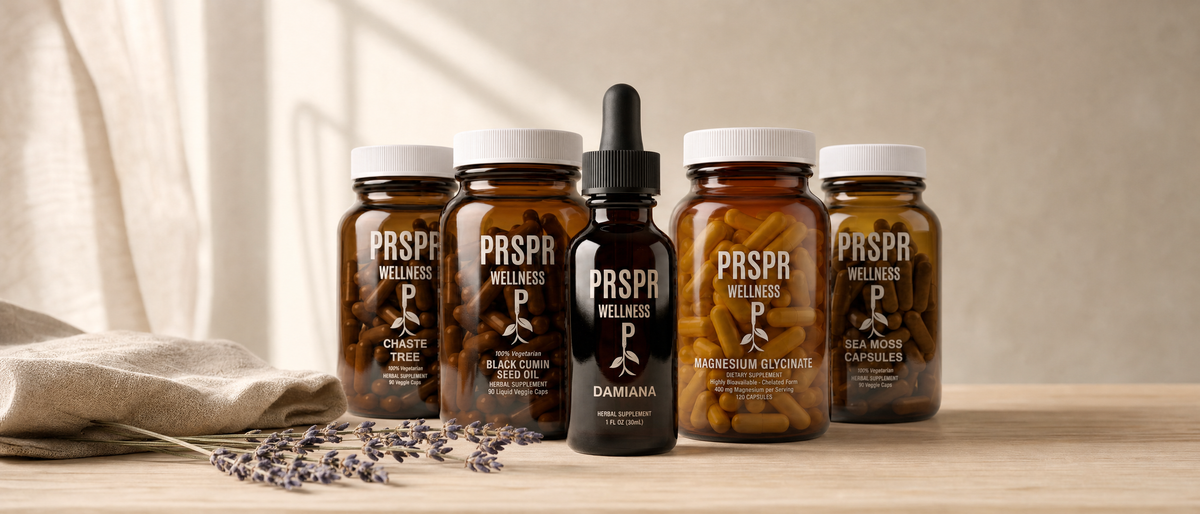
Our Menopause and Perimenopause Bundle is assembled from separate single-purpose formulas rather than blended into one tablet, and Chaste Tree is one of them. Individual bottles mean individual labels, which means you can read each supplement facts panel on its own terms instead of taking a blend on trust. The current listing shows the full set.
Everything we make is manufactured in a GMP-certified facility and third-party batch tested. What is on the label is what is in the bottle. No guessing, no filler, no cutting corners. On a botanical identified by a medieval nickname, verified identity is not a nice extra. It is the whole basis for knowing what you are holding.
If you want the other components explained, we wrote about how to read the magnesium forms on a label and about what sea moss actually is. If you would like help working out where to start, our wellness quiz takes a couple of minutes, and the bundle sits with the rest of our bundles. Please take the medical questions to your clinician first.
Answer all five questions to unlock a clear wellness plan made around your goal, schedule, preferred supplement format, and biggest roadblock.
Get clarity on what matters most right now.
See the product and routine connected to your goal.
Simple next steps you can use right away.
Pick the one you would fix first if you could.
This helps us make the guide easier to follow.
Consistency beats the “perfect” routine you never follow.
Be honest. We’re building something you’ll actually use.
Your guide will include one simple way around it.
Answer two more questions to unlock your product starting point, five-step plan, two-week routine, and one practical tip for your biggest roadblock.
Enter your details to open your five-step plan.
Verified PRSPR customer reviews
Expires when you close this page
*Your personal credit for completing the quiz. It's applied automatically at checkout on one-time purchases and expires when the timer runs out.
View full product detailsEverything in your plan, together — one add to cart.
Expires when you close this page
*Your personal credit for completing the quiz. It's applied automatically at checkout on one-time purchases and expires when the timer runs out.
View full product details Electrolytes
Salt is having a comparison week. Searches for celtic sea salt vs himalayan pink salt are up about 70 percent, pink himalayan salt vs table salt is...
 Kids
KidsPick up a box of children's snacks and somewhere on the front there is a number with the letter g after it, next to the word fiber. It looks like o...
 Label Reading
It is printed on the front of a lot of mineral bottles and it is one of the least understood words in the supplement business. Chelated. Search int...