
◎
Get clear
Get clarity on what matters most right now.

What is sweat made of? That question is climbing fast right now, and it has company. "How does sweat cool the body" is up +70% this week, "what is sweat made of" is up +50%, and the plain question "what is sweat" carries a volume score of 92. Sweat glands sits at 39, and the singular, sweat gland, at 18.
Put those together and you can see the shape of the curiosity. People want to know what the stuff is, where it comes from, and how a damp shirt has anything to do with temperature. Those are chemistry and physics questions, and they have clean answers.
That is where we are going to stay: composition, anatomy and the physics of evaporation. Questions about how much you sweat, why you sweat more than someone else, or what any of it means for you personally are questions for a qualified healthcare professional. We are not going to answer them in either direction.
Start with the definition. Cleveland Clinic describes sweat, also called perspiration, as a salty substance that glands in your skin make to keep your body temperature at a healthy level.
The word itself is old. According to the Online Etymology Dictionary, the noun comes from the Old English swat, used for moisture exuded from the skin in drops through the pores, and the verb from the Old English swætan. English has been naming this liquid for as long as there has been English.
Two parts of that definition matter for the rest of this piece. "Salty" tells you sweat is not plain water. "Glands" tells you it is made by specific structures in the skin, not simply leaking through it. We will take them in that order.
Mostly water, but not only water.
Cleveland Clinic says the sweat from eccrine glands (the common kind, more on those below) is about 99% water. The small remainder is where the chemistry lives. Cleveland Clinic lists sodium and chloride, which together are salt, along with potassium, small amounts of trace minerals such as calcium, magnesium, zinc and iron, and proteins and amino acids.
That list is why sweat tastes salty. The sodium and chloride are not sitting there as little salt crystals. They are dissolved, which means they have come apart into charged particles called ions. Sodium becomes a positively charged ion and chloride a negatively charged one, both moving freely through the water.
Chemists have a word for any substance that splits into ions in water like this: an electrolyte. That is the textbook meaning, and it is worth holding onto, because the same word shows up on the front of drink mixes. If you want the full story on the negatively charged half of salt, our piece on what chloride actually is walks through it from the atom up.
Notice what we are not doing here. We are naming what is in sweat, the way a reference book would. We are not putting numbers on how much of any of it a person loses, because that varies and it is not a label-reading question.
Sweat does not come from one kind of sweat gland. Cleveland Clinic describes two main types, and they differ in where they sit, where they open and what they make.
Eccrine glands are the common ones. Cleveland Clinic says they are spread out all across your body and are densest on the palms and soles. Each has a duct that carries sweat up to the surface of your skin, and Cleveland Clinic describes their output as the clear, light sweat that appears when your body temperature goes up, made up mostly of water and electrolytes.
When people ask what sweat is made of, this is usually the sweat they mean.
Apocrine glands are more specialized. Cleveland Clinic says they sit mostly in the armpits and the groin area, and that instead of opening straight onto the skin they release sweat into hair follicles beneath the surface. It also notes they are present at birth but do not start working until puberty.
Their sweat is different too. Cleveland Clinic describes it as thicker and stickier than eccrine sweat, with fats (lipids), proteins and sugars alongside the water.
Here is a detail most people get backwards. According to Cleveland Clinic, apocrine sweat is odorless when it is made. The smell comes later, when bacteria on the skin break it down. So "sweat smells" is really "sweat gets broken down by something else, and that smells."
This is the fastest-rising question on the list, and it is really a physics question.
Cleveland Clinic puts the biology in one line: when sweat reaches your skin it evaporates, turning from liquid to gas, and that process cools the skin and the tissues underneath. The interesting part is why evaporation cools anything at all.
The U.S. Geological Survey explains it this way: evaporation happens when energy, in the form of heat, breaks the bonds holding water molecules together, and because that energy is required, evaporation removes heat from its surroundings and produces a net cooling. The heat that turns liquid water into vapor has to come from somewhere. On your skin, it comes from your skin.
The USGS uses an example you have probably felt. When a nurse swabs your arm with alcohol before a shot, the alcohol evaporates fast and carries some heat away from the surface of your arm with it, which is why the spot feels cold. Sweat works on the same principle. The liquid itself is not cold. Leaving is what does the cooling.
So the answer to "how does sweat cool the body" has two halves. The glands put water on the skin. Evaporation, which is physics rather than biology, does the cooling as that water turns to vapor.
Now connect the vocabulary to the shelf.
You have just seen that sweat contains dissolved sodium, chloride, potassium and small amounts of other minerals, and that chemists call dissolved, charged minerals electrolytes. Electrolyte drink mixes are sold using that same vocabulary. So a label that mentions sweat is borrowing a real piece of chemistry: both the liquid on your skin and the powder in a stick pack can be described with the same list of mineral names.
That shared list is the connection, and it is worth reading at its actual size. It tells you that sodium, chloride and potassium appear in both places. It does not, on its own, tell you anything about amounts, or about what a drink mix does. Those are different questions, and a list of ingredient names cannot settle them.
When you read an electrolyte label, the useful habit is to treat each mineral line as a chemistry word: sodium, potassium, magnesium, calcium, chloride. Our guide to reading an electrolyte label as a chemistry list goes through a whole panel line by line. And if you have ever wondered where potassium turns up in ordinary food, our piece on potassium-rich foods has a few surprises, bananas included.
Sweat is one of the most ordinary things your body makes, and it is more interesting than it gets credit for.
It is almost all water, with a small, specific set of dissolved minerals. It comes from two different kinds of glands that open in two different places. And it cools you through a plain piece of physics: water needs heat to become vapor, and your skin is where it gets that heat.
We think that is the right way to read the word "sweat" when it shows up on a label. It is a real reference point, because sweat and electrolyte mixes share mineral names. It is not a measurement. That goes for any label that mentions sweat, ours included. Knowing what sweat is made of lets you read the label for what it actually lists.
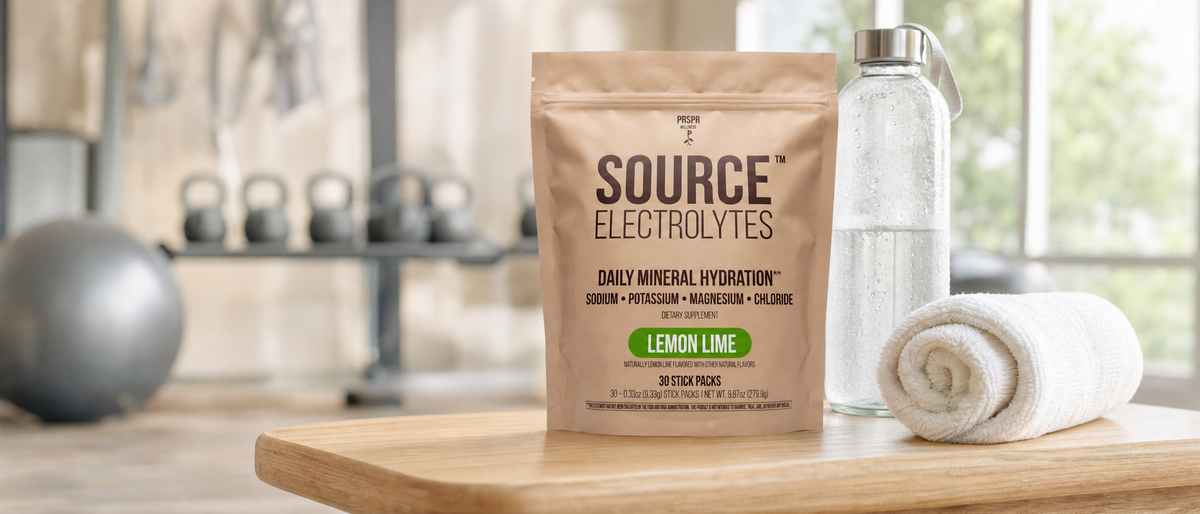
Source Electrolytes - Daily Mineral Hydration is, in the listing's own words, "a stick-pack electrolyte and trace mineral drink mix formulated with Vitamin C, calcium, magnesium, zinc, chloride, sodium, potassium, D-Ribose, taurine, Himalayan pink salt, L-theanine, and ConcenTrace® concentrated seawater." It is made without added sugar and comes in Lemon Lime and Pink Lemonade.
Several of those names are the same words you just met in the sweat section: sodium, chloride, potassium, calcium, magnesium, zinc. The Vitamin C line has a chemistry story of its own, which we told in our piece on vitamin C and its chemical name.
What we will add in our own voice is how it is made. Source Electrolytes is manufactured in a GMP-certified facility and third-party batch tested, so what's on the label is what's in the bottle.
If you want to read the full ingredient list for yourself, open the Source Electrolytes page, browse the rest of the vitamins and supplements collection, or take the build-your-stack quiz to see where it fits alongside everything else we carry.
Answer all five questions to unlock a clear wellness plan made around your goal, schedule, preferred supplement format, and biggest roadblock.
Get clarity on what matters most right now.
See the product and routine connected to your goal.
Simple next steps you can use right away.
Pick the one you would fix first if you could.
This helps us make the guide easier to follow.
Consistency beats the “perfect” routine you never follow.
Be honest. We’re building something you’ll actually use.
Your guide will include one simple way around it.
Answer two more questions to unlock your product starting point, five-step plan, two-week routine, and one practical tip for your biggest roadblock.
Enter your details to open your five-step plan.
Verified PRSPR customer reviews
Expires when you close this page
*Your personal credit for completing the quiz. It's applied automatically at checkout on one-time purchases and expires when the timer runs out.
View full product detailsEverything in your plan, together — one add to cart.
Expires when you close this page
*Your personal credit for completing the quiz. It's applied automatically at checkout on one-time purchases and expires when the timer runs out.
View full product details Mind vocabulary
What is cognition? You have probably seen the word "cognitive" printed on a label, in a headline, or in a product name, and kept scrolling. It is o...
 Biology vocabulary
What is metabolism? You see the word on labels, in gym talk and in nutrition headlines, almost always used as if it were a single setting. Read eno...
 Sleep vocabulary
What are sleep cycles? You hear the phrase on podcasts, see it on sleep trackers, and read it in articles that assume you already know what it mean...