
◎
Get clear
Get clarity on what matters most right now.

What is the digestive system? It is the question behind a lot of homework this week, from a diagram that needs labels to a quiz on which organ comes after the stomach. The short answer is a single tube that runs from your mouth to the exit, plus a handful of solid organs that connect to it. Below is the tour, one organ at a time, in order.
Plenty of people are looking it up. According to Google Trends, for US searches over the past seven days related to the seed term "digestive system," the top related queries included "the digestive system" at 100, "what is digestive system" at 44, "what is the digestive system" at 41, "digestive system organs" at 15, "organs of the digestive system" at 11 and "human digestive system" at 11. Among rising queries, "what does the rectum do in the digestive system" was up 100%, "digestive system labeling" was up 50%, "how the digestive system works" was up 50% and "how digestive system works" was up 40%.
A quick note on those numbers. Google Trends scores are relative within each seed term: 100 marks the most searched query in that set, and the others are scaled against it. They are not search counts. A rising percentage measures growth in interest, not volume.
This piece sticks to plain anatomy: what each part of the human digestive system is called, where it sits, and the order food passes through it. Every definition comes with its source, mainly the National Institute of Diabetes and Digestive and Kidney Diseases (NIDDK) and the National Cancer Institute's SEER Training Modules.
NIDDK describes the digestive system as the gastrointestinal tract, also called the GI tract or digestive tract, together with the liver, the pancreas and the gallbladder. In NIDDK's words, the GI tract is "a series of hollow organs joined in a long, twisting tube from the mouth to the anus." MedlinePlus, from the National Library of Medicine, uses nearly the same picture: a long, twisting tube of hollow organs, with the liver, gallbladder and pancreas also involved.
The SEER Training Modules split the system into two groups, and that split is the easiest way to learn it:
NIDDK adds a useful detail: the tract organs are hollow, while the liver, pancreas and gallbladder are the solid organs of the system. Hollow tube, solid organs beside it.
Here are the organs of the digestive system in the order food meets them.
The entry point. SEER lists the tongue and teeth as accessory structures located here. NIDDK describes chewing breaking food into smaller pieces while saliva moistens it.
The throat. According to SEER, the tongue pushes food into the pharynx, and a swallowing reflex follows: the uvula rises to close off the nasal passage and the epiglottis drops over the larynx and trachea, routing food toward the esophagus.
SEER calls the esophagus a "collapsible muscular tube" connecting the pharynx to the stomach. It lies behind the trachea and in front of the vertebral column, and it passes through the diaphragm at an opening called the esophageal hiatus before it empties into the stomach.
SEER places the stomach in the upper left quadrant of the abdomen and divides it into the fundic, cardiac, body and pyloric regions. At its far end is the pyloric sphincter, which relaxes to let the stomach's contents pass into the small intestine. NIDDK calls that mixture of food and digestive juices chyme.
SEER says the small intestine runs from the pyloric sphincter to the ileocecal valve, where it empties into the large intestine. It has three parts: the duodenum, the jejunum and the ileum. NIDDK confirms the duodenum comes first.
SEER describes the large intestine as the colon, rectum and anal canal, beginning at the ileocecal junction and ending at the anus. In SEER's colorectal module, "The entire colon is about 5 feet (150 cm) long" and is divided into five segments: the cecum, ascending colon, transverse colon, descending colon and sigmoid colon.
The rectum continues from the sigmoid colon to the anal canal, according to SEER, and ends about 5 cm below the tip of the coccyx (the tailbone). SEER's colorectal module treats the rectum as a separate organ from the colon.
The exit. SEER describes the anal canal as the last 2 to 3 cm of the digestive tract. NIDDK describes the anus as the opening where stool leaves the body.
Most digestive system labeling searches come from blank diagrams. Here is every label in tract order.
| Order | Label | Group | Where it sits (source) |
|---|---|---|---|
| 1 | Mouth | Tract | Entry point; holds the tongue and teeth (SEER) |
| 2 | Pharynx | Tract | Throat, between mouth and esophagus (SEER) |
| 3 | Esophagus | Tract | Behind the trachea, in front of the spine, through the diaphragm (SEER) |
| 4 | Stomach | Tract | Upper left quadrant of the abdomen (SEER) |
| 5 | Small intestine: duodenum, jejunum, ileum | Tract | Pyloric sphincter to ileocecal valve (SEER) |
| 6 | Large intestine: cecum, ascending, transverse, descending and sigmoid colon | Tract | Ileocecal junction onward; colon about 5 feet (150 cm) (SEER) |
| 7 | Rectum | Tract | Sigmoid colon to anal canal (SEER) |
| 8 | Anus and anal canal | Tract | Last 2 to 3 cm of the tract (SEER) |
| n/a | Salivary glands: parotid, submandibular, sublingual | Accessory | Release saliva into the mouth (SEER) |
| n/a | Liver | Accessory | Just beneath the diaphragm, mainly upper right (SEER) |
| n/a | Gallbladder | Accessory | Pear-shaped sac on the underside of the liver (SEER) |
| n/a | Pancreas | Accessory | Sends its juice to the small intestine through ducts (NIDDK) |
SEER calls the liver "the largest gland in the body." NIDDK says the liver makes a digestive juice called bile, the gallbladder stores it between meals, and the pancreas sends its own digestive juice to the small intestine through small tubes called ducts.
When people search how digestive system works, the plain answer from NIDDK is that the organs move food along, break it down, or both. NIDDK names the movement peristalsis: muscles in the walls of the tract contract behind the food and relax in front of it, pushing it forward. SEER lists six activities in total: ingestion, mechanical digestion, chemical digestion, movements, absorption and elimination.
NIDDK walks the route like this. Chewing breaks food apart in the mouth. Peristalsis carries it down the esophagus. The stomach's muscles mix it with digestive juices and release the mixture, chyme, slowly into the small intestine. The small intestine mixes in juices from the pancreas, liver and intestine, and its walls absorb water and nutrients into the bloodstream. The large intestine absorbs water and turns what is left into stool.
NIDDK describes the rectum as the lower end of the large intestine, which stores stool until it pushes stool out of the anus during a bowel movement. SEER's colorectal module says the same thing in different words: the rectum "serves as a temporary storage site for stool prior to elimination."
Once you know the map, a lot of terms stop being abstract. "Bile" points to the liver and gallbladder. "Duodenum" is a place, the first part of the small intestine. "Pyloric" names a sphincter at the far end of the stomach. Knowing which organ a word belongs to is the first step in reading anything written about this system.
We like starting with the map. Most confusion about the human digestive system is really confusion about order and names: which part comes first, which organs are in the tube and which sit beside it.
The tube runs mouth, pharynx, esophagus, stomach, small intestine, large intestine, rectum, anus. The solid organs beside it are the salivary glands, liver, gallbladder and pancreas.
If you want more on one stop, our piece on what the gallbladder is and where it sits covers that organ in detail instead of repeating it here. Our explainer on why enzyme names end in "-ase" handles the naming side. And for the words printed on one kind of label, see reading a digestive label: enzymes, betaine HCl and ox bile. Questions about your own body belong with a clinician.
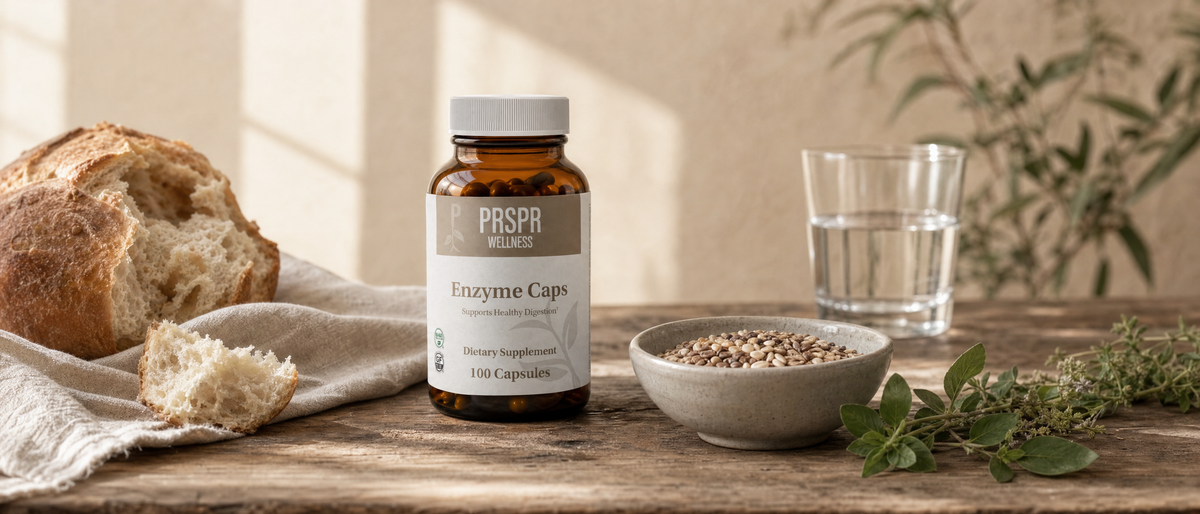
This piece connects to our Enzyme Caps with Betaine HCL & Ox bile through vocabulary. The listing describes it as a dietary supplement containing a blend of digestive enzymes, designed for daily use, and the title names Betaine HCL and Ox bile. The current label reads "Enzyme Caps," "Dietary Supplement" and "100 Capsules." Those are label words, and our label-terms post explains what each one names.
Like everything we carry, it is made in a GMP-certified facility and third-party batch tested, so what's on the label is what's in the bottle. It sits in our Gut Digestion collection, listed at $43.99.
To read the full label, see the Enzyme Caps with Betaine HCL & Ox bile at PRSPR.
NIDDK defines it as the GI tract, a long, twisting tube of hollow organs from the mouth to the anus, plus the liver, pancreas and gallbladder.
Per SEER and NIDDK: mouth, pharynx, esophagus, stomach, small intestine (duodenum, jejunum, ileum), large intestine (colon segments, then rectum and anal canal) and anus. The salivary glands, liver, gallbladder and pancreas are accessory organs.
SEER's colorectal module puts the entire colon at about 5 feet (150 cm), divided into the cecum, ascending, transverse, descending and sigmoid colon.
According to NIDDK, the rectum is the lower end of the large intestine and stores stool until it pushes it out of the anus during a bowel movement.
Answer all five questions to unlock a clear wellness plan made around your goal, schedule, preferred supplement format, and biggest roadblock.
Get clarity on what matters most right now.
See the product and routine connected to your goal.
Simple next steps you can use right away.
Pick the one you would fix first if you could.
This helps us make the guide easier to follow.
Consistency beats the “perfect” routine you never follow.
Be honest. We’re building something you’ll actually use.
Your guide will include one simple way around it.
Answer two more questions to unlock your product starting point, five-step plan, two-week routine, and one practical tip for your biggest roadblock.
Enter your details to open your five-step plan.
Verified PRSPR customer reviews
Expires when you close this page
*Your personal credit for completing the quiz. It's applied automatically at checkout on one-time purchases and expires when the timer runs out.
View full product detailsEverything in your plan, together — one add to cart.
Expires when you close this page
*Your personal credit for completing the quiz. It's applied automatically at checkout on one-time purchases and expires when the timer runs out.
View full product details Botany
You pick up a fallen leaf on a walk, or you read a product label that says a botanical comes from a leaf, and you realize you do not have the words...
 Food Science
You are fine, you just ate, and then one specific food lands in your head and will not leave. Not food in general. That food. Researchers have a na...
 Fitness Terms
You have heard it from a coach, a gym sign-up form, a friend who just bought a set of dumbbells. Strength training. Resistance training. Hypertroph...