
◎
Get clear
Get clarity on what matters most right now.

Two words sit near the end of thousands of ingredient lists, and this week a lot of people stopped to ask about them. What does natural flavors mean? It sounds like a description, the way "fresh" or "homemade" sounds like a description. It is not. In the US it is a defined term, written into the FDA's food labeling rules, with a specific list of what qualifies.
That definition is short enough to read in one sitting. The rest of this piece walks through it, quoting the regulation directly, so you can read the words on a label the way the rule reads them.
Here is what the search data looked like. According to Google Trends, for searches in the US over the past seven days related to the seed term "natural flavors," the top related queries included "what are natural flavors" at 100, "what is natural flavors" at 82, "what is in natural flavors" at 50, "natural flavors ingredients" at 38, "what does natural flavors mean" at 28, "natural flavors in food" at 25 and "natural flavors meaning" at 15. Three rising queries stood out: "what is natural flavor made of," up 120%, "what does natural flavors mean in food," up 90%, and "natural flavoring," up 60%.
A note on those numbers. Google Trends scores are relative within the seed term, not absolute search counts. A top query scored 100 is searched more than one scored 15 inside the same topic, but neither number tells you how many people searched. Rising figures are percentage growth over the prior period.
Read together, the list is one question asked ten ways. What is it, what is in it, what is it made of, what does it mean. So we will start where the answer actually lives: in the text of the rule.
The definition is in Title 21 of the Code of Federal Regulations, section 101.22, the FDA's rule on how foods label spices, flavorings, colorings and chemical preservatives. Per 21 CFR 101.22(a)(3), as published on the eCFR, "The term natural flavor or natural flavoring means the essential oil, oleoresin, essence or extractive, protein hydrolysate, distillate, or any product of roasting, heating or enzymolysis, which contains the flavoring constituents derived from a spice, fruit or fruit juice, vegetable or vegetable juice, edible yeast, herb, bark, bud, root, leaf or similar plant material, meat, seafood, poultry, eggs, dairy products, or fermentation products thereof, whose significant function in food is flavoring rather than nutritional."
That is one long sentence, so it is worth breaking into its three working parts.
The first half of the definition names the forms a natural flavor can be: an essential oil, an oleoresin, an essence or extractive, a protein hydrolysate, a distillate, or a product of roasting, heating or enzymolysis. These are processing words. They describe how flavor is pulled out of a starting material, not what that material was.
The second half is the source list. Per 21 CFR 101.22(a)(3), the flavoring constituents have to be derived from one of the named categories: spice, fruit or fruit juice, vegetable or vegetable juice, edible yeast, herb, bark, bud, root, leaf or similar plant material, meat, seafood, poultry, eggs, dairy products, or fermentation products of those. That is the honest answer to "what is natural flavor made of" as a category: anything on that list, processed in one of those ways.
The last clause sets the job. The ingredient's "significant function in food is flavoring rather than nutritional," per the same paragraph. A natural flavor is in the food for taste and aroma, not as a nutrient.
The word itself started closer to the nose than the tongue. According to the Online Etymology Dictionary, "flavor" dates to around 1300 with the meaning "a smell, odor," from Old French "flaor." The same dictionary dates the sense of "taste, savor" to the 1690s, and records that it was originally "the element in taste which depends on the sense of smell." It dates "flavoring" as a noun to 1831, originally in cookery.
The rule defines artificial flavor first, in paragraph (a)(1), and the two definitions mirror each other. Per 21 CFR 101.22(a)(1), "The term artificial flavor or artificial flavoring means any substance, the function of which is to impart flavor, which is not derived from a spice, fruit or fruit juice, vegetable or vegetable juice, edible yeast, herb, bark, bud, root, leaf or similar plant material, meat, fish, poultry, eggs, dairy products, or fermentation products thereof."
Put the two side by side and the line between them is origin. A natural flavor is derived from a source on the list. An artificial flavor is not. The definitions make no statement about taste, quality or which one a person should prefer, and neither will we. They sort ingredients by where the flavoring constituents came from.
One small detail for close readers: the natural flavor definition says "seafood," while the artificial flavor definition says "fish." The rule also defines spice separately in paragraph (a)(2), which is why a label can say "spice" and "natural flavor" as two distinct entries.
This is the part behind "what is in natural flavors" and "natural flavors ingredients." People see the two words on a list and expect a breakdown underneath. The rule does not require one.
Per 21 CFR 101.22(h)(1), "Spice, natural flavor, and artificial flavor may be declared as 'spice', 'natural flavor', or 'artificial flavor', or any combination thereof, as the case may be." In other words, the regulation lets the collective term stand in on the ingredient statement. That is why the words appear on their own, and why the list itself will not answer what the flavor was made from.
Paragraph (i) covers a different situation: when the front of a package names a flavor, which the rule calls the characterizing flavor. Its own examples include "natural strawberry flavored shortcake" and "grape artificially flavored." That is the vocabulary behind the flavor words you see next to a product name, and it is a separate rule from the ingredient statement.
So when someone asks what does natural flavors mean in food, the regulation gives a three-part answer: a defined category of sources, a defined set of processing forms, and permission to list the result under one collective name.
We think "natural flavors" gets searched so often because it reads like marketing and works like a definition. "Natural" in everyday speech is a feeling. "Natural flavor" on an ingredient list points to paragraph (a)(3) of a federal regulation, with a source list and a function test.
That is the whole reason we write these vocabulary pieces. The natural flavors meaning on a label is narrower and more specific than the word "natural" suggests, and a bit less mysterious once you see the actual sentence. You do not have to take anyone's summary for it, including ours. The text is public on the eCFR.
What the definition does not do is rank anything. It does not say one kind of flavoring is better than another, and this piece covers the vocabulary only. If a question about what your child eats or takes is driving the search, that is a question for your pediatrician.
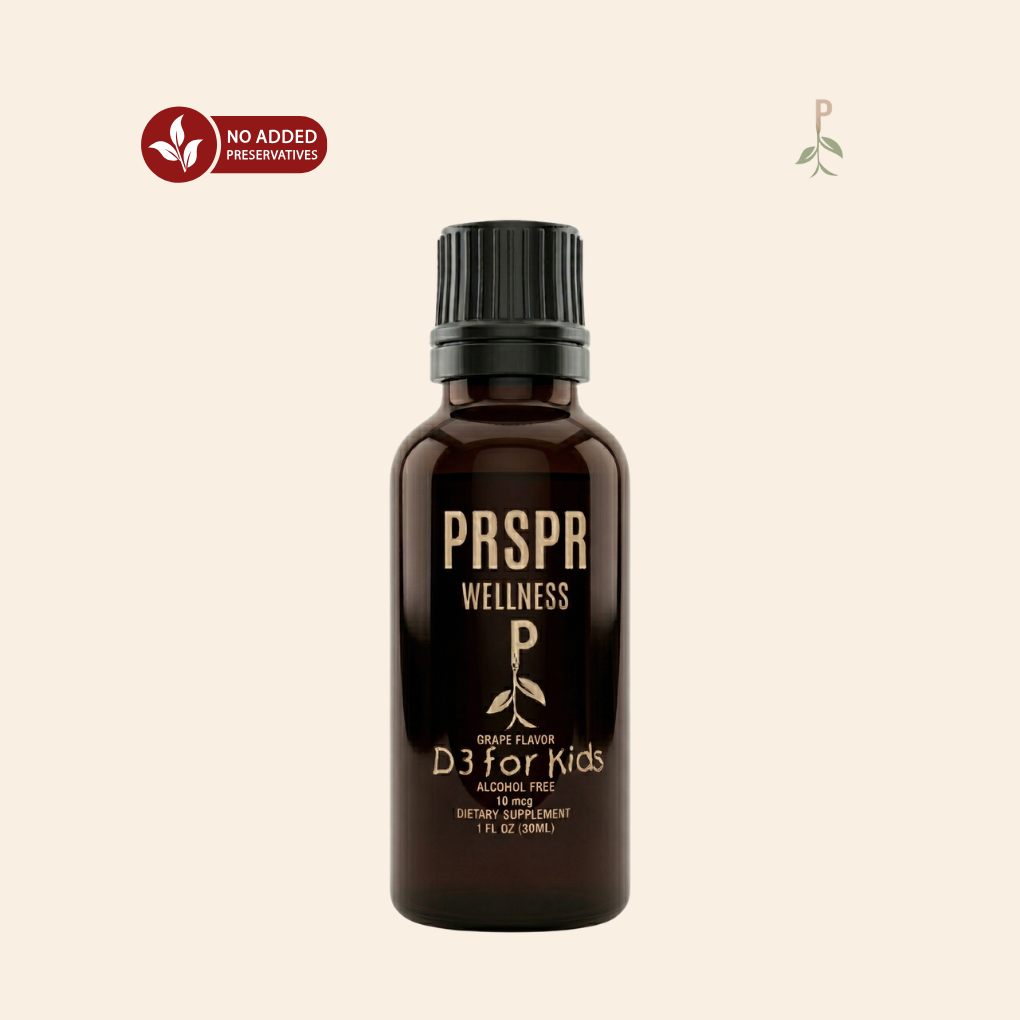
This post grew out of a word on one of our own listings. Children's Liquid Vitamin D3 is a liquid vitamin D3 for children, and its listing describes "a natural grape flavor." We have written about this product's format before, in why kids' vitamin D comes in a dropper and what a dropper actually is, and about the flavor's backstory in why grape flavor tastes like Concord grapes. This time it was the label vocabulary itself.
Like everything we carry, Children's Liquid Vitamin D3 is made in a GMP-certified facility and third-party batch tested. It sells for $21.59, and you can see it with the rest of the range in our Women & Children's Health collection.
If you want to read the full listing for yourself, see Children's Liquid Vitamin D3 at PRSPR.
Per 21 CFR 101.22(a)(3), a natural flavor is an essential oil, oleoresin, essence or extractive, protein hydrolysate, distillate, or product of roasting, heating or enzymolysis, derived from a listed food or plant source, whose significant function in food is flavoring rather than nutritional.
A collective name. Per 21 CFR 101.22(h)(1), natural flavor may be declared simply as "natural flavor" in the statement of ingredients.
The rule defines the possible sources rather than one recipe: spice, fruit or fruit juice, vegetable or vegetable juice, edible yeast, herb, bark, bud, root, leaf or similar plant material, meat, seafood, poultry, eggs, dairy products, or fermentation products of those, per 21 CFR 101.22(a)(3). The ingredient list does not say which one a given flavor came from.
In the rule, yes. Paragraph (a)(3) opens "The term natural flavor or natural flavoring means," giving both names one definition.
By origin. Per 21 CFR 101.22(a)(1), an artificial flavor is a substance that imparts flavor and is not derived from the sources the natural flavor definition lists.
Answer all five questions to unlock a clear wellness plan made around your goal, schedule, preferred supplement format, and biggest roadblock.
Get clarity on what matters most right now.
See the product and routine connected to your goal.
Simple next steps you can use right away.
Pick the one you would fix first if you could.
This helps us make the guide easier to follow.
Consistency beats the “perfect” routine you never follow.
Be honest. We’re building something you’ll actually use.
Your guide will include one simple way around it.
Answer two more questions to unlock your product starting point, five-step plan, two-week routine, and one practical tip for your biggest roadblock.
Enter your details to open your five-step plan.
Verified PRSPR customer reviews
Expires when you close this page
*Your personal credit for completing the quiz. It's applied automatically at checkout on one-time purchases and expires when the timer runs out.
View full product detailsEverything in your plan, together — one add to cart.
Expires when you close this page
*Your personal credit for completing the quiz. It's applied automatically at checkout on one-time purchases and expires when the timer runs out.
View full product details Mind vocabulary
What is cognition? You have probably seen the word "cognitive" printed on a label, in a headline, or in a product name, and kept scrolling. It is o...
 Biology vocabulary
What is metabolism? You see the word on labels, in gym talk and in nutrition headlines, almost always used as if it were a single setting. Read eno...
 Sleep vocabulary
What are sleep cycles? You hear the phrase on podcasts, see it on sleep trackers, and read it in articles that assume you already know what it mean...