
◎
Get clear
Get clarity on what matters most right now.

Methyl anthranilate is having a moment. In Google's related searches for "grape flavor" this week, the compound's name is marked "Breakout" in the rising list. It is a mouthful of a name, and it is sitting next to a fruit most Americans know by taste before they know it by name.
That fruit is the Concord grape. "Concord grapes" carries a volume score of 86 in the same list. In searches around Concord grapes themselves, "are concord grapes good to eat" is up +170% this week, "concord grape juice" scores 27, "what are concord grapes" 23, "concord grapes season" 12, and "do concord grapes have seeds" 5.
Put those together and you get one question: why does "grape flavor" taste like a Concord and not like the green grapes in your fridge? This piece answers it as a flavor and botany explainer. What any food or flavor does in a body is a question for a qualified healthcare professional, and we are not going there.
Start with the plant. Concord is a named grape variety with American roots, and that ancestry is most of the story.
A 2020 study in Horticulture Research, published through the NIH's PubMed Central, calls Concord "the most well-known juice grape" and describes its parentage as the North American grape species Vitis labrusca. That sets it apart from Vitis vinifera, which the same paper calls the common table and wine grape species.
The University of Minnesota Extension says the same thing in growers' terms: Concord has a large amount of V. labrusca heritage, which lends to its foxy flavor. "Foxy" is a real term here, and we will come back to it.
The name is a place. According to WBUR, Boston's public radio station, Ephraim Wales Bull propagated the Concord grape in 1849 in Concord, Massachusetts, where he had moved in the mid-1800s, and in 1853 the grapes won a prize at the Massachusetts Horticultural Society. A grape bred in Concord, named for Concord.
Concord is what growers call a slip-skin grape. Illinois Extension describes the trait plainly: the skin easily slips away from the fruit pulp. Squeeze one and the center can pop out, leaving the skin behind. Oregon State University Extension lists Concord as an American type with slip skin and seeds, and a strong foxy flavor. That is a very different eating experience from a thin-skinned green grape that you bite straight through.
This is the fastest-rising Concord search this week, and we are answering it in the eating-quality sense only: what they are like in your mouth.
Oregon State University Extension lists Concord's uses as "for fresh or wine," so eating them fresh is a normal, listed use. What surprises people is the texture. A graduate program blog at The Ohio State University sums up Concord's traits as "a foxy or musky flavor, large seeds, and a skin that easily slips off."
So the honest eating-quality answer has three parts:
Whether you like that combination is personal. The same traits that make a fresh Concord an acquired texture are part of why the Horticulture Research paper says its foxy character makes it popular for non-fermented juice and jellies.
Yes. Oregon State University Extension lists Concord as seeded, and the Ohio State description names "large seeds" as one of its defining traits.
The seeds even play a role at harvest. Illinois Extension notes that the color of grape seeds changes from green to brown as the fruit ripens, and an Oregon State University Extension answer on Ask Extension gives the same seed-color check for deciding when Concord grapes are ready. Growers taste the fruit and look at the seeds.
If seeds from the wine and juice world interest you, our piece on where grapeseed oil comes from follows grape seeds from the winery onward.
Concord is a late grape. The University of Minnesota Extension notes its very late ripening, and Oregon State University Extension puts Concord's ripening around mid-October in its guide, using Concord as the benchmark other late varieties are measured against. In the Northeast, WBUR reported this week that Concord grapes are coming into season on farms and in backyards, in September.
So the short answer to "concord grapes season" is late summer into fall, from September into October depending on where the vines grow. That timing is exactly why the searches are rising now.
Concord is best known as a juice grape, and the juice story also starts in the nineteenth century. According to the United Methodist Church's history of communion grape juice, a Methodist dentist in Vineland, New Jersey, perfected a juice pasteurization process in his kitchen in 1869 and began selling unfermented juice to churches that wanted an alcohol-free option for Communion. Cumberland County, New Jersey's history of the same business says the company later moved to New York, where a more plentiful supply of Concord grapes could be found.
That is a big part of why, for a lot of Americans, concord grape juice is simply what "grape juice" tastes like.
Now the chemistry. PubChem lists methyl anthranilate with the molecular formula C8H9NO2 and the systematic name methyl 2-aminobenzoate.
Here is why it matters for Concord. The 2020 Horticulture Research paper says Concord's special "foxy" aroma predominantly results from the accumulation of methyl anthranilate in the berries. It describes foxy aroma as an earthy, sweet muskiness present in most V. labrusca grapes, and notes it is rarely noticeable in V. vinifera. The University of Minnesota Extension draws the same line, writing Concord's foxy flavor as "(methyl anthranilate)."
And the compound is not only in the grape. A 2019 paper in the Proceedings of the National Academy of Sciences describes methyl anthranilate as a widely used compound to give grape scent and flavor. That is the link most people have never been told: the compound credited with Concord's signature aroma is also a common way to create a "grape" note in flavoring.
This is the bridge. The research above places the common table and wine grapes in vinifera, and says the foxy, methyl anthranilate aroma is rarely noticeable in them. Concord, with its labrusca parentage, accumulates it in the berries.
So when a candy, a soda or a syrup tastes like "grape," the grape it resembles is not really the one in your fridge. It is much closer to a Concord. The flavor people call grape is, in practice, closer to a nineteenth-century Massachusetts variety than to a supermarket table grape.
That also explains the Breakout search. Once someone learns that grape flavor has a signature compound, the next thing they type is its name.
It also changes how to read the word "grape" on a label. "Grape flavor" describes a taste profile that people recognize, and that taste profile was shaped by one American variety. It does not, by itself, tell you which grape, which compound or which process was involved. The label words are the facts; everything else is background.
We love this one because it rearranges something everyone thinks they already know. "Grape" sounds like a single flavor. It is really the flavor of one American grape, with a named compound that researchers credit for the aroma.
We also think it is a good lesson in reading a flavor line. "Grape flavor" on a label names a taste, not a variety and not a molecule. The words on the label are what the label is telling you, and the rest is context, not a description of the bottle.
That is also why we like a trend like this one. Someone tastes grape candy, wonders why it tastes nothing like the grapes in the fruit bowl, and ends up learning a species name, a Massachusetts town and a chemical formula. That is a better use of a search bar than most, and it is the kind of curiosity we write this blog for.
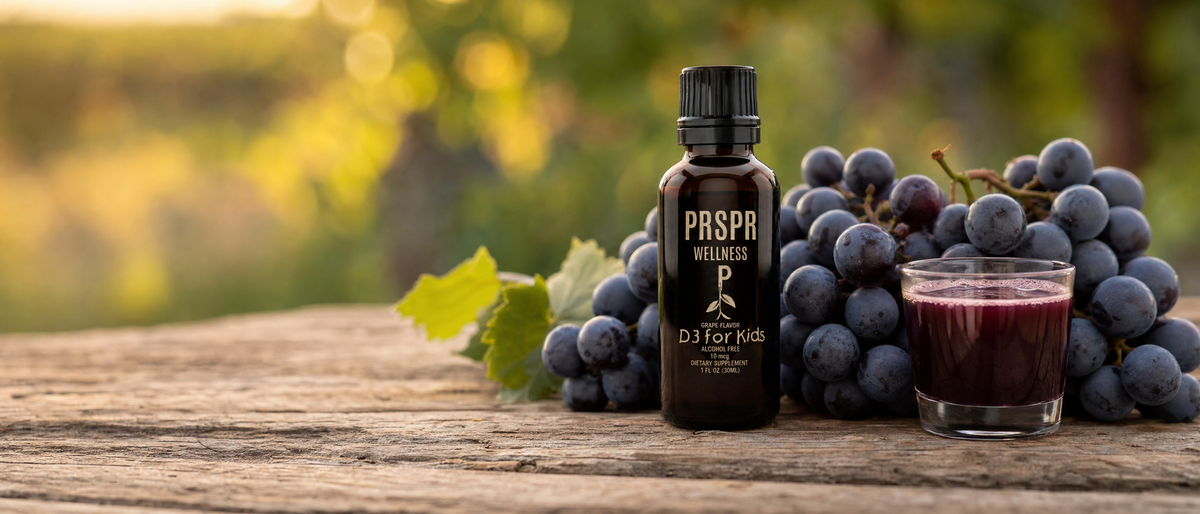
Which brings us to our own bottle. Our Children's Liquid Vitamin D3 has a natural grape flavor. The listing says only "natural grape flavor." It does not name a flavor compound, and we are not going to name one for it. Everything above is about Concord grapes and grape flavor in general, not a description of what is in our bottle.
For the format itself, our pieces on why kids' vitamin D comes in a dropper and the dropper as a measuring instrument cover the bottle and the cap. What we will add in our own voice is how it is made: it is manufactured in a GMP-certified facility and third-party batch tested, so what's on the label is what's in the bottle.
To read the full label for yourself, open the Children's Liquid Vitamin D3 product page, browse the rest of the vitamins and supplements collection, or take the build-your-stack quiz to see where it fits alongside everything else we carry.
Answer all five questions to unlock a clear wellness plan made around your goal, schedule, preferred supplement format, and biggest roadblock.
Get clarity on what matters most right now.
See the product and routine connected to your goal.
Simple next steps you can use right away.
Pick the one you would fix first if you could.
This helps us make the guide easier to follow.
Consistency beats the “perfect” routine you never follow.
Be honest. We’re building something you’ll actually use.
Your guide will include one simple way around it.
Answer two more questions to unlock your product starting point, five-step plan, two-week routine, and one practical tip for your biggest roadblock.
Enter your details to open your five-step plan.
Verified PRSPR customer reviews
Expires when you close this page
*Your personal credit for completing the quiz. It's applied automatically at checkout on one-time purchases and expires when the timer runs out.
View full product detailsEverything in your plan, together — one add to cart.
Expires when you close this page
*Your personal credit for completing the quiz. It's applied automatically at checkout on one-time purchases and expires when the timer runs out.
View full product details Mind vocabulary
What is cognition? You have probably seen the word "cognitive" printed on a label, in a headline, or in a product name, and kept scrolling. It is o...
 Biology vocabulary
What is metabolism? You see the word on labels, in gym talk and in nutrition headlines, almost always used as if it were a single setting. Read eno...
 Sleep vocabulary
What are sleep cycles? You hear the phrase on podcasts, see it on sleep trackers, and read it in articles that assume you already know what it mean...