
◎
Get clear
Get clarity on what matters most right now.

What is grapeseed oil is sitting at a volume score of 100 this week, the top of its cluster. Grapeseed oil for hair is at 58, grapeseed oil smoke point at 41, grape seed oil, spelled as two words, at 24, is grapeseed oil a seed oil at 16, and is grapeseed oil good for hair at 14.
Nothing in this group is spiking. It is a steady cluster, and a revealing one, because it pulls in three directions at once: a kitchen number, a food argument and a hair question. The same oil is being asked about as a cooking fat, as a talking point and as an ingredient on a scalp oil label.
Two of those searches, grapeseed oil for hair and is grapeseed oil good for hair, are questions about what an oil does on a person. Those are questions for a board-certified dermatologist rather than for the company selling the bottle, and we will not answer them here. What the oil is, where it comes from and why it gets described the way it does are all fair game.
Grapeseed oil is exactly what the name says: oil from the seeds of grapes. The interesting part is where those seeds come from.
When grapes are crushed and pressed for wine, the juice goes one way and the solids go another. Those solids have a name. A 2024 review of grape pomace in the journal Foods defines pomace as the grape skins, seeds and stems left after juice extraction. A separate 2020 review of grape seed oil, in the same journal, describes grape seeds as a relevant part of the solid residues that winemaking creates.
That makes grapeseed oil one of the more straightforward by-product stories in the pantry. The raw material is generated every harvest by an industry that exists for a completely different reason. The winery wants the juice. The seeds are what it leaves behind, and somebody found a use for them.
How the oil gets out of the seed is not one fixed process. The 2020 review describes grape seed oil being extracted for many years with organic solvents, usually hexane, and also describes cold pressing and extraction with supercritical carbon dioxide as alternatives. Those are three different routes to a bottle that can carry the same two words on the front. A label that says only grapeseed oil does not tell you which route was taken.
The spelling split in the search data is not a mistake. Grape seed oil, as two words, is how that 2020 review writes it. Grapeseed oil, as one word, is how the Root Revive listing writes it. Same seed, same oil, two spellings, and both are worth searching if you are trying to find everything written about it.
Grapeseed oil smoke point, at 41, is the most technical search here, so it is worth knowing what a smoke point actually measures. It is the temperature at which a heated oil begins to give off a continuous, clearly visible smoke under defined test conditions. The standard lab procedure is the American Oil Chemists' Society's Cleveland Open Cup method, which records smoke, flash and fire points for the same sample.
What surprises people is how soft that number is. The Institute of Shortening and Edible Oils, a trade association for the edible oil industry, publishes a chart of typical smoke, flash and fire points and attaches a plain warning to it. The values come from a single test per oil. They can vary within one source oil because of processing techniques and seasonal variation. And there can be analyst subjectivity in the test itself. Grapeseed oil is not even one of the oils on that chart.
So when you see a single smoke point quoted for grapeseed oil, read it as a typical figure for one sample under one test, not as a fixed property of the seed. That is also why we are not quoting one here.
Why does a kitchen number follow a hair-oil ingredient around? Because most of the vocabulary attached to grapeseed oil was built in the kitchen. This week's cooking searches were big enough to show up in the same data, and smoke point is the kitchen's favorite way to compare oils. The number travels with the name, all the way onto a scalp and beard oil label where nobody is heating anything.
By the plain meaning of the words, yes. It is an oil made from seeds. An explainer from the University of Texas MD Anderson Cancer Center defines seed oils as a type of vegetable oil made from a plant's seeds rather than its fruit, and lists grapeseed oil alongside canola, corn, sunflower, safflower, sesame and several others.
That definition is simple. The argument around it is not. Online, "seed oils" has become shorthand for a running debate about which cooking oils people should or should not be eating, and grapeseed oil gets swept into it by name. Whether any side of that debate is right is a nutrition question, and it belongs with a registered dietitian or your doctor, not with a company that makes a hair oil.
What we can point out is a reading problem. "Seed oil" names a source, the part of the plant the oil came from. It does not name an extraction method, a level of refinement or a use. A seed oil can be sold for frying, for salad dressing or as one of thirteen botanicals in a scalp oil, and those two words alone do not tell you which. Pumpkin seed oil, another seed oil on the same Root Revive label, got the same close reading in pumpkin seed oil and what three bottles buys you.
We think grapeseed oil is a good reminder that an ingredient's reputation usually gets built somewhere other than the product in your hand.
Its identity comes from two places that have nothing to do with hair. A winery produces the seeds as a leftover. A kitchen gave the oil a smoke point and pulled it into an argument about cooking fats. By the time grapeseed oil shows up on a scalp and beard oil label, it is carrying all of that history with it.
None of that is a reason to love it or avoid it. It is a reason to read the word precisely. Grapeseed oil tells you the source plant and the plant part. It does not tell you the extraction method, the refinement, or what a kitchen chart said about a different sample. Ask the label the questions it can answer, and take the rest to someone qualified to answer them.
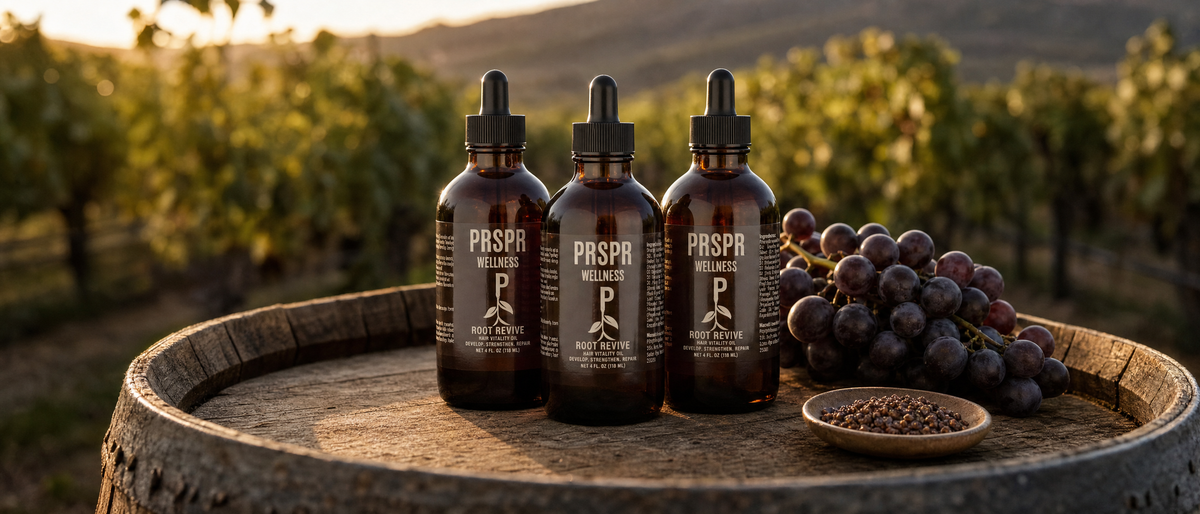
The Root Revive Hair Oil 3 Pack Bundle is three bottles of Root Revive, an organic botanical hair oil. The live listing names Avocado, Olive and Grapeseed Oil among its botanical oils, alongside Castor, Pumpkin Seed and Black Seed Oil and Amla, Brahmi and Fenugreek extracts, and describes applying it to the scalp or beard with the included pipette. That is the composition as the listing states it. The listing does not state how any of those oils was extracted, and we are not going to guess.
What we will add in our own voice is the quality story alone. It is made in a GMP-certified facility and third-party batch tested, so what is on the label is what is in the bottle.
If you are curious how a kitchen-made hair oil differs from a formulated blend, the DIY rosemary infusion piece covers that contrast, and castor oil and the carrier-oil question covers the base of the bottle. Otherwise open the Root Revive 3 Pack page and read the ingredient list for yourself, or take the build-your-stack quiz.
Answer all five questions to unlock a clear wellness plan made around your goal, schedule, preferred supplement format, and biggest roadblock.
Get clarity on what matters most right now.
See the product and routine connected to your goal.
Simple next steps you can use right away.
Pick the one you would fix first if you could.
This helps us make the guide easier to follow.
Consistency beats the “perfect” routine you never follow.
Be honest. We’re building something you’ll actually use.
Your guide will include one simple way around it.
Answer two more questions to unlock your product starting point, five-step plan, two-week routine, and one practical tip for your biggest roadblock.
Enter your details to open your five-step plan.
Verified PRSPR customer reviews
Expires when you close this page
*Your personal credit for completing the quiz. It's applied automatically at checkout on one-time purchases and expires when the timer runs out.
View full product detailsEverything in your plan, together — one add to cart.
Expires when you close this page
*Your personal credit for completing the quiz. It's applied automatically at checkout on one-time purchases and expires when the timer runs out.
View full product details Mind vocabulary
What is cognition? You have probably seen the word "cognitive" printed on a label, in a headline, or in a product name, and kept scrolling. It is o...
 Biology vocabulary
What is metabolism? You see the word on labels, in gym talk and in nutrition headlines, almost always used as if it were a single setting. Read eno...
 Sleep vocabulary
What are sleep cycles? You hear the phrase on podcasts, see it on sleep trackers, and read it in articles that assume you already know what it mean...