
◎
Get clear
Get clarity on what matters most right now.

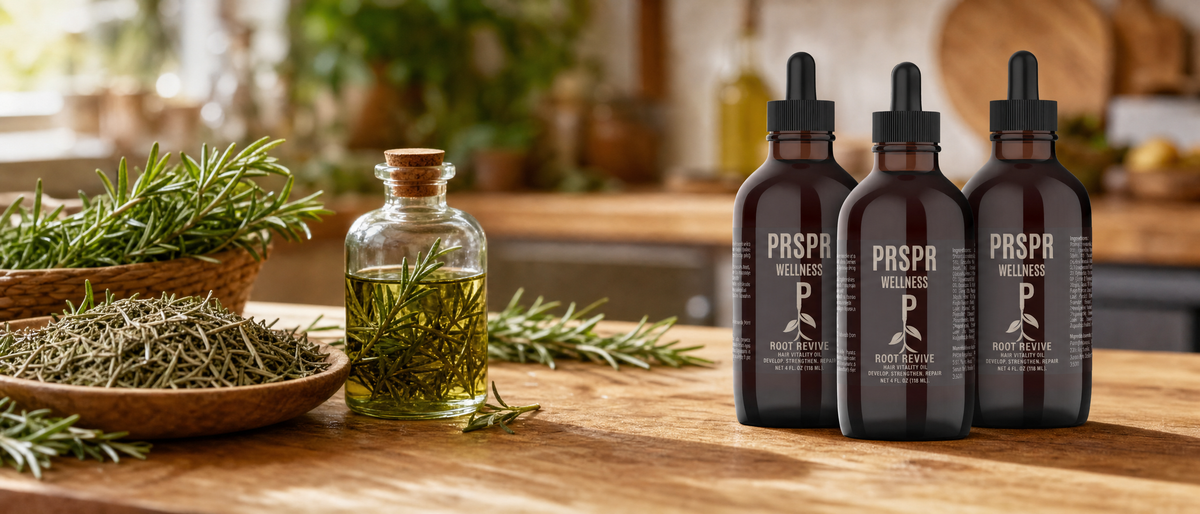
The loudest hair question in search this week is not whether something works. It is how often to do it. How often should i use rosemary oil for hair growth is a breakout term. How often to apply rosemary oil for hair growth is up about 300 percent. Can i use rosemary oil on my hair everyday is up about 170. Making rosemary oil for hair is up about 80 percent, diy rosemary oil for hair growth up about 40, and on the volume side rosemary water for hair and rosemary shampoo both sit at 15.
Read that list again and notice what is missing. Nobody is asking whether it does anything. The question of efficacy has been skipped entirely and the entire cluster has moved on to logistics. That is a specific and interesting stage for a trend to reach, and it is what this article is about.
One thing to state before anything else, because it matters. Rosemary is not one of the botanicals in our hair oil. We are writing about this trend because it is the trend, not because we are in it, and nothing below should be read as suggesting our bottle contains rosemary. We also make no claim about rosemary or about hair growth. Every how-often question here is answered the same way: follow the directions on whatever product you are actually holding, and take questions about your hair to a qualified professional.
Making rosemary oil for hair, up about 80 percent, is a recipe search, and the recipe is old and simple.
What people are making is an infused oil, sometimes called a maceration. Plant material is placed in a carrier oil, left for a period, and then strained out. The carrier oil is the bulk of the finished product, usually something neutral and stable, and the rosemary contributes whatever it contributes during the steeping. Warm infusions speed the process by applying gentle heat; cold infusions take longer and are left to sit.
Rosemary water for hair at 15 is the related version made with water rather than oil, which is a different thing again: a rinse or spray produced by steeping or simmering the herb in water. Water-based preparations do not keep the way oil-based ones do, which is why homemade versions of them are typically made in small batches.
The trend spread on social video, and it spread because the barrier to entry is nearly zero. A supermarket herb, a bottle of oil from the same trip and a jar. There is nothing to buy that you could not buy anyway, which is a large part of why it moved as fast as it did.
This is the genuinely revealing part of the data, and it says something about how trends mature.
A search cluster dominated by frequency questions is a cluster where the audience has already decided. Nobody asks whether they can do a thing every day if they are still weighing up whether to do it at all. The efficacy question got settled, or more accurately got skipped, somewhere upstream, and what remains is implementation.
There is also a practical reason frequency is the sticking point for a homemade preparation specifically. A commercial product arrives with directions printed on it. Somebody made a decision about how it should be used and wrote it on the bottle. A jar you made in your kitchen has no directions at all, because nobody wrote any. So the person who made it has to go and find the instruction elsewhere, and elsewhere is a search box.
That is the whole mechanism behind the breakout term. It is not curiosity. It is a missing label.
We are not going to supply that missing label. Telling a stranger how often to apply a preparation we did not formulate, to a scalp we cannot see, would be exactly the kind of advice this trend is short of and exactly the kind we are not in a position to give.
Here is the contrast that is actually useful, described as manufacturing rather than as a ranking.
An infusion made at home has an unknown composition. How much of anything moved from the plant into the oil depends on the plant material, how dry it was, how long it steeped, at what temperature, and how it was strained. Two jars made by the same person a month apart will not be the same. That is not a criticism, it is simply what an uncontrolled process produces.
A formulated blend is made to a specification. The components are chosen, weighed and combined in fixed proportions, and the same formula produces the same product each time it is made. It is also made in a facility with process controls, which is where the reproducibility comes from.
There is a shelf-life difference too. Oils oxidize, and a homemade infusion with plant material that was not fully dry can carry water into the oil, which shortens how long it keeps. Commercially produced blends are formulated and packaged with that in mind.
Neither of these facts says anything about what either product does for anybody. They are statements about consistency and process, and consistency is the only axis on which a made-in-a-kitchen preparation and a manufactured one can honestly be compared.
Rosemary shampoo at 15 shows the standard third act of a DIY trend, and it is worth naming because it repeats across categories.
The sequence runs: a homemade preparation spreads, the searches move from recipe to frequency, and then a commercial version of the same idea appears and starts absorbing the search volume. People who enjoyed making the thing keep making it. People who wanted the outcome without the jar buy the product. Both groups came from the same video.
What changes at that point is that directions reappear. A commercial shampoo has usage instructions on it, which resolves the exact question the DIY version left open. That is the practical value of a manufactured product in a trend like this, and it is a fair thing to point out without claiming anything about ingredients.
Our honest view is that the missing label is the real story here, and it applies well beyond rosemary.
Homemade preparations are fine and people have made them forever. What the internet added is scale without instructions: millions of people making something from a fifteen second video, with no directions, no batch consistency and no idea how long it keeps. The frequency searches are the sound of that gap being filled by strangers.
So our advice is unglamorous. Whatever you are using, use the directions that came with it. If it came with none because you made it, that is worth knowing about it, and it is a reason to be conservative rather than a reason to ask the internet. And if the question is really about your hair rather than about a product, that is a question for a professional who can look at it.
If the composition question is what interests you, we wrote about what a carrier oil actually is in the castor oil piece, about one of the botanicals in our own blend in pumpkin seed oil and what three bottles buys you, and about how scalp products became their own aisle in the scalp care explainer.
Our Root Revive Hair Oil 3 Pack is three bottles of the same product. Root Revive is an organic hair oil built from 13 botanical oils and extracts, and the ones named on the live listing include castor oil, pumpkin seed oil, black seed oil, avocado, olive and grapeseed oils, and amla, brahmi and fenugreek extracts. It is free from parabens, sulfates and artificial fragrances.
Rosemary is not on that list, and we are saying so plainly for the second time in one article because this is a trend piece about an ingredient we do not use. If rosemary is specifically what you want, ours is not the bottle.
What we will state in our own voice is process. It is made in a GMP-certified facility and third-party batch tested, which is the reproducibility this article has been describing: the same formula, made the same way, with directions on it.
If the difference between a jar and a formula is what stuck, read the label. The Root Revive 3 Pack page lists what is in the bottle and how to use it, and the build-your-stack quiz is there if you want to start from a routine instead.
Answer all five questions to unlock a clear wellness plan made around your goal, schedule, preferred supplement format, and biggest roadblock.
Get clarity on what matters most right now.
See the product and routine connected to your goal.
Simple next steps you can use right away.
Pick the one you would fix first if you could.
This helps us make the guide easier to follow.
Consistency beats the “perfect” routine you never follow.
Be honest. We’re building something you’ll actually use.
Your guide will include one simple way around it.
Answer two more questions to unlock your product starting point, five-step plan, two-week routine, and one practical tip for your biggest roadblock.
Enter your details to open your five-step plan.
Verified PRSPR customer reviews
Expires when you close this page
*Your personal credit for completing the quiz. It's applied automatically at checkout on one-time purchases and expires when the timer runs out.
View full product detailsEverything in your plan, together — one add to cart.
Expires when you close this page
*Your personal credit for completing the quiz. It's applied automatically at checkout on one-time purchases and expires when the timer runs out.
View full product details Mind vocabulary
What is cognition? You have probably seen the word "cognitive" printed on a label, in a headline, or in a product name, and kept scrolling. It is o...
 Biology vocabulary
What is metabolism? You see the word on labels, in gym talk and in nutrition headlines, almost always used as if it were a single setting. Read eno...
 Sleep vocabulary
What are sleep cycles? You hear the phrase on podcasts, see it on sleep trackers, and read it in articles that assume you already know what it mean...