
◎
Get clear
Get clarity on what matters most right now.

What does resilience mean? It is one of those words everyone uses and few people stop to define. You hear it about bridges, power grids, economies, ecosystems and people, sometimes in the same news hour. A word stretched that far is worth reading closely.
This week, plenty of people did exactly that. According to Google Trends, for US searches over the past seven days related to the seed term "resilience," the top related queries included "what is resilience" at 100, "resilience meaning" at 68, "what does resilience" at 57, "resilience definition" at 35, "emotional resilience" at 23, "what does resilience mean" at 20, "resilience synonym" at 20 and "meaning of resilience" at 16. Two rising queries stood out: "resilience part of speech" was up 50% and "resilience antonyms" was up 40%.
A quick note on those numbers. Google Trends scores are relative within each seed term: 100 marks the most searched query in that set, and the others are scaled against it. They are not search counts. A rising percentage measures growth in interest, not volume.
So people want the word itself: its meaning, its grammar, its opposites. This piece is the word's biography, and it starts with the short resilience meaning before the history. It covers the Latin root, the original materials meaning, the part of speech, the synonyms and antonyms, and how psychology writing uses it. Every definition comes with its source.
Start with the plainest answer to "what is resilience." Merriam-Webster gives two senses. The first is physical: "the capability of a body to recover its size and shape after deformation caused especially by compressive stress." Its example is "the resilience of rubber." The second is figurative: "an ability to recover from or adjust easily to misfortune or change."
Dictionary.com lays out three American senses, and the order is telling. First comes "the power or ability of a material to return to its original form, position, etc., after being bent, compressed, or stretched; elasticity." Second comes the ability of a person to adjust to or recover readily from adversity and major life changes. Third comes "the ability of a system or organization to respond to or recover readily from a crisis, disruptive process, etc."
Material, then person, then system. That sequence is the whole story of the word in miniature. The British entries on the same page (from Collins) add two technical senses: in ecology, "the ability of an ecosystem to return to its original state after being disturbed," and in physics, "the amount of potential energy stored in an elastic material when deformed."
So the meaning of resilience is not one thing. It is a family of related meanings, and the context tells you which one is in play.
The root is a jump. Merriam-Webster explains that resilience "derives from the present participle of the Latin verb resilire, meaning 'to jump back' or 'to recoil.'" It adds that the base of resilire is salire, "a verb meaning 'to leap' that also pops up in the etymologies of such sprightly words as sally and somersault."
Dictionary.com's entry for the adjective "resilient" breaks the same root into parts: Latin resilīre, "to spring back," built from re- plus a combining form of salīre, "to leap, jump."
The dictionaries date the word differently, which is worth knowing if you are quoting a year. Dictionary.com says resilience was first recorded in 1620 to 1630 and the adjective resilient in 1635 to 1645. Merriam-Webster gives a first known use of 1807 "in the meaning defined at sense 1," the materials sense. Both can be true at once: an older first appearance of the word, and a later date for the specific engineering meaning.
Before it described a person, resilience described rubber, steel and springs. Merriam-Webster's note on the word puts it this way: "In physics, resilience is the ability of an elastic material (such as rubber or animal tissue) to absorb energy (such as from a blow) and release that energy as it springs back to its original shape."
Engineers made the idea measurable. Collins, in the British physics sense quoted above, ties the word to a quantity: the potential energy an elastic material stores when it is deformed. That is the version of resilience an engineer can put a number on.
That idea, a load followed by a return to shape, is the bridge to everything else. Merriam-Webster says the recovery in the physical case "can be viewed as analogous to a person's ability to bounce back after a jarring setback." The word did not change its meaning so much as borrow its picture. If that pattern sounds familiar, it is the same path we traced in our piece on how stress was an engineering word first. Merriam-Webster's own first definition of resilience even uses "compressive stress," the engineering sense of that word.
Now the grammar question that is rising in search. Resilience is a noun. Merriam-Webster and Dictionary.com both label it that way, and Dictionary.com lists "resiliency" as an alternate form of the same noun.
The word family looks like this:
| Form | Part of speech | Source |
|---|---|---|
| resilience, resiliency | Noun | Merriam-Webster, Dictionary.com |
| resilient | Adjective | Dictionary.com |
| resiliently | Adverb | Dictionary.com |
| nonresilience | Noun | Dictionary.com |
For a resilience synonym, the right answer depends on the sense. Merriam-Webster's thesaurus splits the word in two. In the sense of strength, it lists related words such as tenacity, perseverance, fortitude, grit and backbone. In the sense of flexibility, it lists elasticity, pliability, suppleness and adaptability. Thesaurus.com, for the "elasticity" sense, gives flexibility as its strongest match and pliancy, recoil and snap as strong ones.
Resilience antonyms follow the same split. Merriam-Webster's thesaurus lists "dissimilar words" of weakness and helplessness for the strength sense, and stiffness, rigidity and inflexibility for the flexibility sense.
The phrase "emotional resilience" sits in the search data at 23, and it is a phrase dictionaries recognize. Merriam-Webster's medical definition of resilience uses "emotional resilience" as its example for the sense "an ability to recover from or adjust easily to misfortune or change."
Psychology has its own formal entry. The American Psychological Association's APA Dictionary of Psychology defines resilience as "the process and outcome of successfully adapting to difficult or challenging life experiences, especially through mental, emotional, and behavioral flexibility and adjustment to external and internal demands." It notes the term is "Also called psychological resilience."
Two words in that definition are worth slowing down on. "Process" and "outcome" mean psychologists use resilience to name both something that happens over time and the result at the end. And "flexibility" is a direct echo of the materials sense: the same idea of bending without breaking, now applied to people.
The word kept spreading after that. Dictionary.com's third sense covers systems and organizations, with the example "Cities can build resilience to climate change by investing in infrastructure." That is why you now see climate resilience, business resilience and cyber resilience in the same search results as the dictionary questions.
We think "resilience" is a word worth reading precisely, because it is used so loosely. When you see it, ask which sense is in play. A material property? An ecosystem returning to a prior state? A psychology term with a formal definition? A city's infrastructure plan? The spelling is the same. The meaning is not.
Here is what the word does tell you. It describes a return after a load: a spring that comes back, a system that comes back, a person who adapts. Here is what it does not tell you on its own: what was loaded, how much, or how anyone would measure the return. The materials scientists have a number for it. Most everyday uses do not.
That habit of asking for the definition applies to every label you read, including a supplement label. Words that started in a lab tend to travel. Our explainer on what burnout means, according to the WHO follows another word with a formal definition that gets used far more loosely than written. Questions about your own body belong with a clinician.
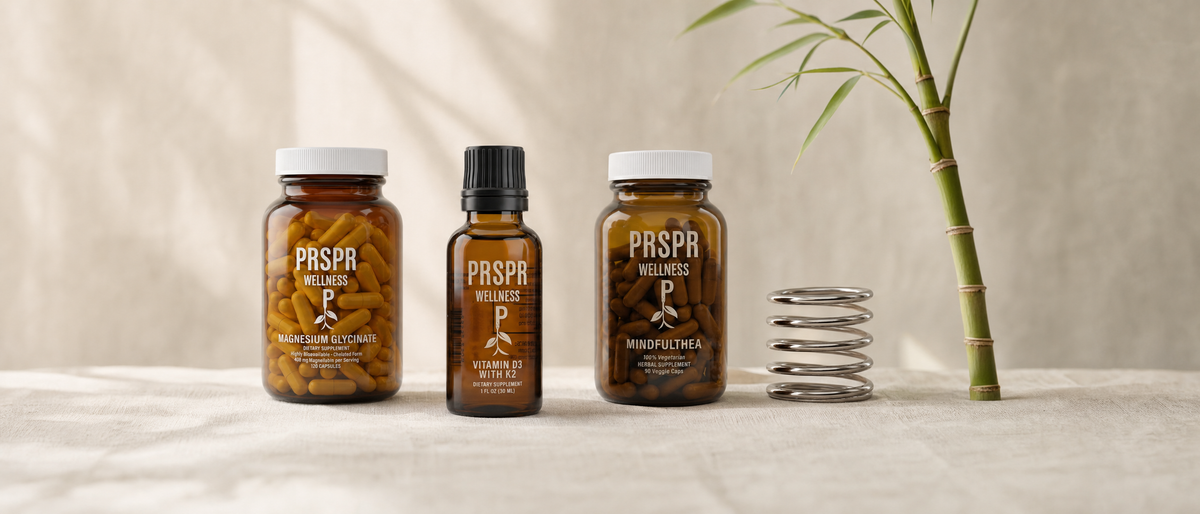
This piece started with a product on our own shelf. Our Anti Anxiety Bundle is a bundle of three products: Magnesium Glycinate, L-Theanine and Vitamin D3 + K2. If one of those names is new to you, our explainer on what L-theanine is is a good place to start reading the vocabulary.
Like everything we carry, it is made in a GMP-certified facility and third-party batch tested, so what's on the label is what's in the bottle. It sits in our Bundles collection, listed at $108.00.
If you want to read each product's details for yourself, read the Anti Anxiety Bundle listing at PRSPR.
Merriam-Webster defines resilience first as "the capability of a body to recover its size and shape after deformation caused especially by compressive stress" and second as "an ability to recover from or adjust easily to misfortune or change." The first sense is the original materials meaning.
The APA Dictionary of Psychology defines it as "the process and outcome of successfully adapting to difficult or challenging life experiences," and notes it is also called psychological resilience.
Resilience is a noun, per Merriam-Webster and Dictionary.com. Dictionary.com lists resiliency as an alternate noun form, resilient as the adjective and resiliently as the adverb.
Merriam-Webster's thesaurus lists weakness and helplessness as dissimilar words for the strength sense, and stiffness, rigidity and inflexibility for the flexibility sense.
It depends on the sense. Merriam-Webster's thesaurus gives tenacity, perseverance and fortitude for the strength sense, and elasticity, pliability and suppleness for the flexibility sense. Thesaurus.com gives flexibility as its strongest match for the elasticity sense.
Merriam-Webster traces it to the Latin verb resilire, "to jump back" or "to recoil," whose base salire means "to leap." Dictionary.com dates the word's first record to 1620 to 1630, and Merriam-Webster dates the materials sense to 1807.
Answer all five questions to unlock a clear wellness plan made around your goal, schedule, preferred supplement format, and biggest roadblock.
Get clarity on what matters most right now.
See the product and routine connected to your goal.
Simple next steps you can use right away.
Pick the one you would fix first if you could.
This helps us make the guide easier to follow.
Consistency beats the “perfect” routine you never follow.
Be honest. We’re building something you’ll actually use.
Your guide will include one simple way around it.
Answer two more questions to unlock your product starting point, five-step plan, two-week routine, and one practical tip for your biggest roadblock.
Enter your details to open your five-step plan.
Verified PRSPR customer reviews
Expires when you close this page
*Your personal credit for completing the quiz. It's applied automatically at checkout on one-time purchases and expires when the timer runs out.
View full product detailsEverything in your plan, together — one add to cart.
Expires when you close this page
*Your personal credit for completing the quiz. It's applied automatically at checkout on one-time purchases and expires when the timer runs out.
View full product details Botany
You pick up a fallen leaf on a walk, or you read a product label that says a botanical comes from a leaf, and you realize you do not have the words...
 Food Science
You are fine, you just ate, and then one specific food lands in your head and will not leave. Not food in general. That food. Researchers have a na...
 Fitness Terms
You have heard it from a coach, a gym sign-up form, a friend who just bought a set of dumbbells. Strength training. Resistance training. Hypertroph...