
◎
Get clear
Get clarity on what matters most right now.

Mulberry leaf tea is holding a volume score of 91 this week. White mulberry leaf sits at 89, mulberry leaf extract at 60, red mulberry leaf at 45, mulberry leaves at 36, white mulberry leaf extract at 18. Rising fastest, up about 140 percent, is white mulberry leaf benefits, which is an outcome question and one for a qualified healthcare professional rather than for us.
Here is what makes that cluster worth writing about. The chlorophyll in our dropper is derived from mulberry leaves, and we have written before about what chlorophyll is and what the dropper format changes. What that piece did not do, because it was about the pigment, is explain the plant. And the plant is genuinely one of the more interesting agricultural stories you will find behind a supplement label.
So this article is about the mulberry. What the tree is, why the search data splits it by colour, why its leaves are farmed at industrial scale for reasons that have nothing to do with supplements, and what taking a pigment out of a leaf actually involves.
Mulberries are trees of the genus Morus, in the fig family. They are deciduous, fast-growing, and remarkably tolerant of poor soil and hard pruning, which turns out to matter enormously later in this story. They are grown across temperate and subtropical regions on every populated continent.
The colour terms in the search data are species names, not varieties of one tree, and the naming is a well-known trap.
Morus alba is the white mulberry. It is native to China and it is the species that has spread furthest around the world by human hand. The white in the name refers to the colour of the buds, not reliably to the colour of the fruit, which on a white mulberry can be white, pink, purple or nearly black depending on the tree. This is the single most common point of confusion about mulberries and it catches almost everybody.
Morus rubra is the red mulberry, native to eastern North America. Morus nigra is the black mulberry, from western Asia, long grown around the Mediterranean and prized for its fruit. So red mulberry leaf and white mulberry leaf are searches about two different trees from two different continents, and the colour in each name is doing a different job.
The reason white mulberry dominates the search volume is that Morus alba is the one grown at scale, and it is grown at scale for its leaves rather than its fruit.
This is the part that surprises people. Mulberry is one of the very few tree crops in the world cultivated primarily for foliage, and the reason is silk.
Sericulture, the raising of silkworms, depends on the mulberry absolutely. The domesticated silkworm, Bombyx mori, feeds on mulberry leaves, and in commercial practice on white mulberry leaves specifically. Its scientific name literally records the dependency. The insect will not thrive on anything else at production scale, which means that for as long as silk has been produced, somebody has been growing mulberry leaves in enormous quantity to feed it.
That has been going on in China for thousands of years, and it travelled westward along the trade routes named for the fabric. The spread of white mulberry out of China and across Asia, the Middle East, southern Europe and eventually the Americas is a direct consequence of people trying to establish silk production, and it is why a Chinese tree is now naturalised on several continents. There were state-backed attempts to start silk industries in colonial North America and in parts of Europe, most of which failed commercially and left the trees behind.
The agronomy that grew up around this is what matters for a modern leaf crop. Mulberry grown for sericulture is not managed as a shade tree. It is cut back hard and repeatedly, kept low and bushy, and harvested for leaf several times a season. The tree tolerates that treatment unusually well, which is precisely why it became the crop. Centuries of selection and technique went into producing a lot of clean leaf per hectare.
So when a modern ingredient supplier needs green leaf material in volume, mulberry arrives with an entire agricultural infrastructure already built, for a completely unrelated reason. That is an unusual thing to be able to say about a supplement ingredient.
The other half of the story is extraction, and the principle is simpler than the vocabulary makes it sound.
Chlorophyll sits inside plant cells, in structures called chloroplasts. It is not water-soluble in its native form, which is the first thing anyone extracting it has to deal with. The general shape of the process is to harvest and dry the leaf, reduce it mechanically so the cells are broken open, and then wash the material with a solvent that the pigment will dissolve into. That gives a crude green extract which is then separated from the spent plant material and concentrated.
The reason this matters for reading a label is the word extract, which appears twice in this week's search data. Mulberry leaf extract at 60 and white mulberry leaf extract at 18 are both people searching a term that describes a process, not an ingredient. An extract is whatever came out of a plant using a particular solvent and a particular set of conditions, and two extracts of the same leaf made differently are not the same material. It is one of the least specific words on any supplement panel, which is exactly why it is worth noticing when you see it.
The same logic applies to a leaf infusion. Mulberry leaf tea, the biggest term in this cluster at 91, is a domestic extraction: dried leaf, hot water, time. Water pulls out what water can pull out, which is a different set of compounds from what an industrial solvent process is after. Two preparations of one leaf, doing different things. We made the same argument at length about a different plant in tea, tincture, extract and capsule as four ways to buy one berry.
We think naming a source plant is one of the more meaningful things a supplement label can do, and almost nobody does it.
Green is the easiest thing in the world to put on a package. A green bottle, a green leaf illustration, the word chlorophyll, and the shopper fills in the rest. What is much rarer is a label that tells you which plant, because that is a checkable statement about a supply chain and checkable statements are a commitment.
And in this case the answer is genuinely good. Mulberry is not an exotic ingredient sourced for a story. It is one of the most thoroughly domesticated leaf crops on earth, farmed at scale for two thousand years because an insect refused to eat anything else. That is not a wellness narrative. It is agricultural history, and it is a better reason to be confident about a supply chain than any adjective on a front label.
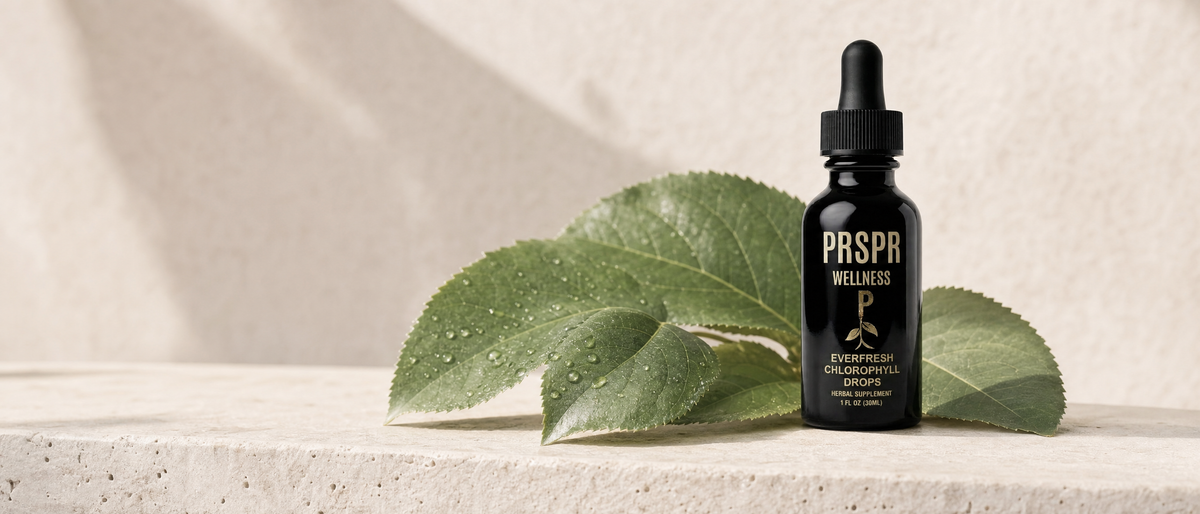
Our Everfresh Liquid Chlorophyll is a liquid dietary supplement made with chlorophyll derived from mulberry leaves and naturally flavoured with peppermint oil. That is the composition as the live listing states it, and the mulberry line on that listing is what this whole article has been about.
What we will add in our own voice is the quality story alone. It is made in a GMP-certified facility and third-party batch tested, so what is on the label is what is in the bottle. No guessing, no filler.
If the pigment rather than the plant is your question, chlorophyll in water and what the dropper changes is the companion piece to this one. Otherwise open the Everfresh page and read the panel, browse the rest of the gut and digestion collection, or take the build-your-stack quiz.
Answer all five questions to unlock a clear wellness plan made around your goal, schedule, preferred supplement format, and biggest roadblock.
Get clarity on what matters most right now.
See the product and routine connected to your goal.
Simple next steps you can use right away.
Pick the one you would fix first if you could.
This helps us make the guide easier to follow.
Consistency beats the “perfect” routine you never follow.
Be honest. We’re building something you’ll actually use.
Your guide will include one simple way around it.
Answer two more questions to unlock your product starting point, five-step plan, two-week routine, and one practical tip for your biggest roadblock.
Enter your details to open your five-step plan.
Verified PRSPR customer reviews
Expires when you close this page
*Your personal credit for completing the quiz. It's applied automatically at checkout on one-time purchases and expires when the timer runs out.
View full product detailsEverything in your plan, together — one add to cart.
Expires when you close this page
*Your personal credit for completing the quiz. It's applied automatically at checkout on one-time purchases and expires when the timer runs out.
View full product details Mind vocabulary
What is cognition? You have probably seen the word "cognitive" printed on a label, in a headline, or in a product name, and kept scrolling. It is o...
 Biology vocabulary
What is metabolism? You see the word on labels, in gym talk and in nutrition headlines, almost always used as if it were a single setting. Read eno...
 Sleep vocabulary
What are sleep cycles? You hear the phrase on podcasts, see it on sleep trackers, and read it in articles that assume you already know what it mean...