
◎
Get clear
Get clarity on what matters most right now.

Type "aphrodisiac" into a search bar and the suggestions do something interesting. The top one is not a product or a recipe. It is a definition. People want the aphrodisiac meaning, and a surprising number of them want to know where the word itself came from.
The short version: the word is named after a goddess. The longer version runs through a Greek adjective, an eighteenth century English dictionary entry, a marble city in southwestern Turkey, and a United States federal regulation. Here it is, in order.
According to Google Trends data for the United States over the past seven days, using "aphrodisiac" as the seed term, the top related search is "aphrodisiac meaning" at 100. Behind it sit "what is aphrodisiac" at 84, "what is an aphrodisiac" at 39, "what is a aphrodisiac" at 25 and "aphrodisiacs" at 15. Among rising searches, "aphrodisias" is marked Breakout, "aphrodisia" is up +190%, and "what are aphrodisiacs" is up +90%.
A note on reading those numbers: they are relative scores within the seed term, not absolute search counts. The rising figures are percentage growth, and Breakout means growth of more than 5,000%.
The same seed also surfaced a run of food questions, people asking whether cinnamon, shrimp, coffee or oysters count. We are leaving those searches alone. This piece is about the word.
Start with the definitions, because they are more careful than most people expect.
Cambridge Dictionary defines an aphrodisiac as "something, usually a drug or food, that is believed to cause sexual desire in people." Notice the phrase "is believed to." The dictionary is describing how the word is used, not vouching for anything it is used about.
Collins COBUILD does the same thing with different words: an aphrodisiac is "a food, drink, or drug which is said to make people want to have sex." Again, "is said to." Dictionary.com lists it two ways, as an adjective meaning "arousing sexual desire" and as a noun for "an aphrodisiac food, drug, potion, or other agent." Collins and Dictionary.com both note it works as an adjective as well as a noun.
The rising search "aphrodisia" is not a typo. Dictionary.com lists aphrodisia as a separate noun meaning "sexual desire," and dates it to 1820 to 1830. It traces it through New Latin to Greek, as the neuter plural of aphrodisios, "of Aphrodite." So aphrodisia names the thing, and aphrodisiac names whatever the word gets attached to.
If this reminds you of another word that is mostly searched for its definition, it should. We traced a similar path for where the word "libido" came from, which turns out to be a much younger piece of vocabulary.
According to the Online Etymology Dictionary, "aphrodisiac" entered English as a noun in 1719. It comes from a Latinized form of the Greek aphrodisiakos, which in turn comes from Aphrodisios, meaning "sacred to Aphrodite" or "pertaining to Aphrodite." The same source records the adjective use from 1775, with an earlier form, "aphrodisical," also dated to 1719.
Dictionary.com and Collins date the word slightly differently, to the period 1710 to 1720, and break the Greek down the same way: aphrodisios, "of Aphrodite," plus the ending -akos, which English turned into "-ac." Collins sums up the origin as eighteenth century, from Greek aphrodisiakos, from aphrodisios, "belonging to Aphrodite."
The goddess's own name is less settled. The Online Etymology Dictionary notes that the ancient Greeks themselves linked it to aphros, "foam," from the story of her birth, but that the name may instead have come from the East, possibly through Phoenician. It also notes the Greek name could mean "sexual pleasure" or "a temple of Aphrodite," which is how one goddess's name ended up carrying a whole family of words.
That is the full chain. A goddess, an adjective meaning "of the goddess," a Greek word built on that adjective, and an English borrowing that has now been in use for roughly three centuries.
Which brings us to the Breakout search. Aphrodisias is not a misspelling of aphrodisiac. It is a place, and its name is built on the same goddess.
UNESCO lists Aphrodisias as a World Heritage Site, inscribed in 2017. Per UNESCO, it sits in southwestern Turkey, in the upper valley of the Morsynus River, in the ancient region of Caria. The listing covers two parts: the archaeological site of the city and the marble quarries northeast of it.
UNESCO says the temple of Aphrodite dates from the 3rd century BC and the city was built about a century later. It describes the cult of Aphrodite as the most important cult of Aphrodisias, with a distinctive cult statue that "defined the city's identity." The city's wealth, per the same listing, came from those marble quarries and from its sculptors, who were famous across the Roman Empire for portrait sculpture.
So when someone searches "aphrodisias" next to "aphrodisiac," they have found a real connection. Two words, one a city and one a dictionary entry, both pointing back at the same name.
We like words that carry their history in plain sight. "Aphrodisiac" is one of them. You can read the goddess right there in the spelling.
What we find more useful, though, is knowing that the word also has a regulatory meaning in the United States. Under 21 CFR 310.528, a Food and Drug Administration rule published in the Federal Register on July 7, 1989, any over-the-counter drug product whose labeling claims it will arouse or increase sexual desire, or improve sexual performance, is defined as an aphrodisiac drug product. The rule states that any such OTC drug product "cannot be generally recognized as safe and effective," and noncompliant products first introduced after January 8, 1990 are subject to regulatory action.
That is a word doing real work on a label. In that rule, "aphrodisiac" is not mythology. It is a category defined by what a label claims.
Our view is simple. A word with that much history and that much regulatory weight should be read carefully, wherever you see it. We would rather a label tell you exactly what is inside, by name, and let you look up the words yourself. That is also why we keep writing pieces like this one, and our explainer on what a tincture is and where that word comes from.
If you have a personal health question, a clinician is the right person to ask.
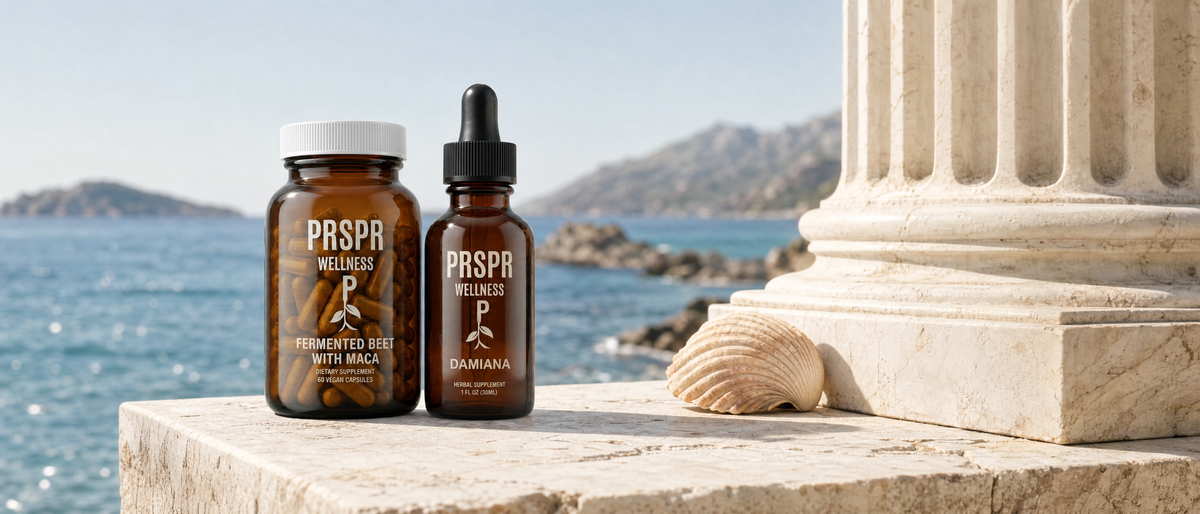
The Love Bundle is a pairing of two PRSPR products: Fermented Beet Root + Maca, and Damiana. Both are listed by name on the product page, so you know exactly what is in the box.
Damiana has its own story, too. It is a plant name you might recognize from a bottle on a bar shelf, which we covered in why damiana shows up in a Mexican liqueur.
Like everything we carry, the Love Bundle is made in a GMP-certified facility and third-party batch tested, so what's on the label is what's in the bottle. You can browse it alongside the rest of our new arrivals, or take the PRSPR quiz to build a stack around your own routine.
Now you know where the word comes from. See exactly what is in the box: shop the Love Bundle at PRSPR.
It is the plural of the noun, and the dictionaries define it by how people use it. Cambridge Dictionary describes an aphrodisiac as "something, usually a drug or food, that is believed to cause sexual desire in people," and Collins says it is a food, drink or drug that "is said to" have that effect.
It is a noun, and per the Online Etymology Dictionary it has been in English since 1719, from Greek aphrodisiakos, built on the name of the goddess Aphrodite. In United States regulation, 21 CFR 310.528 defines an aphrodisiac drug product by what its label claims.
Dictionary.com lists "aphrodisiac" as an adjective as well as a noun. The Online Etymology Dictionary dates the adjective use to 1775.
It is the same question as "what is an aphrodisiac," typed quickly. English uses "an" before a vowel sound, so "an aphrodisiac" is the standard form, and the definitions above apply either way.
A separate noun. Dictionary.com defines aphrodisia as "sexual desire" and dates it to 1820 to 1830, from Greek aphrodisios, "of Aphrodite."
An ancient city in southwestern Turkey named for Aphrodite. UNESCO inscribed the archaeological site of Aphrodisias and its nearby marble quarries on the World Heritage List in 2017.
Answer all five questions to unlock a clear wellness plan made around your goal, schedule, preferred supplement format, and biggest roadblock.
Get clarity on what matters most right now.
See the product and routine connected to your goal.
Simple next steps you can use right away.
Pick the one you would fix first if you could.
This helps us make the guide easier to follow.
Consistency beats the “perfect” routine you never follow.
Be honest. We’re building something you’ll actually use.
Your guide will include one simple way around it.
Answer two more questions to unlock your product starting point, five-step plan, two-week routine, and one practical tip for your biggest roadblock.
Enter your details to open your five-step plan.
Verified PRSPR customer reviews
Expires when you close this page
*Your personal credit for completing the quiz. It's applied automatically at checkout on one-time purchases and expires when the timer runs out.
View full product detailsEverything in your plan, together — one add to cart.
Expires when you close this page
*Your personal credit for completing the quiz. It's applied automatically at checkout on one-time purchases and expires when the timer runs out.
View full product details Mind vocabulary
What is cognition? You have probably seen the word "cognitive" printed on a label, in a headline, or in a product name, and kept scrolling. It is o...
 Biology vocabulary
What is metabolism? You see the word on labels, in gym talk and in nutrition headlines, almost always used as if it were a single setting. Read eno...
 Sleep vocabulary
What are sleep cycles? You hear the phrase on podcasts, see it on sleep trackers, and read it in articles that assume you already know what it mean...