
◎
Get clear
Get clarity on what matters most right now.

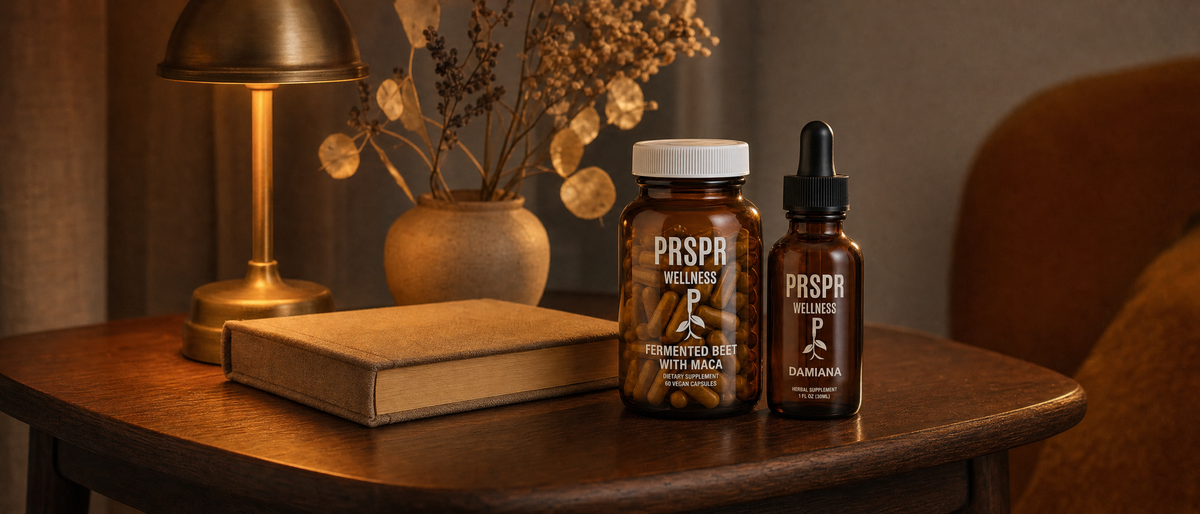
Type the word into a search bar and you get a shopping aisle. Type it into an etymology dictionary and you get Vienna, 1890s. Libido is one of the more unusual words in the supplement business, because it arrived from academic psychology, spent seventy years as a technical term almost nobody used casually, and then became a retail category with its own search patterns.
What is libido ran at 30 in the past week's related queries, and libido meaning at 5. Those two are the definitional half. The commercial half is much larger: libido supplements for women at 100, supplements to increase libido at 55, libido supplements for men at 48, female libido supplements at 46. Ashwagandha rose 40 percent in the same cluster, which is worth mentioning only because it shows how much adjacent traffic the category pulls in. It is not in our Love Bundle and this article is not about it.
This piece is about the word. Where it came from, what it denotes, and why the search results split the way they do.
Libido is Latin. It means desire or lust, and it is related to the verb libet, meaning it pleases or it is pleasing. In classical usage it was a general purpose word for wanting, not specifically a sexual one.
What made it a modern term was psychoanalysis. Sigmund Freud adopted it as a technical label in his writing around the turn of the twentieth century, and in his usage it named psychic energy attached to the drives, which is broader and stranger than how the word gets used now. Carl Jung then widened it further, treating it as general psychic energy rather than specifically sexual energy, and the two of them argued about the definition for years.
So the word entered English through a professional dispute about what it meant. It escaped that dispute the way technical vocabulary usually does, by being useful in ordinary conversation, and by the second half of the twentieth century it had settled into its current everyday sense: a person's overall level of sexual desire. The academic breadth fell away and the narrower meaning stuck.
It is worth being precise about what the word denotes today, because it is narrower than people assume. In ordinary current usage libido refers to desire itself, the wanting, and not to any physical capacity, function, or performance. Those are separate ideas with separate vocabulary, and the fact that they get collapsed together in marketing copy is a marketing decision rather than a linguistic one. The word has never meant them.
Now look at what the search data does with it, because the shape is unusually clean.
The largest phrase in this cluster is libido supplements for women at 100. Female libido supplements sits close behind at 46. Libido supplements for men runs at 48. Supplements to increase libido, with no audience attached, runs at 55. So roughly two thirds of the category volume arrives with a gender already specified, and the women's phrasings together are the clear majority.
That is a meaningful thing to notice about a retail category. Most supplement categories are searched generically first and get filtered later. This one is filtered at the moment of typing. People do not appear to be asking what is out there. They are asking what is out there for them specifically, which suggests the category is understood well enough that the general question has already been answered in most people's heads.
There is a second pattern worth naming. Supplements to increase libido, the ungendered phrasing at 55, is the only high volume term in the group built around a verb rather than a noun. Everything else in the cluster names a thing: a supplement, a category, an audience. That one names an action. Search terms built around verbs tend to signal a person further along in the decision, closer to buying and further from browsing.
The definitional searches, what is libido and libido meaning, sit underneath all of that at much lower volume. Which is the ordinary pattern for a word that has fully crossed over. Very few people look up a term they are already comfortable shopping with.
Here is the bridge between the etymology and the aisle, and it is not a coincidence.
Libido survived into commercial vocabulary because it is clinical enough to be polite. English has plenty of other words for the same idea and almost all of them are either crude or coy. Libido is neither. It came from a consulting room, it sounds like a term of art, and it can be printed on a box and typed into a phone without embarrassment. That is a genuinely useful property for a word, and it is why the category is named after a Latin noun that passed through Viennese psychoanalysis rather than after anything in plain English.
The same thing happens elsewhere in this aisle. Botanical names do similar work: they are precise, they are neutral, and they let a conversation happen. We looked at one of them in our piece on fermented beet root and maca, where the plant names carry the description rather than any promise about outcomes.
To be direct about what this article is not doing: we are not telling you that any product changes libido, ours included. The increase phrasings above are things people type into search bars, recorded here as search behaviour and nothing else. Anything to do with sexual health or desire that is actually concerning you belongs in a conversation with a qualified healthcare professional.
We find the etymology genuinely useful, and not as trivia. Knowing that libido started as a broad word for wanting, then got narrowed by a specific school of psychology, then got narrowed again by retail, tells you something about how much the word is now carrying that it was never designed to carry.
It also explains the audience split in the search data. When a single word has to cover desire, energy, mood, connection, and confidence all at once, of course people immediately qualify it. Of course they type for women or for men. The word on its own has been stretched too thin to be a useful query.
Our preference is always for the more specific vocabulary. Name the plant. Name the amount. Let the reader decide what they are looking at.
The Love Bundle is fermented beet root, maca, and damiana, sold together. It sits in our vitamins and supplements collection.
What we will state is what we can verify. Each product in it is manufactured in a GMP certified facility and third party batch tested, and each label prints what is in it in amounts you can read. That is the standard we hold, and it is the only claim on this page.
If you want the botany behind one of the three, there is a post on this blog about damiana and its botanical name. And if you would rather work out what belongs in your routine before shopping a category at all, take the quiz and build your own stack.
Answer all five questions to unlock a clear wellness plan made around your goal, schedule, preferred supplement format, and biggest roadblock.
Get clarity on what matters most right now.
See the product and routine connected to your goal.
Simple next steps you can use right away.
Pick the one you would fix first if you could.
This helps us make the guide easier to follow.
Consistency beats the “perfect” routine you never follow.
Be honest. We’re building something you’ll actually use.
Your guide will include one simple way around it.
Answer two more questions to unlock your product starting point, five-step plan, two-week routine, and one practical tip for your biggest roadblock.
Enter your details to open your five-step plan.
Verified PRSPR customer reviews
Expires when you close this page
*Your personal credit for completing the quiz. It's applied automatically at checkout on one-time purchases and expires when the timer runs out.
View full product detailsEverything in your plan, together — one add to cart.
Expires when you close this page
*Your personal credit for completing the quiz. It's applied automatically at checkout on one-time purchases and expires when the timer runs out.
View full product details Electrolytes
Salt is having a comparison week. Searches for celtic sea salt vs himalayan pink salt are up about 70 percent, pink himalayan salt vs table salt is...
 Kids
KidsPick up a box of children's snacks and somewhere on the front there is a number with the letter g after it, next to the word fiber. It looks like o...
 Label Reading
It is printed on the front of a lot of mineral bottles and it is one of the least understood words in the supplement business. Chelated. Search int...