
◎
Get clear
Get clarity on what matters most right now.

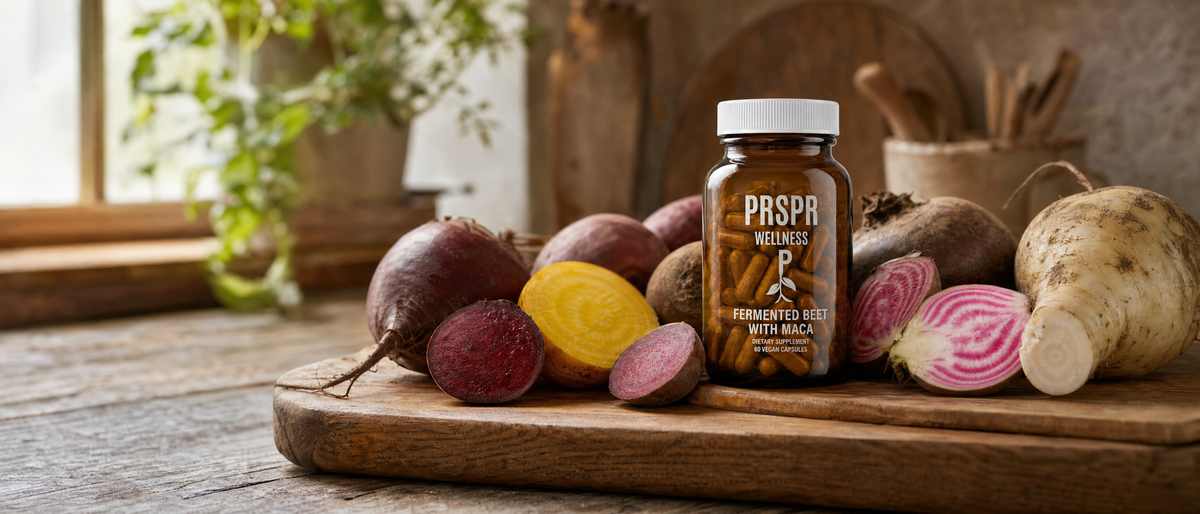
What are beets, exactly? Enough people are asking right now that the question sits inside a whole cluster of beet searches, and one of the steadiest is for a beet most people have never seen on a plate: sugar beets, with a volume score of 31.
The rest of the list is a tour of the vegetable aisle. Pickled beets lead at 62. Red beets follow at 36, then sugar beets at 31, what are beets at 29, and fresh beets and raw beets at 19 each. The two fastest risers are roasted golden beets, up +50%, and a question people are typing word for word: what does beets taste like, also up +50%.
Read those together and a pattern shows up. People are noticing that the beet is not one thing. There is a red one, a golden one, a pickled one in a jar, and a pale one that never reaches the produce section at all. So they are looking it up.
We are going to stay on the vegetable: the varieties, the names, the taste, and the ways beets show up in kitchens. What beets do in a body is a question for a qualified healthcare professional, and we are not going to answer it in either direction.
A beet is the swollen root of a plant called Beta vulgaris. That one species is far more varied than its reputation.
In a 2021 review in Frontiers in Plant Science, the researchers Goldman and Janick describe the Beta vulgaris complex as including sugar beet, mangel wurzel, Swiss chard, fodder beet and table beet. Same species, very different crops. Chard is grown for its leaves and stalks. The same review describes fodder beet as a livestock food. Sugar beets are grown for sugar. Table beets are the ones you cook.
So when a search asks what are beets, the honest answer has two layers. In a grocery store, "beets" means table beets. In a botany book, it means a whole family of crops that happen to share a scientific name.
The word itself is old. The Online Etymology Dictionary traces "beet" to the Old English bete, from the Latin beta, and dates the compound "beetroot" to the 1570s, meaning simply the root of the beet plant.
Table beets come in more colours than most shoppers realise. University of Wisconsin Extension, in its guide to growing root crops, says beet cultivars may be red, yellow, purple, white or striped, and shaped like a top, a globe, a flattened disc or a long cylinder.
Red beets are the default, the deep crimson root that stains cutting boards and fingers. The colour comes from pigments. Goldman and Janick describe beets as carrying red-violet pigments called betacyanins and yellow pigments called betaxanthins. A red beet is one where the red-violet side dominates.
That red has been around a while. The same review notes that the first coloured illustration of a swollen-rooted table beet can be found in frescos painted in 1515 to 1517 at the Villa Farnesina in Rome.
Golden beets are the yellow version. In the pigment terms above, they are the beets where the yellow betaxanthins lead instead of the red betacyanins. Goldman and Janick explain the colour as a matter of genetics: specific versions of two genes decide whether a root comes out red, yellow or white.
The +50% rise in roasted golden beets tells you how most people meet them. Roasting is a common way golden beets appear on menus and in home kitchens, often cut into wedges so the orange-gold flesh shows. We are describing that as a way the vegetable turns up, not as a recipe.
The showpiece of the family is the striped beet. University of Wisconsin Extension describes Chioggia as a pre-1840 Italian heirloom variety of garden beet, sometimes called Candystripe Beet or Bull's Eye Beet, distinguished by alternating concentric rings of red and white inside. The same page notes it for its relative absence of "bleeding," the colour run you get from a red beet.
Slice one crosswise raw and you see a target. That is why it shows up so often in salads, where the rings are left on display.
Sugar beets are the beet most people never see whole, and they explain a lot about the word "sugar" on a food label.
A sugar beet is not the red globe in the produce aisle. It is not sold for cooking. It is grown to be processed.
The history is a chemistry story. Goldman and Janick write that sugar beet was selected from fodder beet, that a chemist identified sucrose from Beta vulgaris in 1747, and that by 1801 a sugar factory had opened in Silesia. In other words, someone proved the sugar in a beet was the same compound as the sugar in cane, and breeders spent the following decades selecting beets that held more of it.
It is not a niche crop in the United States. USDA's Economic Research Service reports that since the mid-1990s, sugar beets have accounted for about 55 percent of domestic sugar production, with sugarcane making up the rest. ERS lists sugar beet growing regions across 11 states, from Michigan and the Red River Valley of Minnesota and North Dakota to Colorado, Idaho, California and the Pacific Northwest.
That is worth knowing the next time a package simply says "sugar." The word names the compound. It usually does not name the crop it came from, cane or beet.
The question is usually typed exactly that way, grammar and all, and it has a real answer.
Beets are sweet and earthy at the same time. The sweetness makes sense once you know the sugar beet story: this is a species that stores sucrose in its root. The earthiness has a name. University of Missouri Integrated Pest Management puts it plainly: the earthy taste of beets is due to a compound called geosmin.
Geosmin is the same molecule behind the smell of damp soil. A 2021 study in the journal G3 describes it as the volatile molecule that gives moist soil its distinctive aroma, and says it has been identified as the characteristic flavour of table beet. The same study notes that in table beet roots, geosmin is concentrated in and directly under the skin, and it reports Chioggia as a cultivar with relatively high geosmin and the cultivar Touchstone Gold as relatively low.
That is why people describe beets so differently. Some taste "sweet with a little dirt." Some taste "like the garden." Both are describing the same pair of things, sugar and geosmin, in different proportions.
The last three searches on the list are about form: how the vegetable reaches you.
Fresh beets are sold whole, often with the leafy tops still attached, and usually need scrubbing. Raw beets are fresh beets eaten without cooking, typically grated or sliced thin into salads. That is where Chioggia's rings get shown off.
Pickled beets, the top search of the whole cluster, are cooked beets kept in a vinegar brine, usually sliced and jarred. They are the form many people grew up with, and the reason some people think of beets as something that comes in a can or a jar rather than out of the ground.
One vocabulary note: pickling in vinegar and fermenting are not the same process, even though both can end in a jar. We walked through that difference in our guide to what foods are fermented, and it matters for the next section.
Every search on this list is about the whole vegetable: a variety, a colour, a taste, a jar. A supplement label works differently. It names an ingredient and a process, and it usually stops there.
Our Fermented Beet Root & Maca listing says it is made with beetroot and maca root, combined using a fermentation process. It says beetroot. It does not name a variety, red, golden, striped or otherwise, and we are not going to guess at one. Everything above about Chioggia rings and golden roasting belongs to the vegetable aisle, not to the capsule.
If you want the two-roots side of that label, our piece on the beet root and maca supplement label reads it line by line, and our comparison of beet root powder vs capsules covers the format question.
We think "beet" is one of the most underexplained words in the grocery store.
It covers a red vegetable, a yellow one, a striped heirloom, a leafy green in chard, and a pale industrial root that supplies a big share of American sugar. Most of the time the word is doing its job fine. On a label, though, it pays to read it at its actual size. "Beetroot" tells you the plant part. It does not tell you the colour, the variety or the farm.
So here is the habit we would build. When you see "beet" on anything, ask two questions: which part of the plant, and which kind. If the label answers only the first, that is all you know. That goes for our labels too.
Fermented Beet Root & Maca is a dietary supplement made with beetroot and maca root, combined using a fermentation process, in capsules. That is the listing's own description, and it is the whole of what we say the product is.
What we will add in our own voice is how it is made. Fermented Beet Root & Maca is manufactured in a GMP-certified facility and third-party batch tested, so what is on the label is what is in the bottle. No guessing, no filler, no cutting corners.
If you want to read the label for yourself, open the Fermented Beet Root & Maca page, browse the rest of the vitamins and supplements collection, or take the build-your-stack quiz to see where it fits alongside everything else we carry.
Answer all five questions to unlock a clear wellness plan made around your goal, schedule, preferred supplement format, and biggest roadblock.
Get clarity on what matters most right now.
See the product and routine connected to your goal.
Simple next steps you can use right away.
Pick the one you would fix first if you could.
This helps us make the guide easier to follow.
Consistency beats the “perfect” routine you never follow.
Be honest. We’re building something you’ll actually use.
Your guide will include one simple way around it.
Answer two more questions to unlock your product starting point, five-step plan, two-week routine, and one practical tip for your biggest roadblock.
Enter your details to open your five-step plan.
Verified PRSPR customer reviews
Expires when you close this page
*Your personal credit for completing the quiz. It's applied automatically at checkout on one-time purchases and expires when the timer runs out.
View full product detailsEverything in your plan, together — one add to cart.
Expires when you close this page
*Your personal credit for completing the quiz. It's applied automatically at checkout on one-time purchases and expires when the timer runs out.
View full product details Mind vocabulary
What is cognition? You have probably seen the word "cognitive" printed on a label, in a headline, or in a product name, and kept scrolling. It is o...
 Biology vocabulary
What is metabolism? You see the word on labels, in gym talk and in nutrition headlines, almost always used as if it were a single setting. Read eno...
 Sleep vocabulary
What are sleep cycles? You hear the phrase on podcasts, see it on sleep trackers, and read it in articles that assume you already know what it mean...