
◎
Get clear
Get clarity on what matters most right now.

Some words work harder in a search bar than they ever did in a dictionary. Right now, in the wellness aisle, none is working harder than "anti-inflammatory."
The numbers show a phrase being stretched across three completely different kinds of thing. "Best anti inflammatory" sits at 100 on the relative interest scale. "Best anti inflammatory supplements" sits at 99. "Anti inflammatory diet" sits at 49, and "anti inflammatory foods" is climbing about 100 percent. In the same result set, two plant names turn up: "sarsaparilla root" at 100 and "what is sarsaparilla" at 43, alongside "black seed oil benefits" at 42.
So one phrase is being used to describe a way of eating, a list of groceries, a shelf of bottles, and individual plants. That is a lot of weight for one hyphenated adjective, and it is worth separating out what it is doing in each case. What this article will not do is tell you that anything affects inflammation in your body. That is a medical claim, we do not make them, and if that is the question you arrived with, it belongs with a healthcare professional.
Start with the grammar, because it explains the confusion. "Anti-inflammatory" is an adjective describing an intended effect. It is not a category of substance, a plant family, or a manufacturing process. Any noun can be put behind it, which is exactly why the search results contain foods, diets, supplements and individual botanicals all at once.
Compare that with how the rest of the aisle is labelled. "Magnesium glycinate" names a compound. "Capsule" names a format. "500 milligrams" names a quantity. Each of those constrains what you are looking at. An effect-adjective constrains nothing about the object. It only describes what somebody hopes the object will do.
This is why "best anti inflammatory" cannot resolve into a ranked list the way "best 4K monitor" can. A ranking needs a shared axis and comparable objects. Olive oil, a week of meal planning, a capsule and a dried root are not comparable objects, and the phrase that groups them is describing an aspiration rather than a property. The search is perfectly reasonable. The category is the thing that cannot answer it.
There is a second layer worth noticing. "Anti-inflammatory" has a precise meaning in medicine, where it describes specific drugs with specific mechanisms and specific regulatory status. The same word in a grocery context is being used loosely and colloquially. Those two usages look identical on a screen and mean very different things, and a search engine will happily return both to the same query. If you take one thing from this section, take that: check which of the two senses a page is using before you read anything else on it.
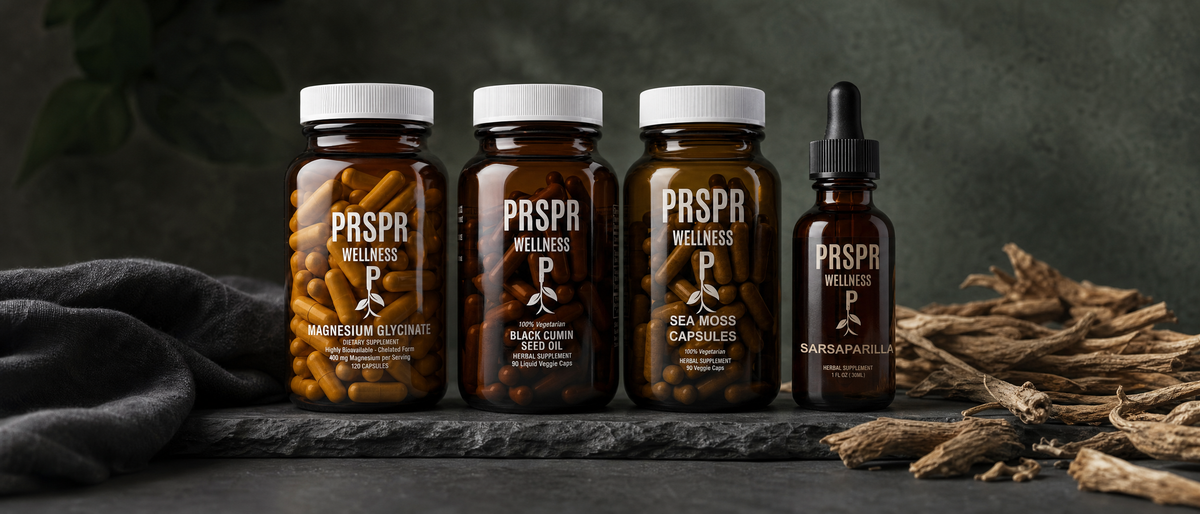
Since the adjective will not tell you what is in front of you, here are the nouns. The Inflammation Reset Stack is assembled from four separate formulas, and each one is a different kind of thing.
Sarsaparilla is a root. It comes from climbing vines in the genus Smilax, which grow in tropical and subtropical regions including Central and South America and the Caribbean. The harvested part is the long, fibrous underground root. Its name is a borrowing from Spanish, and it carries a great deal of cultural baggage from an entirely separate direction, which is that it flavoured a nineteenth-century soft drink and consequently shows up in saloon scenes and video games. The root and the soda are related only by flavouring history.
Magnesium glycinate is a mineral compound: magnesium bound to glycine, an amino acid. The pairing is what the word "glycinate" is telling you. It is a chelated form, meaning the mineral is attached to an organic molecule rather than a simple salt.
Black seed oil is pressed from the seeds of Nigella sativa, a flowering annual grown across the Mediterranean, the Middle East and South Asia. The seeds are small, angular and black, which is where the plain-English name comes from. Sold as an oil, it is often encapsulated rather than taken by spoon.
Sea moss is a seaweed, a red alga harvested from Atlantic coastal waters, dried and either processed into a gel or milled into capsules.
A root, a mineral compound, a pressed seed oil and a seaweed. Four different kingdoms of thing, in four different physical forms, grouped under one adjective. That is the honest description of this box, and it is a lot more informative than the adjective was.
One more thing the noun list makes visible: these four are not stored or finished the same way. A pressed seed oil in a capsule, a milled seaweed, a chelated mineral and a dried root have different shelf behaviour, and an oil is the component most worth keeping away from heat and light. A box that keeps four things in four bottles lets each one carry its own storage line. A blend cannot, because it has to average them.
It is also why the phrase "anti inflammatory diet" and the phrase "best anti inflammatory supplements" should never be read as versions of the same question. One describes a pattern of eating built up over months. The other describes an object you can put in a basket this afternoon. They sit next to each other in the search results because they share an adjective, and they have almost nothing else in common.
We think effect-adjectives are the least useful words on any label, and the most used.
The reason is obvious enough. An adjective about an outcome speaks directly to why somebody is shopping, where a noun only tells them what a thing is. So the adjective gets the front of the pack and the noun gets relegated to the ingredients panel, and shoppers end up comparing hopes instead of objects.
What bothers us is not that people search this way. Searching by the outcome you care about is completely rational. It is that the industry has learned to answer that search with more adjectives, when the useful answer is always a noun. Tell somebody a thing is a dried root from a climbing vine and they can go and learn about it. Tell them it is anti-inflammatory and you have told them nothing they can check.
So our position is unromantic. Use the adjective to find the aisle. Then demand the nouns, and take any question about what those nouns do inside a human body to somebody with the training to answer it.
The Inflammation Reset Stack keeps its four components in four separate bottles rather than blending them, which means four labels and four supplement facts panels you can read individually. Where a category word is this vague, individual labels are the only place real information lives.
Everything we make is manufactured in a GMP-certified facility and third-party batch tested. What is on the label is what is in the bottle. No guessing, no filler, no cutting corners. With botanicals identified by common names that overlap with sodas and songs, verified identity is not a bonus feature. It is the entire basis of knowing what you have.
If you want the components covered properly, we wrote about how to read the magnesium forms on a label and about what sea moss actually is. Our wellness quiz can help you work out where to start, and the stack sits with the rest of our bundles.
Answer all five questions to unlock a clear wellness plan made around your goal, schedule, preferred supplement format, and biggest roadblock.
Get clarity on what matters most right now.
See the product and routine connected to your goal.
Simple next steps you can use right away.
Pick the one you would fix first if you could.
This helps us make the guide easier to follow.
Consistency beats the “perfect” routine you never follow.
Be honest. We’re building something you’ll actually use.
Your guide will include one simple way around it.
Answer two more questions to unlock your product starting point, five-step plan, two-week routine, and one practical tip for your biggest roadblock.
Enter your details to open your five-step plan.
Verified PRSPR customer reviews
Expires when you close this page
*Your personal credit for completing the quiz. It's applied automatically at checkout on one-time purchases and expires when the timer runs out.
View full product detailsEverything in your plan, together — one add to cart.
Expires when you close this page
*Your personal credit for completing the quiz. It's applied automatically at checkout on one-time purchases and expires when the timer runs out.
View full product details Electrolytes
Salt is having a comparison week. Searches for celtic sea salt vs himalayan pink salt are up about 70 percent, pink himalayan salt vs table salt is...
 Kids
KidsPick up a box of children's snacks and somewhere on the front there is a number with the letter g after it, next to the word fiber. It looks like o...
 Label Reading
It is printed on the front of a lot of mineral bottles and it is one of the least understood words in the supplement business. Chelated. Search int...