
◎
Get clear
Get clarity on what matters most right now.

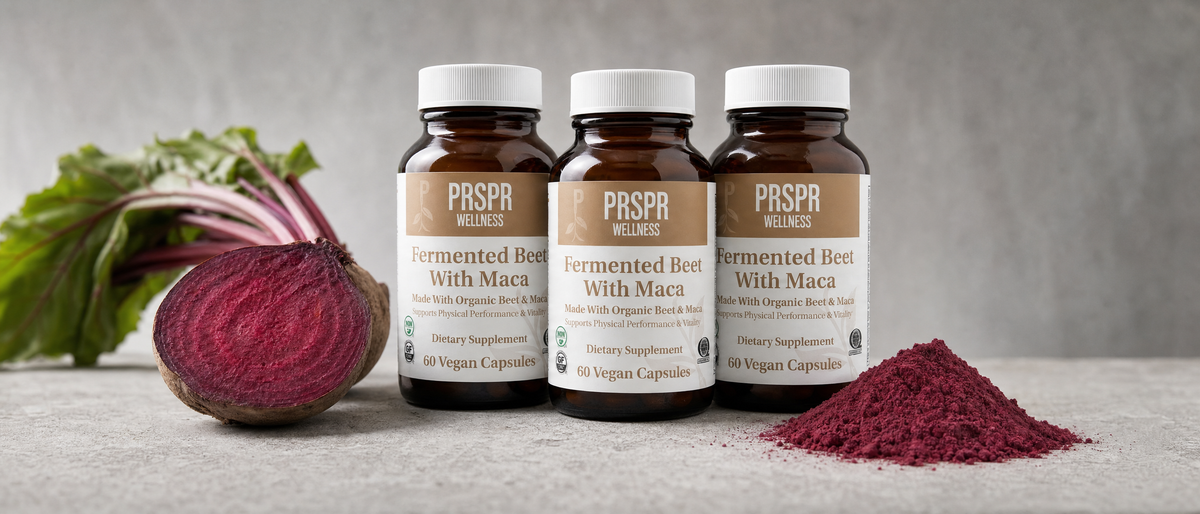
Pick up almost any beet supplement and somewhere on the packaging or the page you will find the same three words. They are doing more selling than the beet is.
The search data says the phrase has become the category. "Best nitric oxide supplement" sits at 100 on the relative interest scale. "Nitric oxide supplements" sits at 51, "nitric oxide booster" at 41, "nitric oxide benefits" at 39, "nitric oxide supplement benefits" at 39, and the bare molecule name "nitric oxide" at 31. The actual plant words trail behind: "beet root powder" at 37 and "maca powder" at 29.
That is a striking inversion. People are searching a molecule more than they are searching the vegetable it is associated with. This piece is about what that phrase is doing in the category's language, and about the format question underneath it. What it will not do is tell you that anything in a bottle affects nitric oxide in your body, or affects circulation, stamina or performance. Those are claims, and we do not make them.
Start with the molecule, plainly and without connecting it to anything. Nitric oxide is about as simple as a molecule gets: one nitrogen atom and one oxygen atom, written NO. At room temperature it is a colourless gas. Chemists have known it for centuries, and for most of that time it was studied as an industrial and atmospheric gas, which is where it sits in the story of smog and combustion.
Its second career came much later, when physiologists identified it as a signalling molecule in living systems. That line of work won a Nobel Prize in Physiology or Medicine in 1998. We are stating that as a fact about the history of science, and stopping there. What that research means for anybody's body, and whether any supplement bears on it, is not something we will characterise.
Now the category language, which is the part you can actually use. "Nitric oxide supplement" is a naming convention built around a mechanism rather than around an ingredient. That is unusual. Most supplement categories are named for what is in them, like "magnesium supplements," or for who they are for, like "prenatal." This one is named for a process.
The practical consequence is the same one that afflicts every mechanism-named category: the name tells you nothing about the contents. Products sold under this phrase contain a wide range of different substances, and the phrase itself does not narrow them. "Best nitric oxide supplement" therefore cannot resolve into a ranking, because the things being ranked are not a comparable set. The only way to compare them is to ignore the phrase and read what each one actually contains, which will be a plant, a compound, or a list of them.
There is a small vocabulary point worth having too. "Booster" is not a technical term and has no defined meaning on a label. It is a marketing word, and it appears at 41 in the search list because that is how the products are named, not because it denotes anything specific.
The other half of the search list is format, and this is where the honest differences live.
Beet root and maca are both sold as loose powder and as capsules, and the two are the same material in different containers. What differs is entirely practical.
A powder is measured. You take a scoop, and the serving is whatever the scoop holds, which means it is adjustable and also means it is approximate unless you are weighing it. Powders go into liquid, which suits some people and puts others off completely, because beet powder in particular has a strong earthy flavour and a colour that is difficult to ignore.
A capsule is counted. The serving is decided at the factory and printed on the label, the flavour is bypassed entirely, and the arithmetic is exact: count divided by serving size gives you days. The trade is that fitting a meaningful amount of a bulky plant powder into capsules takes several capsules per serving, which is why botanical capsule servings are so often two or three rather than one.
So the question is not which format is better. It is which of three things you care about most: flavour avoidance, precision, or adjustability. Capsules give you the first two. Powder gives you the third and costs you the first.
Multi-packs sit on top of that as a duration decision rather than a product one. Three bottles of the same capsule is three times the days, and the arithmetic is exactly as simple as it sounds once you know the serving size.
It is worth being precise about one more thing on these labels, since the search list contains both "beet root powder" and "maca powder." Those two words describe milled plant material, and they are not the same as an extract. A powder is the dried plant ground up. An extract has been through a solvent process that concentrates some fraction of it, and extracts carry a ratio on the label to say how concentrated. When you compare two bottles, checking whether you are looking at powder or extract matters more than almost anything else on the pack, because the numbers are not comparable across that line.
Fermentation is a third thing again, and it belongs to neither category. We covered what that word describes on this particular label in a separate piece, linked below.
Mechanism-named categories are the ones we would most like to see the back of, and this is the clearest example on the shelf.
The problem is not that the science is uninteresting. It is that naming a product category after a process inside the body puts the mechanism on the front of the pack, where a shopper cannot verify it, and pushes the ingredient to the back, where they could. It inverts exactly the information a person needs to make a comparison.
It also creates a strange situation where the most-searched term in a category is a molecule most people could not describe if asked. That is not the searcher's failing. It is what happens when an entire aisle is labelled with a word borrowed from physiology and then never explained anywhere on the packaging.
So our position is the same as ever, and it is boring on purpose. Read the plant names. Compare servings, not bottles. Treat mechanism words as the category's marketing vocabulary rather than as product information, and take any question about what happens inside your body to somebody qualified to answer it.
Our Fermented Beet and Maca capsules name their two plants on the front, which is the convention we would rather follow. The three pack is a duration decision and nothing more elaborate than that.
Everything we make is manufactured in a GMP-certified facility and third-party batch tested. What is on the label is what is in the bottle. No guessing, no filler, no cutting corners. In a category whose vocabulary is this abstract, the verifiable facts are the only ones with any weight.
If you want the two plants and the fermentation step explained properly, we wrote about what beet root and maca are and what fermented means on that label. Our wellness quiz takes a couple of minutes if you are working out where a beet capsule fits.
Answer all five questions to unlock a clear wellness plan made around your goal, schedule, preferred supplement format, and biggest roadblock.
Get clarity on what matters most right now.
See the product and routine connected to your goal.
Simple next steps you can use right away.
Pick the one you would fix first if you could.
This helps us make the guide easier to follow.
Consistency beats the “perfect” routine you never follow.
Be honest. We’re building something you’ll actually use.
Your guide will include one simple way around it.
Answer two more questions to unlock your product starting point, five-step plan, two-week routine, and one practical tip for your biggest roadblock.
Enter your details to open your five-step plan.
Verified PRSPR customer reviews
Expires when you close this page
*Your personal credit for completing the quiz. It's applied automatically at checkout on one-time purchases and expires when the timer runs out.
View full product detailsEverything in your plan, together — one add to cart.
Expires when you close this page
*Your personal credit for completing the quiz. It's applied automatically at checkout on one-time purchases and expires when the timer runs out.
View full product details Electrolytes
Salt is having a comparison week. Searches for celtic sea salt vs himalayan pink salt are up about 70 percent, pink himalayan salt vs table salt is...
 Kids
KidsPick up a box of children's snacks and somewhere on the front there is a number with the letter g after it, next to the word fiber. It looks like o...
 Label Reading
It is printed on the front of a lot of mineral bottles and it is one of the least understood words in the supplement business. Chelated. Search int...