
◎
Get clear
Get clarity on what matters most right now.

Best time to take creatine is holding a volume score of 71 this week. When is best to take creatine sits above it at 87. How to take creatine is at 67, when do you take creatine at 25, when to take creatine women at 19. And rising fastest of all, up about 350 percent, is when should i take creatine for best results, with how long does it take for creatine to work climbing about 50 percent behind it.
Seven phrasings. Count the distinct questions in them and you get one.
That is worth sitting with, because it does not happen often. Most ingredients generate a spread of questions: what it is, what it does, which form, how much, what else goes with it. Creatine generates a single question, asked over and over in slightly different words, at enormous volume, year after year. This article is about why that one question is so insistent, and about what a label direction can and cannot settle. It does not recommend a schedule. Timing and amount are decisions for a qualified healthcare professional who knows your situation, and that is not a formality.
Read the seven phrasings side by side and they separate into two intents that look identical and are not.
The first is procedural. How to take creatine, when do you take creatine. These are asking about mechanics, the way somebody asks how to use an unfamiliar kitchen appliance. They come from a person holding a container for the first time who wants to know the routine, and they are perfectly answerable by the directions on the panel, because that is what directions are for.
The second is optimising. Best time to take creatine, when is best to take creatine, when should i take creatine for best results. The word doing the work is best. These are not asking what to do, they are asking whether there is a better version of what they are already doing. That is a different question and it comes from a different person: somebody already using the product who suspects they might be leaving something on the table.
Notice which of the two is rising fastest. When should i take creatine for best results, up about 350 percent, is the optimising question in its purest form, and it is the biggest mover in the entire cluster. The mechanics question is steady. The optimisation question is what is spiking.
So why creatine? Vitamin D does not generate this. Neither does magnesium, and neither does iron. All three are taken daily by enormous numbers of people and none of them produces a search cluster made almost entirely of one timing question.
Three things about creatine's situation seem to explain it, and none of them are about the compound itself.
First, it comes from a performance culture, and performance culture is organised around protocol. Training has a schedule. Nutrition has a schedule. Someone arriving at creatine through that door arrives already expecting there to be a right time, because everything else in that world has one. The question is imported along with the ingredient.
Second, it is bound up with the workout as an event. Most daily supplements are attached to a meal or to the day in general. Creatine is attached, in most people's mental model, to a session, and a session has a clear before and after. As soon as there is a before and an after, there is a question about which, and that question does not arise for something you take with breakfast.
Third, it has a piece of protocol jargon attached to its history in a way almost nothing else does. That vocabulary teaches people that this is an ingredient with a procedure, and once you believe there is a procedure, you go looking for its details. We traced where that particular phrase came from in the piece on the creatine loading phase, and it is the direct ancestor of the question this article is about. That piece is about where a piece of jargon came from. This one is about the everyday question the jargon left behind.
Here is the part that is genuinely useful, and it applies to every supplement you will ever buy.
A direction on a panel is written by the maker of that product, for that product, in general terms. It can tell you a serving size. It can tell you how many units make a serving. It can tell you the maker's intended frequency, and whether the maker suggests taking it with water, with food, or mixed into something. On a powder it will usually tell you how to mix it. That is a real and complete set of instructions for using the product as designed, and it settles the procedural question entirely.
What a direction cannot do is optimise for you. It does not know your schedule, your training, your other supplements, your medications or your health. It is a general instruction printed months before you bought the tub, and general instructions cannot resolve questions about an individual. So the optimising half of this cluster, the entire best half, is structurally unanswerable by a label. Not because labels are unhelpful, but because that question is addressed to somebody who knows you, and a label does not.
How long does it take for creatine to work, up about 50 percent, is the same shape of question wearing a timeline instead of a clock. It is asking about an outcome in a body, which is exactly the territory a qualified healthcare professional owns and a product blog does not. We are naming it because it is in the data, and stopping there.
We think the honest answer to the most-asked question about creatine is that the question is bigger than the ingredient.
Seven phrasings of one query, at this volume, for this long, is not a gap in the available information. There is no shortage of people willing to answer it, confidently, in both directions. The persistence tells you something else: that the question is doing emotional work as much as practical work. It is the question you ask when you want to be sure you are doing it right, and the reason it never resolves is that reassurance is not the kind of thing a search result can deliver.
So our position is unglamorous. Read the directions on the tub you own, because they settle the procedural half completely and most people have never actually read them. Take the optimising half to somebody qualified who knows your situation, because that is who it is addressed to. And be a little wary of anyone who answers it with total confidence on a page that is also selling you the tub.
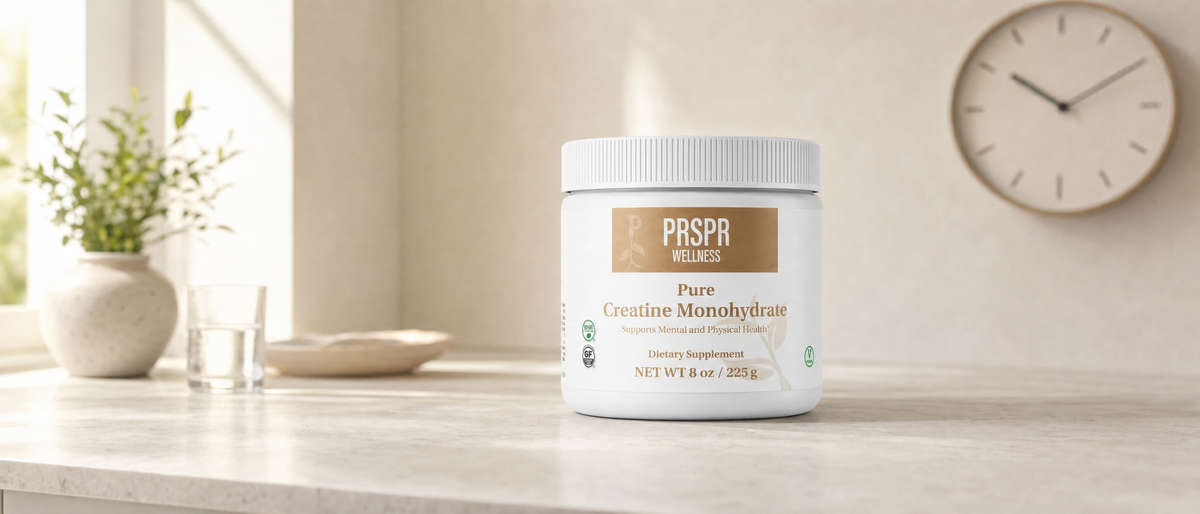
Our Pure Creatine Monohydrate is a single-ingredient dietary supplement made with creatine monohydrate. Single-ingredient means the panel is short and the directions on it are about one thing, which makes them unusually easy to actually read. Those are composition facts from the live listing.
What we will add in our own voice is the quality story alone. It is made in a GMP-certified facility and third-party batch tested, so what is printed on the tub is what is in it. No guessing, no filler.
If format rather than timing is your question, powder against capsules compares the two on the numbers, and creatine gummies explains a format we do not sell and why. Otherwise open the Pure Creatine Monohydrate page, read the directions before anything else, browse the rest of the muscle and joint collection, or take the build-your-stack quiz.
When is the best time to take creatine?
This is the optimising version of the question and it is the one a label cannot answer, because it depends on facts about a specific person. It belongs with a qualified healthcare professional who knows your situation.
How do you take creatine?
The procedural version, and this one the panel does answer. The directions on the product you own state the serving size, the number of units in a serving and how the maker intends it to be mixed or taken.
How long does it take for creatine to work?
An outcome question about a body over time, which is not something a company selling the product should be answering. Take it to a clinician.
When should you take creatine for best results?
The fastest-rising phrasing in this cluster and, again, an optimising question rather than a procedural one. The honest answer is that it is addressed to a professional who knows your circumstances rather than to a search engine.
Answer all five questions to unlock a clear wellness plan made around your goal, schedule, preferred supplement format, and biggest roadblock.
Get clarity on what matters most right now.
See the product and routine connected to your goal.
Simple next steps you can use right away.
Pick the one you would fix first if you could.
This helps us make the guide easier to follow.
Consistency beats the “perfect” routine you never follow.
Be honest. We’re building something you’ll actually use.
Your guide will include one simple way around it.
Answer two more questions to unlock your product starting point, five-step plan, two-week routine, and one practical tip for your biggest roadblock.
Enter your details to open your five-step plan.
Verified PRSPR customer reviews
Expires when you close this page
*Your personal credit for completing the quiz. It's applied automatically at checkout on one-time purchases and expires when the timer runs out.
View full product detailsEverything in your plan, together — one add to cart.
Expires when you close this page
*Your personal credit for completing the quiz. It's applied automatically at checkout on one-time purchases and expires when the timer runs out.
View full product details Mind vocabulary
What is cognition? You have probably seen the word "cognitive" printed on a label, in a headline, or in a product name, and kept scrolling. It is o...
 Biology vocabulary
What is metabolism? You see the word on labels, in gym talk and in nutrition headlines, almost always used as if it were a single setting. Read eno...
 Sleep vocabulary
What are sleep cycles? You hear the phrase on podcasts, see it on sleep trackers, and read it in articles that assume you already know what it mean...