
◎
Get clear
Get clarity on what matters most right now.

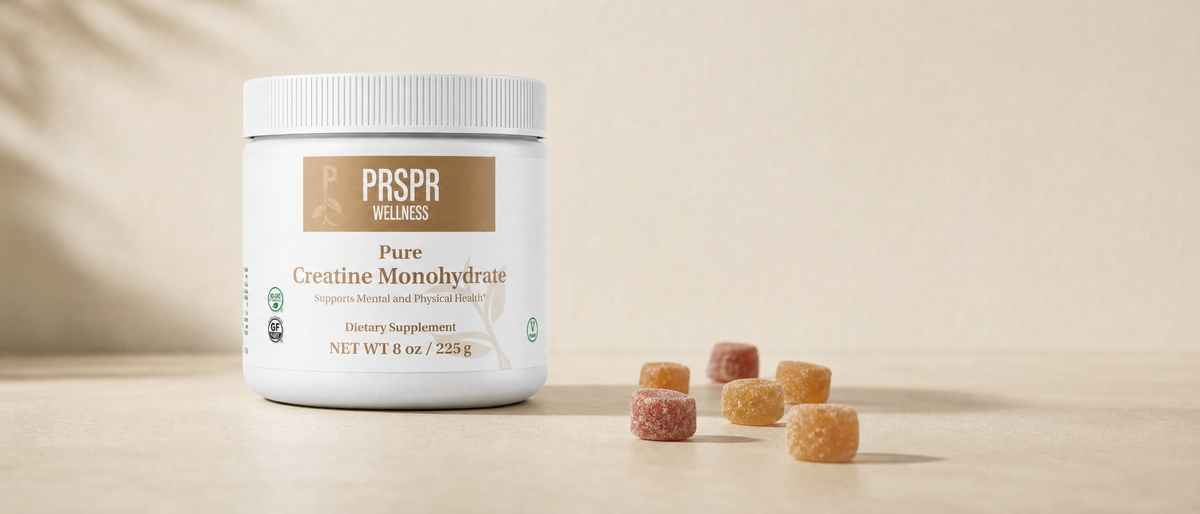
Creatine monohydrate gummies is holding a volume score of 46 this week. Creatine gummies sits at 45, creatine gummies for women at 40, and creatine powder at 55. Rising alongside them, does creatine make you gain weight is up about 60 percent.
Now look at the rest of that search result, because it is the most striking thing in the data. Almost the entire top of this cluster is brand names. Not ingredients, not questions, not comparisons. Names. In a normal supplement category the biggest terms are generic and the brands sit underneath. Here it is inverted, and the generic terms are the ones scraping along the bottom of the chart.
That inversion is the story. A brand-dominated search result is what a format looks like in its first few years, before the vocabulary settles. And underneath the marketing there is a genuinely interesting engineering problem that almost nobody writes about: getting a creatine serving into a gummy is hard, and the reason is arithmetic.
Start with the object. A gummy is a confection. Its structure is a gelling agent, gelatin or pectin, set in a syrup base of sugars, with acid, flavour and colour. That matrix is most of the mass of the finished piece, and it has to be, because it is what makes a gummy chewable rather than a brick.
Now add an active ingredient. Every gram of active material you put in is a gram that has to be accommodated by the matrix without wrecking texture, set, mouthfeel or shelf stability. There is a ceiling on how much of a finished gummy can be something other than the matrix, and in practice that ceiling is low.
Which is fine for ingredients measured in micrograms or small milligram amounts. A vitamin D gummy is carrying a vanishingly small quantity of the actual vitamin. Most vitamin gummies on the market are, in mass terms, almost entirely confection.
Creatine is not that kind of ingredient. It is used in gram quantities, not milligram quantities, which puts it in a completely different bracket from nearly everything else the gummy format has successfully absorbed. Run the arithmetic and the problem is immediate. If a serving is several grams of creatine, and a gummy can only be a modest fraction active by mass, then a serving is not one gummy. It is a handful. That is the whole engineering constraint, and it is why creatine monohydrate gummies is a search term with a real question behind it rather than a novelty.
There is a second constraint that gets less attention. Creatine monohydrate is a crystalline powder that is only modestly soluble in water and is known to be sensitive in acidic, wet conditions over time. A gummy is, by construction, an acidic, wet, sugar-rich environment that sits on a shelf for months. Those two facts do not obviously agree with each other, and the format has to solve that as well as the mass problem.
So when a scoop and a gummy sit side by side, what is the real comparison?
Not flavour, and not convenience, though those are what the packaging talks about. The comparison is amount per serving and how many units make it. A scoop is a single measured object that delivers a whole serving. A gummy is one piece of a serving, and the number of pieces is on the panel.
That means the only honest way to compare the two is to look at the total amount of creatine in a stated serving and at the count of units required to get there, and then to look at price on the same basis. This is the identical discipline required when comparing a capsule to a powder, which we set out in why a capsule count and a scoop size are not comparable numbers. A count is not a dose until you know what one unit contains.
The second thing to compare is what else is in the serving. A single-ingredient powder is creatine monohydrate and nothing else. A gummy is creatine monohydrate plus the entire confection matrix, which means sugars or sweeteners, gelling agent, acid, flavour and colour, in quantities that scale with the number of pieces. Take a serving as several gummies and you are also taking several gummies' worth of everything else. That is not a criticism, it is just the arithmetic, and it is on the panel if you look.
Creatine gummies for women, at 40, is a format search with an audience word attached to it. The format half is what this article is about. The audience half we have already dealt with separately, in the piece about a label that does not have a gender printed on it.
Back to the odd shape of the search result.
When a format is new, there is no settled generic vocabulary for it, so people search the way they first encountered it, which is by name. They saw a specific product, they remembered the name, they typed the name. Over time the generic term overtakes the brands as the category matures and the vocabulary stabilises. Coffee pods went through this. So did seltzer, and so did nearly every new consumer format before them.
Right now creatine gummies is at the very start of that curve, which is exactly what a brand-heavy result tells you. It also means the search results are, for the moment, a poor guide to the category, because you are being shown marketing rather than a field. The generic terms, creatine monohydrate gummies and creatine gummies, are the ones worth typing, and they are the ones sitting at 46 and 45 while the names sit near 100.
We do not sell creatine gummies and we are not going to pretend that is a moral position. It is a format judgement, and here it is plainly.
Creatine is used in gram amounts. Gummies are good at carrying micrograms and milligrams. Putting the two together means either a large number of pieces per serving or a serving that is small for the category, and both of those are worth knowing before you buy rather than after. If a gummy is genuinely the only version somebody will keep taking, then a format they will use beats a format they will not, and that is a real argument. We would just rather it were made with the panel in view.
What we object to is the format being sold as an upgrade when it is a trade-off. Every format in this aisle is a trade-off. The powder's trade-off is that it needs water, a scoop and thirty seconds. Say the trade-off out loud and let people choose. That is all we want from anyone selling any of it, ourselves included.
Our Pure Creatine Monohydrate is a single-ingredient dietary supplement made with creatine monohydrate, sold as a powder. Single-ingredient means the panel is short and the arithmetic above is easy to do on it. Those are composition facts from the live listing.
What we will add in our own voice is the quality story alone. It is made in a GMP-certified facility and third-party batch tested, so what is on the panel is what is in the tub. No guessing, no filler.
If the chemistry of the name is what interests you, what the second word on a creatine label means is the one to read next, and if timing rather than format is your question, the eight ways people ask when to take creatine covers that. Otherwise open the Pure Creatine Monohydrate page, read the panel, browse the rest of the muscle and joint collection, or take the build-your-stack quiz if you would rather start from a routine than from a format.
Answer all five questions to unlock a clear wellness plan made around your goal, schedule, preferred supplement format, and biggest roadblock.
Get clarity on what matters most right now.
See the product and routine connected to your goal.
Simple next steps you can use right away.
Pick the one you would fix first if you could.
This helps us make the guide easier to follow.
Consistency beats the “perfect” routine you never follow.
Be honest. We’re building something you’ll actually use.
Your guide will include one simple way around it.
Answer two more questions to unlock your product starting point, five-step plan, two-week routine, and one practical tip for your biggest roadblock.
Enter your details to open your five-step plan.
Verified PRSPR customer reviews
Expires when you close this page
*Your personal credit for completing the quiz. It's applied automatically at checkout on one-time purchases and expires when the timer runs out.
View full product detailsEverything in your plan, together — one add to cart.
Expires when you close this page
*Your personal credit for completing the quiz. It's applied automatically at checkout on one-time purchases and expires when the timer runs out.
View full product details Mind vocabulary
What is cognition? You have probably seen the word "cognitive" printed on a label, in a headline, or in a product name, and kept scrolling. It is o...
 Biology vocabulary
What is metabolism? You see the word on labels, in gym talk and in nutrition headlines, almost always used as if it were a single setting. Read eno...
 Sleep vocabulary
What are sleep cycles? You hear the phrase on podcasts, see it on sleep trackers, and read it in articles that assume you already know what it mean...