
◎
Get clear
Get clarity on what matters most right now.

Black maca root is holding a volume score of 18 this week. Black maca sits at 17, best maca root at 16, maca powder at 17, and black maca benefits at 13. Five terms, all clustered close together, and three of them are about a colour.
That is unusual. Most root supplements are searched by name, by format or by benefit. Maca gets searched by colour, the way you would search for a variety of apple or a grade of olive oil. Somebody typing black maca root already knows what maca is. What they want to know is why the bag in front of them says black when the one next to it says red.
So that is the subject here. What the colours are, where they come from, and what maca powder means as a format choice next to a capsule. Nothing in this article says a colour does anything, because that is not a statement a company selling maca should be making about its own ingredient.
Maca is Lepidium meyenii, a plant in the brassica family, which makes it a relative of turnip, radish, cabbage and mustard. It is grown high in the Peruvian Andes, on plateaus above the tree line where very little else is farmed, and it has been cultivated there for a very long time. The part harvested and dried is the hypocotyl, the swollen storage organ at the base of the stem where the plant keeps its reserves. In everyday language everyone calls it a root, and that is close enough to be useful, though botanically it sits somewhere between a root and a stem.
The colours are real and they are natural. A maca field does not produce one uniform crop. It produces hypocotyls in a range of shades running from cream and pale yellow through to purple, grey and near black, and the range appears within a single harvest rather than from separate farms or separate breeding programmes. Growers sort them after lifting.
Yellow, or cream, is by a wide margin the most common. Red and purple sit in the middle of the range. Black is the least common of the three commercial groupings. That scarcity is the practical reason black maca root and black maca show up as their own search terms while nobody types yellow maca root. The colour that is hardest to find is the colour that gets a name on the front of the bag.
There is one more step between the field and the bag that explains why maca reaches you as a powder in the first place. The harvested hypocotyls are traditionally dried before anything else happens to them, laid out in the open at altitude where the air is thin, cold at night and intensely sunny by day. That drying is what makes the material stable enough to store and to mill, and it is why maca has historically travelled as a dried root rather than a fresh vegetable. Everything downstream, whether it ends up loose in a bag or measured into a capsule, starts from the same dried and milled material.
A conventional maca product is made from the whole sorted harvest, which means it is predominantly the common pale material with whatever else came out of the ground alongside it. If a maker wants to sell a colour, somebody has to physically separate it, and that separation is manual work done on a sorting table at altitude.
That is the whole mechanism behind the label. A colour claim on a bag of maca is a sourcing statement about which fraction of the harvest went in. It is a supply chain fact, in the same family as single-origin on a coffee bag or single-estate on tea. It tells you something concrete about how the material was handled before it reached the mill.
What it is not is a description of an effect. The internet will tell you otherwise, at length, and best maca root is holding a score of 16 largely because of that. We are not going to join in. Which colour, if any, belongs in anyone's routine is a question for a qualified healthcare professional, not a blog run by a company that sells the stuff.
The other half of this cluster is format. Maca powder holds 17, which is close to the volume of the colour terms, and it reflects how the ingredient has traditionally travelled: dried, milled and sold loose, to be spooned into whatever you are already drinking.
The differences between loose powder and a capsule are practical rather than mysterious. Powder is measured by the person using it, usually with a spoon or a scoop, which means the amount varies with how you fill it. It has a flavour, which is distinctly malty and earthy and which people either enjoy or work around. It has to go into something, so it needs a drink or a bowl of food and thirty seconds of attention. It is also usually the cheaper way to buy a given weight of material.
A capsule is the same milled material with the measuring already done. The amount per capsule is printed on the panel, so the variable is how many capsules rather than how heaped the spoon was. There is no flavour to work around, and no drink required. What you give up is the ability to adjust the amount freely and, generally, some cost per gram, because somebody encapsulated it for you.
Neither of those is better. They are different objects for different habits, and the honest way to choose is to ask which one you would actually keep doing in eight weeks. We made the same argument about a different root when we wrote about beet root as a powder against a capsule, because the trade-off is the same one every time it comes up.
We like that maca is sold by colour, and we think most shoppers are being sold the colour badly.
Sorting a harvest by hand at fourteen thousand feet is genuinely interesting, and it is the kind of specific that most supplement packaging never offers. It deserves to be explained as what it is, which is agriculture. Instead it gets turned into a hierarchy, with black positioned as the premium tier and yellow as the ordinary one, and a set of implied outcomes attached to each. That framing is not coming from the field. It is coming from marketing.
Our position is simple. Ask what fraction of the crop is in the bag, because that is a real and checkable question. Do not ask a colour to promise you anything, and be a little suspicious of anyone who lets it.
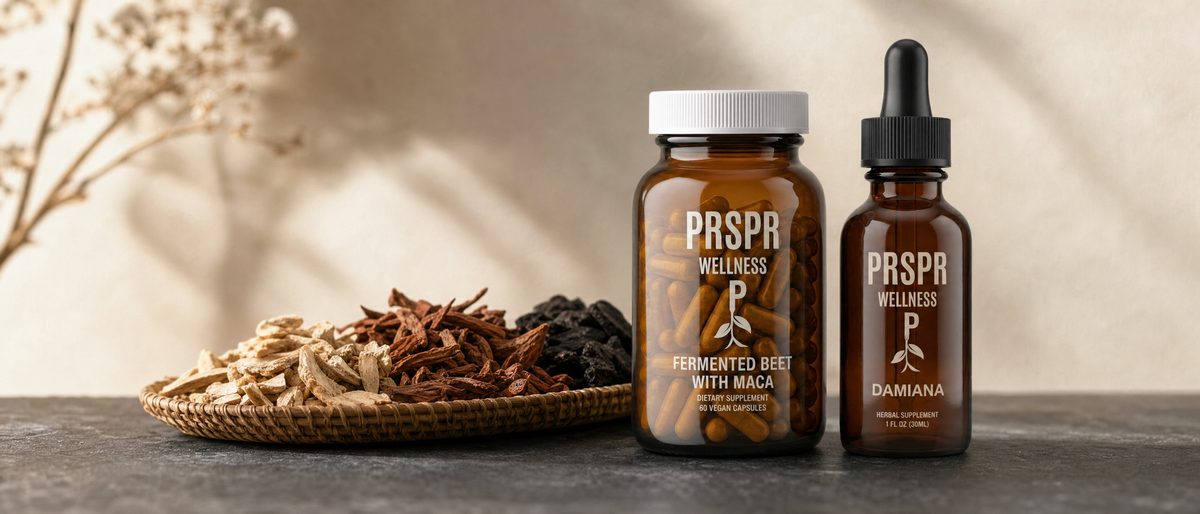
Our Love Bundle is three products sold together: Fermented Beet Root, Maca, and Damiana. The maca component arrives as a capsule rather than loose powder, which is the format decision described above, made once so it does not have to be made every morning. Those are composition facts, taken from the live listing.
What we will add in our own voice is the quality story and nothing beyond it. It is made in a GMP-certified facility and third-party batch tested, so what is on the panel is what is in the bottle. No guessing, no filler.
If the plants themselves are what interest you, our piece on what beetroot and maca are, and what fermented means is the one to read next, and the third component has its own story in damiana, a Mexican liqueur and a wine valley. Otherwise open the Love Bundle page and read the panel, browse the rest of the bundles collection, or take the build-your-stack quiz if you would rather start from a routine than from an ingredient.
Answer all five questions to unlock a clear wellness plan made around your goal, schedule, preferred supplement format, and biggest roadblock.
Get clarity on what matters most right now.
See the product and routine connected to your goal.
Simple next steps you can use right away.
Pick the one you would fix first if you could.
This helps us make the guide easier to follow.
Consistency beats the “perfect” routine you never follow.
Be honest. We’re building something you’ll actually use.
Your guide will include one simple way around it.
Answer two more questions to unlock your product starting point, five-step plan, two-week routine, and one practical tip for your biggest roadblock.
Enter your details to open your five-step plan.
Verified PRSPR customer reviews
Expires when you close this page
*Your personal credit for completing the quiz. It's applied automatically at checkout on one-time purchases and expires when the timer runs out.
View full product detailsEverything in your plan, together — one add to cart.
Expires when you close this page
*Your personal credit for completing the quiz. It's applied automatically at checkout on one-time purchases and expires when the timer runs out.
View full product details Mind vocabulary
What is cognition? You have probably seen the word "cognitive" printed on a label, in a headline, or in a product name, and kept scrolling. It is o...
 Biology vocabulary
What is metabolism? You see the word on labels, in gym talk and in nutrition headlines, almost always used as if it were a single setting. Read eno...
 Sleep vocabulary
What are sleep cycles? You hear the phrase on podcasts, see it on sleep trackers, and read it in articles that assume you already know what it mean...