
◎
Get clear
Get clarity on what matters most right now.

Ricinus communis is the plant behind every bottle of castor oil, and this week a lot of people went looking for it by name. They also went looking for the words printed on the bottles: cold-pressed, hexane-free, organic, food grade, Jamaican black. And a fast-rising query asked a question that sounds alarming next to a beauty aisle: what is ricin?
Those searches belong together. Each one is about where castor oil comes from and how it got into the bottle. This piece covers that vocabulary only: the plant, the processing words, and what a federal health agency says about ricin. Every fact names the reference it came from.
First, the search data. According to Google Trends, for US searches over the past seven days related to the seed term "castor oil," the fastest-rising related queries included "food grade castor oil" at +60%, "ricinus communis" at +50%, "what is ricin" at +50% and "cold pressed hexane free castor oil" at +40%. Among the top related queries, "black castor oil" scored 59, "jamaican castor oil" 38, "castor oil organic" 31 and "jamaican black castor oil" 30.
A quick note on reading those numbers. Top-query scores are relative within the seed term: 100 is the most-searched query in that set, so a 59 is searched more than a 30, but neither is a count of people. The rising percentages measure growth over the prior period, not volume. A query can climb fast from a small base. What the list shows is the shape of the curiosity, and right now it is pointed at the plant and the label.
The USDA PLANTS Database lists the castor plant as Ricinus communis L., with the common name "castorbean" and "castor bean" as an alternate. The database places the species in the genus Ricinus and in the family Euphorbiaceae, which it calls the spurge family.
That family detail is worth a second look. The plant is called a bean in everyday English, but the USDA classification files it with the spurges, under the order Euphorbiales. The "bean" in castor bean is a common name, not a family assignment.
The same USDA record describes the plant as both annual and perennial in duration, and lists four growth habits for it: forb/herb, shrub, subshrub and tree. The USDA also marks Ricinus communis as introduced, not native, in the lower 48 states, Hawaii, Puerto Rico and the US Virgin Islands.
Castor oil comes from the seed. The CDC's ricin fact sheet states it plainly: castor beans "are processed throughout the world to make castor oil." Everything else on a castor oil label, from cold-pressed to Jamaican black, is a description of what happened to those seeds between the field and the bottle.
This is the search that sounds out of place, so here is the answer exactly as the Centers for Disease Control and Prevention gives it. The CDC's ricin fact sheet opens with the definition: "Ricin is a poison found naturally in castor beans."
The same fact sheet connects ricin to oil production directly. It says that castor beans are processed around the world to make castor oil, and that "ricin is part of the waste 'mash' produced when castor oil is made." It also notes that ricin "can be made from the waste material left over from processing castor beans."
So the CDC's own framing places ricin in the leftover mash from processing the beans. That is the agency's description. The CDC fact sheet is the place to read further. If you have a personal question about exposure, that is a conversation for your clinician.
Most castor oil labels lead with how the oil was extracted. Two terms do most of the work.
The Codex Alimentarius Standard for Named Vegetable Oils (CODEX-STAN 210-1999), as published by the FAO, defines cold pressed oils as oils "obtained, without altering the oil, by mechanical procedures only, e.g. expelling or pressing, without the application of heat." The same standard says they may be purified only by washing, settling, filtering and centrifuging.
The standard draws a line next door, too. It defines virgin oils as obtained by mechanical procedures "and the application of heat only." In Codex language, then, the difference between virgin and cold pressed is heat. On a castor oil label, "cold-pressed" borrows that vocabulary, and it is the seller's description of its process.
Hexane is a solvent. PubChem, the chemistry database of the US National Library of Medicine, lists hexane (CID 8058) with the formula C6H14, and its records state that "the main use of hexane is as a solvent to extract edible oils from seed and vegetable crops," with soybeans, peanuts and corn given as examples.
That is what a "hexane-free" label is responding to. Pressing squeezes oil out mechanically. Solvent extraction dissolves oil out of the seed material instead. A label reading cold pressed hexane free castor oil is telling you two things about method: pressed without applied heat, and not extracted with that solvent. It is a statement about process, made by the seller.
In the US, "organic" is a regulated word for agricultural products. Under the USDA organic regulations at 7 CFR 205.301, a product labeled "100 percent organic" must contain 100 percent organically produced ingredients, and a product labeled "organic" must contain not less than 95 percent organically produced ingredients, both measured by weight or fluid volume, excluding water and salt. A "made with organic" claim requires at least 70 percent. We walk through those tiers, and the seal itself, in our guide to what the USDA organic seal means.
"Food grade" is a label term, and it is worth reading narrowly. When a bottle says food grade castor oil, read it as the seller's statement about the oil's grade, not a usage instruction. For reference, the federal text that names castor oil as a food additive is the FDA regulation at 21 CFR 172.876. It requires the additive to meet the specifications of the United States Pharmacopeia XX (1980) and lists two uses: a release and antisticking agent in hard candy production, and a component of protective coatings for vitamin and mineral tablets. This piece is about the word only.
Black castor oil, often sold as Jamaican black castor oil or simply Jamaican castor oil, is the dark bottle in the castor oil lineup. Sellers commonly describe it as made from castor beans that are roasted before the oil is extracted, and they tie the dark color to that step. We looked for a government standard or a peer-reviewed definition of the term and did not find one. Read it as a trade name for a process the seller describes, not a defined grade, and treat any method a label prints as the seller's own account.
Here is how we read a castor oil label. Most of the words on it are not about the oil's identity, which is the same plant every time. They are about process: how the seeds were handled, whether heat or a solvent was involved, how the farming was certified, which specification it was made to. Some of those words have a written definition behind them, like the USDA organic tiers or the FDA's food additive section. Some, like Jamaican black, are trade names with a story attached.
That distinction is the useful part. When a word is defined, you can look it up and know what it commits the seller to. When it is not, it tells you how the seller wants the product understood. Both are worth reading. Only one is a standard. We covered a related question, how castor oil fits among other carrier oils, in our piece on whether castor oil is a carrier oil.
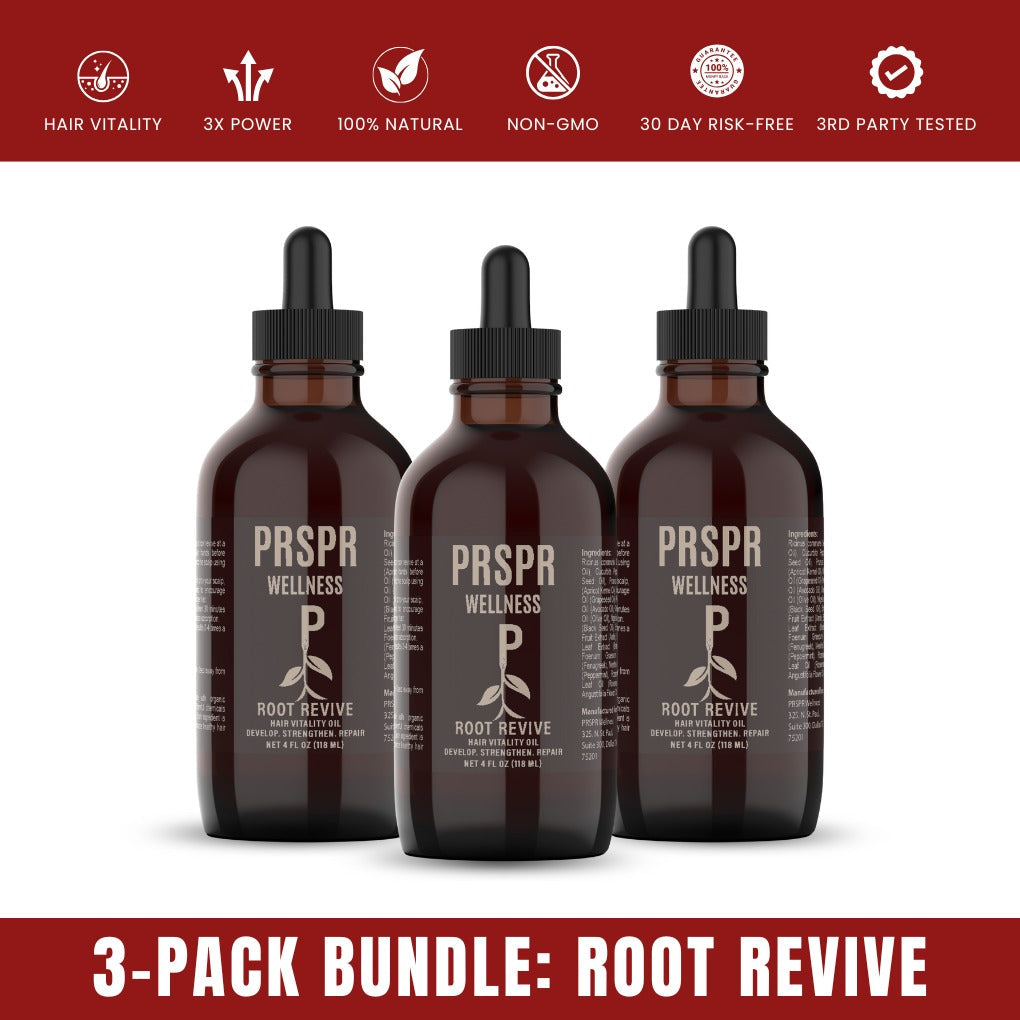
The Root Revive Hair Oil 3 Pack Bundle is three bottles of Root Revive, a topical oil applied to the scalp. The listing names 13 botanical oils and extracts, and among them it names castor oil, pumpkin seed oil and black seed oil. If pumpkin seed oil is the name you want to read up on, we have a separate explainer on pumpkin seed oil.
The bundle is listed at $99.99. Like everything we carry, it is made in a GMP-certified facility and third-party batch tested, so what's on the label is what's in the bottle. If you want to read the full ingredient listing yourself, see the Root Revive Hair Oil 3 Pack Bundle at PRSPR.
Ricinus communis is the botanical name of the castor plant. The USDA PLANTS Database lists it with the common name castorbean and places it in Euphorbiaceae, the spurge family.
According to the CDC, "Ricin is a poison found naturally in castor beans." The CDC's fact sheet adds that ricin is part of the waste mash produced when castor oil is made.
It describes method. The Codex standard defines cold pressed oils as obtained by mechanical procedures only, without applied heat, and PubChem lists hexane as a solvent mainly used to extract edible oils from seed crops, so "hexane-free" signals the oil was not extracted with it.
It is a label term, the seller's statement about grade. For reference, the FDA's food additive section for castor oil, 21 CFR 172.876, requires that additive to meet United States Pharmacopeia XX (1980) specifications.
Answer all five questions to unlock a clear wellness plan made around your goal, schedule, preferred supplement format, and biggest roadblock.
Get clarity on what matters most right now.
See the product and routine connected to your goal.
Simple next steps you can use right away.
Pick the one you would fix first if you could.
This helps us make the guide easier to follow.
Consistency beats the “perfect” routine you never follow.
Be honest. We’re building something you’ll actually use.
Your guide will include one simple way around it.
Answer two more questions to unlock your product starting point, five-step plan, two-week routine, and one practical tip for your biggest roadblock.
Enter your details to open your five-step plan.
Verified PRSPR customer reviews
Expires when you close this page
*Your personal credit for completing the quiz. It's applied automatically at checkout on one-time purchases and expires when the timer runs out.
View full product detailsEverything in your plan, together — one add to cart.
Expires when you close this page
*Your personal credit for completing the quiz. It's applied automatically at checkout on one-time purchases and expires when the timer runs out.
View full product details Mind vocabulary
What is cognition? You have probably seen the word "cognitive" printed on a label, in a headline, or in a product name, and kept scrolling. It is o...
 Biology vocabulary
What is metabolism? You see the word on labels, in gym talk and in nutrition headlines, almost always used as if it were a single setting. Read eno...
 Sleep vocabulary
What are sleep cycles? You hear the phrase on podcasts, see it on sleep trackers, and read it in articles that assume you already know what it mean...