
◎
Get clear
Get clarity on what matters most right now.

Copper chlorophyllin is sitting at the top of search right now with a volume score of 100. Right beside it, from a completely different corner of the internet, what is photosynthesis also carries a volume score of 100.
The rest of the cluster fills in the picture. Chlorophyll scores 73, sodium copper chlorophyllin 65, photosynthesis definition 17, and purpose of photosynthesis 5. Half of that list reads like a supplement label. The other half reads like a science class.
They belong together more than it looks. Chlorophyll is the green pigment at the center of photosynthesis, and chlorophyllin is a word built from it that shows up constantly on liquid green products. Two words, a couple of letters apart, and they do not name the same molecule. That is what this piece sorts out.
We are going to stay on the chemistry and the naming, because that is what these searches are actually asking and because it is answerable from the reference books. What any of this does in a person, and whether a green supplement suits you, are questions for a qualified healthcare professional. We are not answering those in either direction.
Start with the plant, because that is where the word chlorophyll comes from and where it does its job.
Here is a plain photosynthesis definition: it is the process green plants, algae and some bacteria use to capture energy from light and store it in sugar, built from water and carbon dioxide, with oxygen released along the way. Merriam-Webster traces the word to Greek roots meaning light and putting together, which is a fair summary of the whole thing. Light comes in. Something new gets assembled.
The purpose of photosynthesis, from the plant's point of view, is food and fuel. A plant cannot go looking for a meal. It stands still and makes its own, and the sugar it builds becomes the raw material for stems, roots, leaves and seeds. Nearly every food chain on land starts with that step, which is why the question turns up in every biology classroom and why what is photosynthesis ranks where it does.
That is as far into the textbook as we need to go. You do not need the balanced equation to read a label. You need to know which molecule catches the light.
Chlorophyll is that molecule. It is a pigment, meaning a compound that looks colored because of which parts of the light it takes in and which parts it sends back.
Merriam-Webster traces chlorophyll to Greek words for pale green and leaf. The name describes exactly what you see. Chlorophyll takes in red and blue light strongly and passes most of the green light back out, so green is the color that reaches your eye. That is why a mulberry leaf, a blade of grass and a spinach leaf are all the same basic shade.
Inside the leaf, chlorophyll sits in small structures called chloroplasts, packed into membranes and arranged like antennae. When light hits it, the energy gets handed along a chain of other molecules and eventually used to build sugar. Chlorophyll is the collector. The rest of the machinery does the building.
Structurally, Encyclopaedia Britannica describes chlorophyll as a ring-shaped molecule with a magnesium atom held at its center, attached to a long, oily tail. Keep those two features in mind: the magnesium at the center and the oily tail. Both matter for the next section.
There is also more than one chlorophyll. Land plants carry chlorophyll a and chlorophyll b, which differ slightly in structure and in the exact shades of light they collect. On a label you will almost never see that distinction. You will see the single word chlorophyll.
Now the word that tops the list.
Chlorophyllin is not simply chlorophyll spelled differently. It is the name for a family of compounds made by chemically modifying chlorophyll. The modification comes down to two changes, and they line up with the two features above.
That salt is where the longer name comes from. Sodium copper chlorophyllin tells you three things in order: sodium is part of the salt, copper is the metal at the center, and chlorophyllin is the modified pigment. Read left to right, the name is a short description of how the compound was made. You will also see it listed as a green coloring on food and cosmetic labels, where it is used for its color alone.
So the difference between chlorophyll and chlorophyllin is not cosmetic. One is the pigment as it exists in a leaf, magnesium center and oily tail intact. The other is a semi-synthetic derivative with a different metal and no tail, made to dissolve in water. The ending -in is the tell. If you remember nothing else from this article, remember that those two extra letters mark a different compound.
If they are different, why do so many people treat them as one?
Partly because they look almost identical on a screen. Partly because both are green, both come from plants at some point, and both land in the same aisle. And partly because product copy does not always help. Some labels say chlorophyll when the ingredient panel lists sodium copper chlorophyllin. Some say liquid chlorophyll as a product category and leave the specific form to the fine print.
That is the whole reason copper chlorophyllin and chlorophyll can both rank in the same search week. People are holding a bottle, seeing one word on the front and another on the back, and asking which is which. The answer is that the front of the bottle is often a category and the ingredient panel is where the form gets named.
We have written about the drink format before. Our piece on what is in the dropper when you add chlorophyll to water covers how people use liquid drops. This one is narrower: it is about the word on the panel.
Here is the practical version. When you pick up any liquid green product, look for three things.
That last point applies to us too. Our own Everfresh listing reads "chlorophyll derived from mulberry leaves." That is the wording, and we are not going to stretch it into a statement about which form is in the bottle. If you want to read about the leaf itself, our piece on the mulberry leaf behind the chlorophyll in this bottle covers the plant. For the flavoring on the same panel, our breakdown of peppermint oil versus peppermint extract explains why oil and extract are different words.
Chlorophyll and chlorophyllin should never be used as synonyms. Not on a front label, not in ad copy, not in a product name.
They are different compounds with different names, and the names already carry the information a shopper needs. Copper chlorophyllin tells you the metal. Sodium copper chlorophyllin tells you the salt. Chlorophyll tells you the pigment as it occurs in a leaf. The vocabulary is precise. The problem is that it gets flattened into one green word for marketing, and then people have to go searching to un-flatten it.
The standard we want is simple: print the exact form on the panel, name the source when you know it, and do not let the front of the bottle say something the back does not. Clear amounts, no guesswork. When a listing stops short of naming the form, the honest move is to say so, not to guess. That is what we have done with our own wording above.
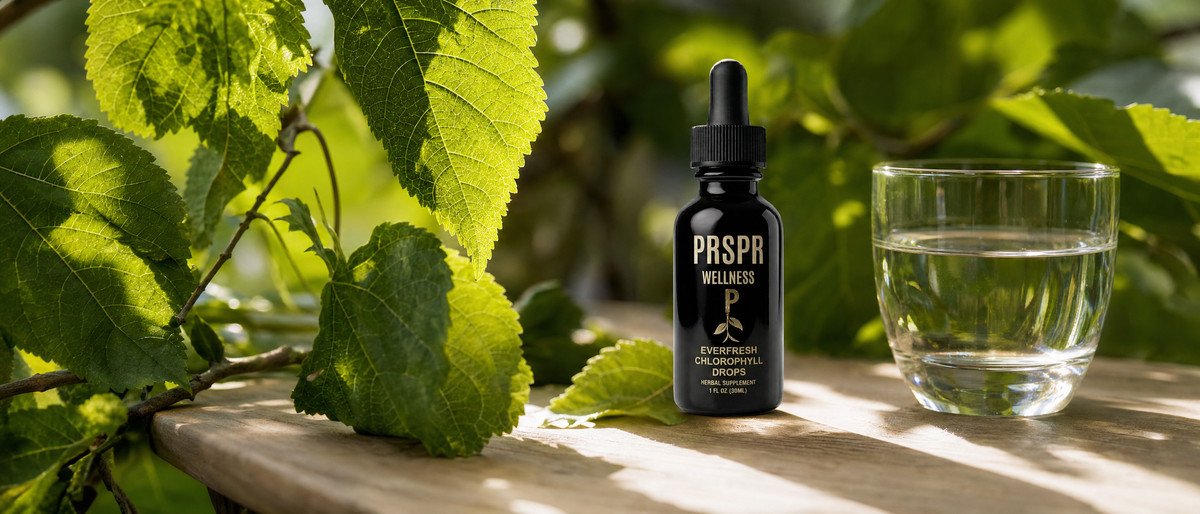
Everfresh Chlorophyll drops is a liquid dietary supplement made with chlorophyll derived from mulberry leaves and naturally flavored with peppermint oil. It is formulated for convenient daily use. Those sentences are the listing's own, and they are the whole of what we say the product is.
What we will add in our own voice is how it is made. Everfresh is manufactured in a GMP-certified facility and third-party batch tested, so what is on the label is what is in the bottle. No guessing, no filler, no cutting corners.
If the naming matters to you, go to the source. Open the Everfresh Chlorophyll drops page and read the listing exactly as it is written, browse the rest of the vitamins and supplements collection, or take the build-your-stack quiz. For anything about what a supplement does or whether it belongs in your routine, ask a qualified healthcare professional.
Answer all five questions to unlock a clear wellness plan made around your goal, schedule, preferred supplement format, and biggest roadblock.
Get clarity on what matters most right now.
See the product and routine connected to your goal.
Simple next steps you can use right away.
Pick the one you would fix first if you could.
This helps us make the guide easier to follow.
Consistency beats the “perfect” routine you never follow.
Be honest. We’re building something you’ll actually use.
Your guide will include one simple way around it.
Answer two more questions to unlock your product starting point, five-step plan, two-week routine, and one practical tip for your biggest roadblock.
Enter your details to open your five-step plan.
Verified PRSPR customer reviews
Expires when you close this page
*Your personal credit for completing the quiz. It's applied automatically at checkout on one-time purchases and expires when the timer runs out.
View full product detailsEverything in your plan, together — one add to cart.
Expires when you close this page
*Your personal credit for completing the quiz. It's applied automatically at checkout on one-time purchases and expires when the timer runs out.
View full product details Mind vocabulary
What is cognition? You have probably seen the word "cognitive" printed on a label, in a headline, or in a product name, and kept scrolling. It is o...
 Biology vocabulary
What is metabolism? You see the word on labels, in gym talk and in nutrition headlines, almost always used as if it were a single setting. Read eno...
 Sleep vocabulary
What are sleep cycles? You hear the phrase on podcasts, see it on sleep trackers, and read it in articles that assume you already know what it mean...