
◎
Get clear
Get clarity on what matters most right now.

Is peppermint extract the same as peppermint oil is up 100 percent in search this week. Around it, peppermint tea holds a volume score of 36, how to make peppermint oil sits at 17 and pure peppermint oil at 15. What does peppermint oil do sits at 18, and that one is a question for a qualified healthcare professional rather than for the company selling the bottle.
The rising question is the interesting one, because it is a vocabulary question. Oil, extract, tea: in a kitchen those words get used almost interchangeably, and the search data shows people have noticed they might not be.
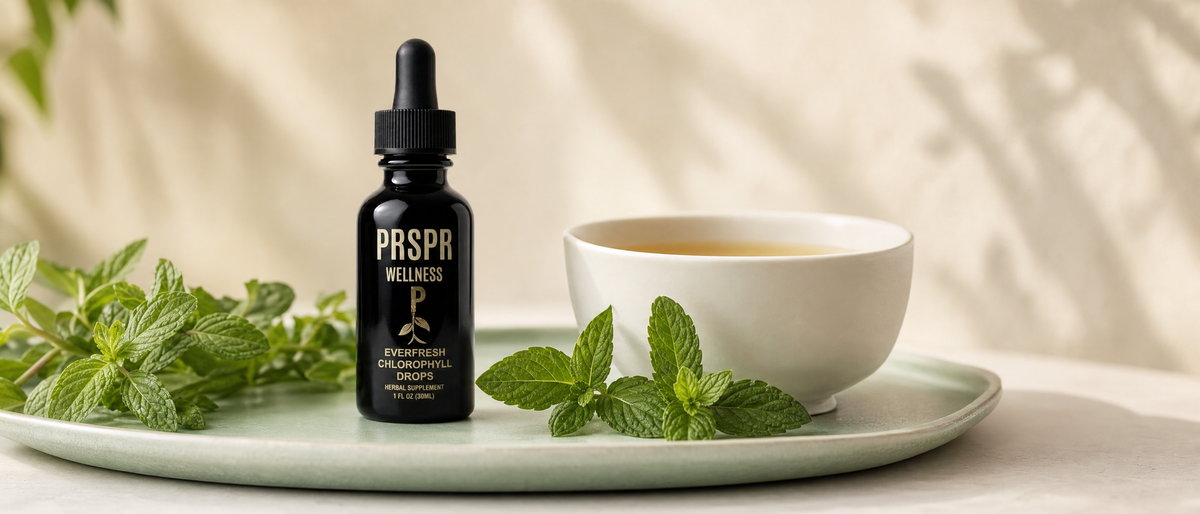
They are not. They name three different materials made by three different processes from one plant. And the difference matters to us for a plain reason: the live listing for our Everfresh chlorophyll drops says naturally flavored with peppermint oil. That is a flavoring line, and this article is about how to read it.
Peppermint is Mentha x piperita, a member of the mint family, Lamiaceae. The x in the name marks a hybrid. NC State Extension's plant toolbox describes peppermint as a cross between watermint, Mentha aquatica, and spearmint, Mentha spicata, and notes that it spreads by rhizomes and rarely sets seed. The same page notes that the leaves contain essential oils.
Peppermint oil has a formal definition, and it is a useful one. The United States Pharmacopeia and National Formulary, a compendium of published quality standards, defines Peppermint Oil as the volatile oil distilled with steam from the fresh overground parts of the flowering plant of Mentha piperita. The monograph adds that the oil is rectified by distillation, is not dementholized, and must meet minimum levels of menthol and of esters.
Three things in that sentence are worth holding onto:
Volatile oil is the Pharmacopeia's term; on a shop shelf the same kind of material is sold as an essential oil. Volatile means its aroma compounds evaporate readily, which is what lets steam carry them out of the plant.
No, and the federal food-labeling rules draw the line for you. The US Food and Drug Administration's definition of natural flavor, at 21 CFR 101.22, lists the essential oil, oleoresin, essence or extractive, protein hydrolysate and distillate as separate items. Essential oil and extractive sit side by side in that list as different things.
The reason is process. A distilled oil is what steam carries out of the plant, recovered once the vapor is cooled and the oil separates from the water. An extract is named for extraction: something has been dissolved out of plant material into a solvent, and the choice of solvent shapes what comes out.
That means a bottle labeled peppermint extract is a different product from a bottle labeled peppermint oil even when peppermint oil is one of its ingredients. The front says extract; the ingredient line on the back tells you what the peppermint was carried in and whether peppermint oil is there at all. Read the back before you assume the two bottles are interchangeable.
Whether either one belongs in a recipe, a drink or anywhere near your mouth, and in what amount, is a question for a qualified professional. What we can tell you is that the names are not synonyms.
How to make peppermint oil is a popular search, and the honest answer is that two different processes travel under that one phrase.
The first is steam distillation, the process in the Pharmacopeia definition. Steam is passed through the plant material. The volatile aroma compounds come out with the steam. The vapor is then cooled back into a liquid, and because the oil does not mix with water, it separates out and can be drawn off. The equipment is a still, and the product is an essential oil.
The second is infusion, and it is what many home instructions posted under the same name actually describe. Leaves are left to steep in a carrier oil, a fixed oil such as olive oil, so that some of the plant's aroma compounds dissolve into it. What comes out is an infused oil: mostly carrier oil, with character from the peppermint. We covered the same distinction for a different herb in the DIY rosemary infusion versus a formulated blend.
Both processes are legitimate. They simply do not make the same thing, and a jar of leaves in oil is not a homemade version of the distilled oil in the Pharmacopeia definition. Neither description here is an instruction to make anything to eat or drink.
Peppermint tea, the biggest term in this cluster at 36, is the simplest of the three. It is dried peppermint leaf steeped in hot water. It is an herbal infusion rather than a distilled or extracted product.
Water pulls out what water can pull out. That is a different set of compounds from what steam distillation carries off, and a different set again from what a solvent or a carrier oil takes up. So one leaf can end up as three unrelated products: an essential oil, an extract and a cup of tea. We made the same argument about a different plant in the mulberry leaf behind our chlorophyll, where a leaf infusion and an industrial extract of the same leaf are two different materials.
Pure peppermint oil is a shopping phrase, and pure is not one of the terms in the Pharmacopeia definition. The definition works through plant, part and process. So when you read a label, the botanical name Mentha piperita and the words steam distilled tell you more than the adjective does.
A flavoring line is a different kind of statement again. The FDA's definition of natural flavor describes an ingredient whose significant function in food is flavoring rather than nutritional, and its labeling rules use the pattern of a natural characterizing flavor followed by the word flavored. When a finished product says naturally flavored with peppermint oil, it is telling you which ingredient carries the flavor and where that flavor came from.
That line describes that product. It says nothing about what a separate bottle of essential oil is for, and questions about taking any essential oil belong with a qualified healthcare professional.
We think flavoring lines deserve to be read as closely as ingredient lines, and they are easy to skip.
A label can say natural flavors and leave you guessing, or it can name the specific flavoring and the plant it came from. The second is a checkable statement. Naming peppermint oil points to a defined material with a plant, a part and a process behind it, which is more than an adjective on a front panel ever gives you.
And we think it is worth learning that oil, extract and tea are not three strengths of one thing. They are three processes. Once you see that, the aisle reads very differently.
Our Everfresh Liquid Chlorophyll is a liquid dietary supplement made with chlorophyll derived from mulberry leaves and naturally flavored with peppermint oil. That is the composition as the live listing states it, and the flavoring half of that sentence is what this article has been reading.
What we add in our own voice is the quality story alone. It is made in a GMP-certified facility and third-party batch tested, so what is on the label is what is in the bottle.
If the green rather than the mint is your question, read what chlorophyll is and what is in the dropper. Otherwise open the Everfresh page and read the panel, browse the gut and digestion collection, or take the build-your-stack quiz.
Answer all five questions to unlock a clear wellness plan made around your goal, schedule, preferred supplement format, and biggest roadblock.
Get clarity on what matters most right now.
See the product and routine connected to your goal.
Simple next steps you can use right away.
Pick the one you would fix first if you could.
This helps us make the guide easier to follow.
Consistency beats the “perfect” routine you never follow.
Be honest. We’re building something you’ll actually use.
Your guide will include one simple way around it.
Answer two more questions to unlock your product starting point, five-step plan, two-week routine, and one practical tip for your biggest roadblock.
Enter your details to open your five-step plan.
Verified PRSPR customer reviews
Expires when you close this page
*Your personal credit for completing the quiz. It's applied automatically at checkout on one-time purchases and expires when the timer runs out.
View full product detailsEverything in your plan, together — one add to cart.
Expires when you close this page
*Your personal credit for completing the quiz. It's applied automatically at checkout on one-time purchases and expires when the timer runs out.
View full product details Mind vocabulary
What is cognition? You have probably seen the word "cognitive" printed on a label, in a headline, or in a product name, and kept scrolling. It is o...
 Biology vocabulary
What is metabolism? You see the word on labels, in gym talk and in nutrition headlines, almost always used as if it were a single setting. Read eno...
 Sleep vocabulary
What are sleep cycles? You hear the phrase on podcasts, see it on sleep trackers, and read it in articles that assume you already know what it mean...