
◎
Get clear
Get clarity on what matters most right now.

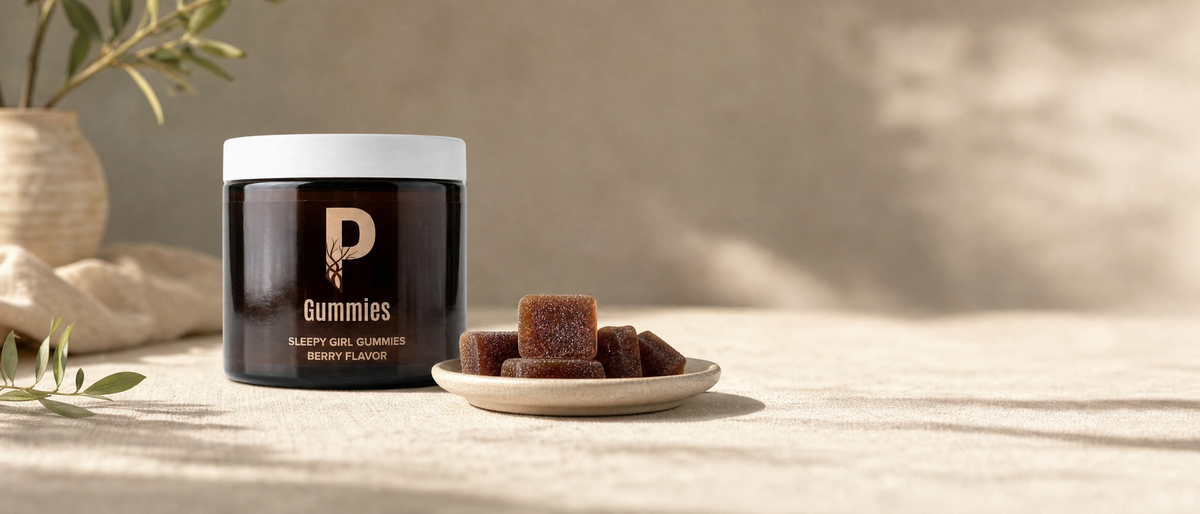
Walk the sleep aisle in any pharmacy and count how many products you are meant to chew. Then open a search bar and start typing. The phrase people reach for most in this category is not an ingredient at all. It is a shape.
"Gummies for sleep" is the highest-volume search in this corner of the shelf right now, sitting at 100 on the relative interest scale. "Best gummies for sleep" sits at 95. "Best sleep gummies" sits at 94, which is the same request with the words swapped around. "Gummies to sleep" sits at 53. Four of the six most-searched phrases here describe the delivery format rather than anything inside it.
That is a strange way to shop, once you notice it. Nobody types "tablets for headaches." People search the active ingredient and let the format sort itself out afterwards. The sleep aisle has inverted that, and it is worth understanding why, because it changes how you read every label on the shelf.
There is a practical reason the format phrase wins. The sleep aisle has become genuinely crowded, and the ingredient list on the average pack is now long enough that most people cannot hold it in their head while they compare. The format word is the one piece of information that survives that. It is fast, it is visual, and it narrows a wall of thirty products down to the eight you can chew. Search behaviour tends to follow whatever is easiest to type with confidence, and almost nobody feels confident typing an ingredient they only half remember from a label.
A gummy is a confection first and a supplement second. Strip one down and you find a gelling agent, a sweetener, water, an acid for tartness, flavour, colour, and then whatever the manufacturer has chosen to carry in it. The gelling agent is doing the structural work. Traditionally that is gelatin, which is why old-fashioned gummies have that specific springy chew. Pectin, drawn from fruit, does the same job with a softer and shorter bite and no animal input.
The format is older than the supplement industry that adopted it. Chewable medicinal lozenges built on gum arabic were sold by apothecaries throughout the nineteenth century, on a simple premise: a preparation that tastes like a sweet gets taken, and one that tastes like medicine gets left in the cupboard. European confectioners refined the gelatin version into a mass-market sweet in the 1920s. The pharmacy shelf borrowed it back in the middle of the twentieth century, when chewable children's vitamins turned "take your vitamin" from a negotiation into a treat.
The adult version arrived much later, and it arrived for the same reason it worked on children. A gummy removes the two small frictions that stop people finishing a bottle: swallowing something, and needing water to do it. Nothing about the format changes what is being delivered. It changes whether the bottle gets opened on day twenty.
The format also carries real trade-offs, and they are worth knowing before you commit to a jar. A gummy has to taste good enough to be worth chewing, which means something is sweetening it, and that something takes up room. It is also a physically small object, so the amount of any given ingredient that fits inside one is limited by geometry rather than by intent, which is why gummy servings are so often two or three pieces rather than one. And unlike a capsule, a gummy is sensitive to heat and humidity, which is why jars clump in a hot car and why the storage line on the back of the pack is not boilerplate.
None of that makes the format better or worse than a capsule. It makes it different, with a different set of things to check. A capsule asks you to swallow it. A gummy asks you to read the serving size twice.
Here is the split that explains the whole search list. "Gummies for sleep" is a format search. It tells you the shape of the thing, the aisle it sits in, and roughly when someone intends to take it. It tells you nothing whatsoever about the contents. "Magnesium gummies," at 64, is an ingredient search wearing a format word, and "magnesium for sleep," at 66, is a pure ingredient search. Those two phrases sit in the same result set as the format phrases, and they are asking a completely different question.
This matters at the shelf. A format word describes a vehicle, and any vehicle can carry almost anything. Two bottles can both honestly be called sleep gummies and share nothing beyond pectin and berry flavour. The category name on the front of the pack is a shelf location, not a formula, and the "best" queries stack on top of it. When 95 out of 100 searchers ask for the best gummies for sleep, they are asking a question the format cannot answer, because the format is not the variable.
The variable is on the back. The supplement facts panel is the only part of the label that tells you what you are actually buying, and it is the part the search phrase skips. If you take one habit from this piece, make it that one: read the front panel to find the aisle, then turn the pack over to find the product.
We are glad the format took off, and we are wary of what it did to the vocabulary.
Glad, because compliance is the quiet problem in this whole industry. A supplement someone abandons in week two is a waste of their money, whatever is in it. If a chewable square is the difference between a finished bottle and a forgotten one, that is a real gain and we are not going to be precious about it.
Wary, because a format word is doing work it was never built for. "Sleep gummies" has quietly become shorthand for a product type in people's heads, when it only ever described a manufacturing decision. That gap is exactly where a shopper stops checking. Somebody comparing four bottles by the word on the front is comparing packaging. The honest version of that comparison takes thirty seconds longer and happens on the back of the pack.
So use the format word to find the aisle. Do not let it finish the decision for you.
Our Sleepy Girl Gummies are a blend of botanicals and nutrients made for everyday use as part of a balanced lifestyle. The directions are exactly as plain as they look: take 1 to 2 gummies daily, or as directed by a qualified healthcare professional. That serving line is worth reading properly, because a range is a range. The panel lists 30 servings at two gummies per serving, and that is the arithmetic that decides what a bottle actually costs you per month.
They are manufactured in a GMP-certified facility and third-party batch tested. What is on the label is what is in the jar. No guessing, no filler, no cutting corners because a trend made demand spike. We hold that line on the chewable products specifically, because a format built for pleasantness is the easiest place in the industry to get quietly careless.
If you want the ingredient side of this conversation rather than the format side, we wrote about what CBN, melatonin and magnesium actually mean on a sleep-gummy label, and about how to read the magnesium forms behind those magnesium searches. If you are looking at more than one bottle at a time, the piece on how evening routines get assembled and named covers that vocabulary.
Not sure where a gummy fits, or whether it fits at all? Our wellness quiz walks you through it in a couple of minutes. And if you already know what you are after, the Sleepy Girl Gummies are here, alongside the rest of our vitamins and supplements.
Answer all five questions to unlock a clear wellness plan made around your goal, schedule, preferred supplement format, and biggest roadblock.
Get clarity on what matters most right now.
See the product and routine connected to your goal.
Simple next steps you can use right away.
Pick the one you would fix first if you could.
This helps us make the guide easier to follow.
Consistency beats the “perfect” routine you never follow.
Be honest. We’re building something you’ll actually use.
Your guide will include one simple way around it.
Answer two more questions to unlock your product starting point, five-step plan, two-week routine, and one practical tip for your biggest roadblock.
Enter your details to open your five-step plan.
Verified PRSPR customer reviews
Expires when you close this page
*Your personal credit for completing the quiz. It's applied automatically at checkout on one-time purchases and expires when the timer runs out.
View full product detailsEverything in your plan, together — one add to cart.
Expires when you close this page
*Your personal credit for completing the quiz. It's applied automatically at checkout on one-time purchases and expires when the timer runs out.
View full product details Electrolytes
Salt is having a comparison week. Searches for celtic sea salt vs himalayan pink salt are up about 70 percent, pink himalayan salt vs table salt is...
 Kids
KidsPick up a box of children's snacks and somewhere on the front there is a number with the letter g after it, next to the word fiber. It looks like o...
 Label Reading
It is printed on the front of a lot of mineral bottles and it is one of the least understood words in the supplement business. Chelated. Search int...