
◎
Get clear
Get clarity on what matters most right now.

Open any sleep thread right now and someone will tell you about their stack.
Not their supplement. Their stack. The word has quietly taken over how people talk about sleep support, and it changed what the question even is. Fewer people are asking which single bottle to buy. More are asking what goes in the pile on the nightstand, in what order, and what to call the whole arrangement.
That is a vocabulary problem before it is a shopping problem. Supplements for sleep used to be a single-bottle decision and the language has not caught up. So let us take the vocabulary apart.
Search interest over the past week backs the shift up. Three phrases climbed together: types of magnesium supplements, up around 60 percent, sleep supplements without melatonin, up around 40 percent, and glycine for sleep, also up around 40 percent. Sitting above all of them on raw volume is the plainest phrase of the lot, supplements for sleep, which holds the top of the category outright.
Read those four together and a pattern falls out. People are not searching for a product. They are searching for a category map. They want to know what the options are called, which ones get grouped together, and which words on one label mean the same thing as which words on another. Stack language is that same instinct. It is a word for a group, and it caught on because people started buying in groups.
"Stack" did not start in the sleep aisle. It came out of gym forums and nootropic message boards, where people who were combining several things at once needed a shorthand for the combination itself. A stack meant the set, not any one item in it. The word travelled because it filled a gap in ordinary language that nothing else filled.
Before it arrived, the honest word for the same thing was "routine." And routines built out of more than one item are not new in the slightest. A bath, then a tea, then a book, then the light off. Warm milk. A window cracked open. Cultures all over the world assembled their evenings out of several small steps rather than one big one, and nobody thought that was unusual enough to name.
What is genuinely new is the shopping pattern underneath. Buying three separate products at once, from one brand, meant to be used in the same hour of the same day, is a modern retail shape. It needed a modern retail word. "Stack" got the job.
So when you see the phrase now, translate it plainly. Someone is describing a set of things they use together at night. That is all the word promises. It says nothing about what is inside any of them.
This is the part the search data makes obvious. Once you buy in groups, you run straight into the fact that a single word on a shelf can cover a lot of different products.
Take the fastest riser in the group, types of magnesium supplements. That phrase exists because "magnesium" is not one item. Walk a shelf and you will read citrate, oxide, glycinate, malate and threonate, all under the same headline word. Someone typing that phrase is not asking for a recommendation. They are asking for a list, because they just realised the word they had been using was a category, not a product.
The same thing is happening with glycine for sleep. Glycine is an amino acid, and its name is sitting inside a word people have been reading on labels for years without noticing: glycinate. Once you spot that, the shelf stops looking like a wall of brand names and starts looking like a set of compound words you can actually break apart. That is a real skill, and it is the one this whole search cluster is quietly building.
Then there is sleep supplements without melatonin, which is stranger than it looks. It describes a product by what is not printed on the label. Shopping by absence is a demanding way to shop. It means the person doing it has already learned enough label vocabulary to know what they are looking to avoid, and is now filtering rather than browsing. You do not get to that stage on your first bottle.
And then there is the phrase that beats all of them on volume, supplements for sleep, which is about as plain as a search gets. That is worth noticing. The most-typed phrase in the whole category is still the one with no jargon in it at all. The specialist vocabulary is growing fast at the edges, but the front door is still three ordinary words. Most people arrive knowing nothing about forms or formats, and everything above is what they run into in the first ten minutes.
Which is also why order and timing come up constantly in these threads. A set of three products is three decisions about when, not one. A gummy and two capsules do not have to be taken in the same way or at the same minute, and each label carries its own directions. The set does not overwrite them.
One more phrase belongs in this cluster, and it is a question: can i take magnesium glycinate. We are not going to answer that one. Whether any supplement suits you is a conversation for a qualified healthcare professional who knows your history, not something a blog post gets to decide. We are pointing at it because it shows the same shift: people are asking about fit, not about hype.
We think the stack conversation is the healthiest thing to happen to this category in years, and we think most brands have read it wrong.
The reflex has been to treat "stack" as a marketing word, print it on a box and move on. That misses what people are actually doing with it. They are building a map. They want to know how the pieces are grouped, what the group is called, and where each piece sits in an evening. Nobody builds a map because they are impulsive. They build one because they intend to stick around.
So we would rather be plain about what a set is than clever about it. A stack is three things you bought together. What matters is whether you can read all three labels and say out loud what is in them. If you cannot, the word on the box is doing work that the label should be doing.
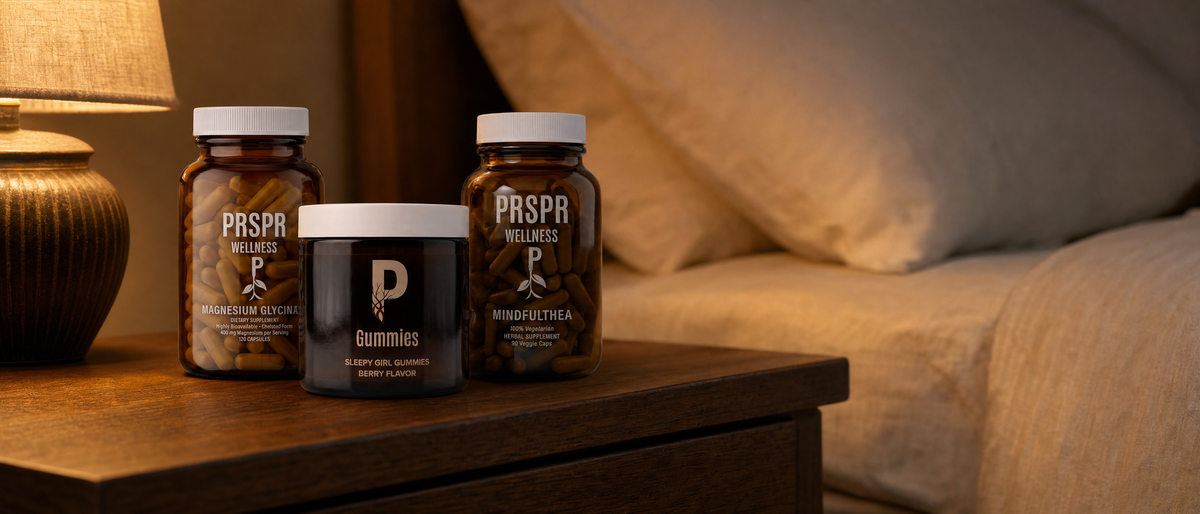
Our Sleep & Recovery Stack is a set in exactly the plain sense above. Three separate products, sold together: Sleepy Girl Gummies, our Magnesium Glycinate at 400 mg of magnesium per serving, and MindfulThea, which is made with L-theanine. One is a gummy in a jar. Two are capsules in amber glass. That is the whole assembly, and it is $115.97 as a set.
We manufacture in a GMP-certified facility and batch test through a third party, which is the only reason we are comfortable naming what is in each bottle as plainly as we just did. What is on the label is what is in the bottle.
If you want the individual pieces read out in more detail, we have written about each of them separately: how to read the magnesium forms on a label, where L-theanine came from, and what the words on a sleep gummy jar are telling you. We also wrote about what is actually inside this particular set when it launched.
Go read the Sleep & Recovery Stack label list for yourself, or browse the rest of our bundles and see how the sets are put together. If you would rather work backwards from your own routine, take the quiz and build the set yourself instead of buying one off the shelf.
Answer all five questions to unlock a clear wellness plan made around your goal, schedule, preferred supplement format, and biggest roadblock.
Get clarity on what matters most right now.
See the product and routine connected to your goal.
Simple next steps you can use right away.
Pick the one you would fix first if you could.
This helps us make the guide easier to follow.
Consistency beats the “perfect” routine you never follow.
Be honest. We’re building something you’ll actually use.
Your guide will include one simple way around it.
Answer two more questions to unlock your product starting point, five-step plan, two-week routine, and one practical tip for your biggest roadblock.
Enter your details to open your five-step plan.
Verified PRSPR customer reviews
Expires when you close this page
*Your personal credit for completing the quiz. It's applied automatically at checkout on one-time purchases and expires when the timer runs out.
View full product detailsEverything in your plan, together — one add to cart.
Expires when you close this page
*Your personal credit for completing the quiz. It's applied automatically at checkout on one-time purchases and expires when the timer runs out.
View full product details Electrolytes
Salt is having a comparison week. Searches for celtic sea salt vs himalayan pink salt are up about 70 percent, pink himalayan salt vs table salt is...
 Kids
KidsPick up a box of children's snacks and somewhere on the front there is a number with the letter g after it, next to the word fiber. It looks like o...
 Label Reading
It is printed on the front of a lot of mineral bottles and it is one of the least understood words in the supplement business. Chelated. Search int...