
◎
Get clear
Get clarity on what matters most right now.

Pull a single hair from your head and look at the end. There is often a tiny pale nub there, and most people assume that nub is the whole root. It is not. It is one small piece of a structure with a surprising number of named parts, and the question behind it is simple: what is a hair follicle, and what is actually down there?
Plenty of people are asking. On Google Trends this week (US, past seven days), searches related to "hair follicle" were led by "what is the hair follicle" at a relative volume score of 28 and "what is a hair follicle" at 25. "Hair root" scored 14, "hair shaft" 12 and "arrector pili" 10. "Sebaceous glands" and "hair follicle function" each scored 9, while "hair follicle structure" and "hair bulb" each scored 8, and "papilla" scored 7. Each score is relative within the "hair follicle" seed, so read them as a ranking of what people ask, not a head count.
So this piece is an anatomy tour. We start at the base of the follicle, work up through the root and the shaft, then look at the two structures attached to the side: an oil gland and a very small muscle. Along the way we trace where each name came from.
Cleveland Clinic defines a hair follicle as "a tube-like structure (pore) that surrounds the root and strand of a hair." TeachMeAnatomy, an anatomy reference for students, describes it as "a specialised epidermal structure that extends into the dermis of the skin and produces hair." Put simply, a follicle is a small pocket in the skin that holds the lower part of a hair.
The word itself describes that shape. The Online Etymology Dictionary traces "follicle" to the early 15th century, from the Latin folliculus, "a little bag," a diminutive of follis, which meant bellows or an inflated ball.
There are a lot of these bags. According to Cleveland Clinic, you are born with over 5 million hair follicles in your body and over one million on your head. Each one shares the same basic layout.
The easiest way to learn hair follicle structure is to start at the deepest point and climb toward the surface. Four names do most of the work: the bulb, the papilla, the root and the shaft.
At the bottom of the follicle, the tube widens into a rounded base. TeachMeAnatomy puts it this way: "The root expands distally into the hair bulb, which surrounds a vascular structure called the dermal papilla." The hair bulb is a cup, and something sits inside it.
This is also the part people think they see when they pull out a hair. Cleveland Clinic notes that if you pull out a strand, "you might notice a bulb or round ball (root) attached to the end of the hair strand." The follicle, the pocket it came out of, stays in the skin.
Inside the cup of the bulb sits the dermal papilla. TeachMeAnatomy describes it as a vascular structure at the base of the follicle that "provides the hair bulb with oxygen and nutrients."
The name is older than the anatomy. According to the Online Etymology Dictionary, "papilla" entered English in the 1690s from the Latin papilla, "nipple," a diminutive of papula, "swelling." By 1713 it had widened to mean any nipple-like bump, which is a fair description of how the papilla pokes up into the base of the bulb.
Wrapped around the papilla is the hair matrix. TeachMeAnatomy lists it as the zone "containing rapidly dividing matrix cells and pigment-producing melanocytes." Kenhub, another anatomy reference, notes that matrix keratinocytes "proliferate to form the growing hair shaft."
Here is the distinction most people blur. TeachMeAnatomy draws the line clearly: "The visible portion of the hair that emerges above the epidermis is the shaft, while the portion embedded within the skin is known as the root."
So the hair root is not a separate organ. It is simply the part of the hair that is still inside the follicle. The hair shaft is the same strand once it has left the skin: the part you brush, cut and color. Same hair, two names; the dividing line is the skin surface.
The shaft has its own layers. TeachMeAnatomy lists three: the medulla, "a central core of loosely arranged cells"; the cortex, "the thickest layer, rich in keratin filaments"; and the cuticle, a thin outer layer of overlapping keratin scales. If the word keratin caught your eye, our explainer on keratin as a protein and a salon menu item covers it, and the cuticle's overlapping scales are the subject of our piece on what hair porosity actually describes.
Between the hair root and the wall of the follicle sit two sleeves. TeachMeAnatomy describes an inner root sheath that guides the shaft upward before breaking down, and an outer root sheath, "a downward continuation of the epidermis." They are the lining of the tube.
A follicle does not work alone. Two structures sit against its side, and together they make up what anatomists call a unit. TeachMeAnatomy states: "Together, the hair follicle and sebaceous gland form the pilosebaceous unit."
Cleveland Clinic defines sebaceous glands as "an organ in your skin that make and secrete sebum," and notes that "the majority of your sebaceous glands have openings attached to your hair follicles." Sebum, per the same source, is made of fat molecules, listed as cholesterol, fatty acids, glycerides, squalene and wax.
Location is where it gets interesting. According to Cleveland Clinic, you have the most sebaceous glands on your face and scalp, and the only places you do not have them are the palms of your hands and the soles of your feet.
The name is a kitchen word. The Online Etymology Dictionary dates "sebaceous" to 1728 in the sense of "secreting sebum," from the Latin sebaceus, "of tallow," from sebum, "tallow, grease."
The last part is the one that shows up in goosebumps. The arrector pili is a very small muscle attached to the follicle. In a 2014 review in the International Journal of Trichology, Torkamani and colleagues describe it as "a smooth muscle" whose proximal end "surrounds the whole follicle in the bulge region," and write that it raises "the hair from the skin surface (piloerection) resulting in goose bumps." TeachMeAnatomy adds that it "attaches to the follicle at an oblique angle."
The name spells out the job. Wiktionary traces arrector to the Latin verb arrigō, "to raise, erect," and gives pilī as the genitive of pilus, "a hair." Arrector pili is, word for word, the raiser of the hair. Goosebumps are that name in action.
Everything above is structure: parts, positions and names. Hair follicles also move through phases over time, and that vocabulary (anagen, telogen and the rest) has its own guide in our piece on the words you meet while researching hair shedding.
The anatomy is the part that makes the rest readable. Once you know that the root is the hair still inside the follicle, that the papilla is the bump at the base of the bulb, and that sebaceous glands open into the follicle, most hair writing stops sounding like jargon. Stylist vocabulary works the same way, and our explainer on hair density versus thickness separates two words that describe the strands on your head, not the follicles under them.
It is the tube-like pocket in the skin that surrounds the root of a hair, per Cleveland Clinic's definition, with a bulb and dermal papilla at its base and a sebaceous gland and arrector pili muscle attached to its side.
In anatomy terms, the follicle is the structure the hair grows from. TeachMeAnatomy describes it as a structure that "produces hair," with the matrix at the base making the cells that form the strand and the root sheaths lining the channel it travels up.
From bottom to top: the hair bulb, the dermal papilla inside it, the hair matrix around the papilla, the hair root held inside the follicle, the inner and outer root sheaths, and the hair shaft above the skin. Attached to the side are sebaceous glands and the arrector pili muscle.
We think anatomy is the most underrated part of hair content. Most hair content jumps straight to routines and skips what the words mean. That is backwards. If you do not know the difference between a hair root and a hair shaft, every label and article after that is harder to follow.
So learn the map first. Bulb, papilla, root, shaft, gland, muscle. Six words, all with Latin behind them, all easy to check. What any product or ingredient might mean for your own hair is a question for your healthcare provider. The vocabulary, though, is yours to keep.
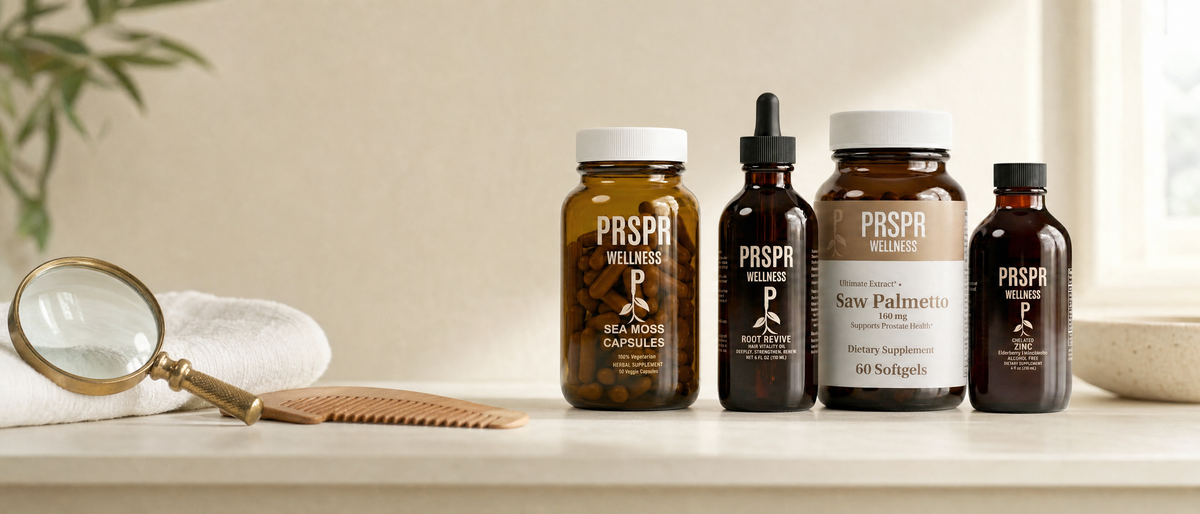
Our Hair Renewal Protocol - Hair Growth Essentials is a four-product bundle. It contains Root Revive Hair Growth Oil, which the listing describes as a botanical oil blend, alongside Saw Palmetto Capsules, Seamoss Capsules and Zinc + Elderberry.
Every product in the Hair Renewal Protocol is manufactured in a GMP-certified facility and third-party batch tested, so what's on the label is what's in the bottle.
You can read the full listing on the Hair Renewal Protocol product page, or see it next to our other multi-product sets in the Bundles collection. Not sure which pieces belong in your own routine? Take the PRSPR Wellness quiz and build a stack around what you already use.
Answer all five questions to unlock a clear wellness plan made around your goal, schedule, preferred supplement format, and biggest roadblock.
Get clarity on what matters most right now.
See the product and routine connected to your goal.
Simple next steps you can use right away.
Pick the one you would fix first if you could.
This helps us make the guide easier to follow.
Consistency beats the “perfect” routine you never follow.
Be honest. We’re building something you’ll actually use.
Your guide will include one simple way around it.
Answer two more questions to unlock your product starting point, five-step plan, two-week routine, and one practical tip for your biggest roadblock.
Enter your details to open your five-step plan.
Verified PRSPR customer reviews
Expires when you close this page
*Your personal credit for completing the quiz. It's applied automatically at checkout on one-time purchases and expires when the timer runs out.
View full product detailsEverything in your plan, together — one add to cart.
Expires when you close this page
*Your personal credit for completing the quiz. It's applied automatically at checkout on one-time purchases and expires when the timer runs out.
View full product details Mind vocabulary
What is cognition? You have probably seen the word "cognitive" printed on a label, in a headline, or in a product name, and kept scrolling. It is o...
 Biology vocabulary
What is metabolism? You see the word on labels, in gym talk and in nutrition headlines, almost always used as if it were a single setting. Read eno...
 Sleep vocabulary
What are sleep cycles? You hear the phrase on podcasts, see it on sleep trackers, and read it in articles that assume you already know what it mean...