
◎
Get clear
Get clarity on what matters most right now.

The layers of the skin have names most of us last heard in a biology class: epidermis, dermis and hypodermis. Each one is a distinct tissue, and the outermost one is split into its own stack of sublayers with Latin names. Below is what each layer is called, how many layers of skin anatomists count, what the strata of the epidermis are, what Langerhans cells are, and where hair follicles and oil glands sit. It is a vocabulary guide, written to be read in a few minutes.
Plenty of people are asking. According to Google Trends, for US searches over the past seven days related to the seed term "layers of skin," the rising related queries included "fat tissue that connects skin to muscles" at +400% and "what are langerhans cells?" at +200%. The top related queries included "layers of the skin" at 100, "the layers of the skin" at 99, "what are the layers of skin" at 36, "epidermis" at 28, "how many layers of skin" at 22, "dermis" at 20, "3 layers of the skin" at 11 and "hypodermis" at 8.
Those numbers are relative, not counts. A rising percentage shows how much a query grew compared with the previous period, so +400% means the query was searched far more than in the previous period, not that 400 people searched it. A top score is scaled against the most searched query in the set, which is set at 100. A score of 8 means a query was searched far less than the top one, not that eight people searched it.
This piece is anatomy vocabulary only. The main sources are the "Layers of the Skin" page in the National Cancer Institute's SEER Training Modules, section 5.1 "Layers of the Skin" in OpenStax Anatomy and Physiology 2e, the Cleveland Clinic's "Epidermis" article, and the Neue Deutsche Biographie entry on Paul Langerhans.
Ask how many layers of skin there are and the standard textbook answer is three. From the surface inward, the 3 layers of the skin are the epidermis, the dermis and the hypodermis. OpenStax says the skin "is in fact made of tissues that work together as a single structure."
| Layer | Other names | Position | Main tissue, per the sources |
|---|---|---|---|
| Epidermis | None in common use | Outermost | Keratinized, stratified squamous epithelium (OpenStax) |
| Dermis | None in common use | Middle | Two layers of connective tissue (OpenStax) |
| Hypodermis | Subcutis, subcutaneous layer, superficial fascia | Innermost | Fat and collagen (SEER); loose areolar connective tissue and adipose tissue (OpenStax) |
Thickness varies a great deal. The SEER page says the epidermis is only 0.05 mm thick on the eyelids and 1.5 mm thick on the palms and soles, and the Cleveland Clinic gives the same two figures. SEER calls the dermis the thickest of the three, at 1.5 to 4 mm, making up about 90 percent of the skin's thickness. It says the thickness of the hypodermis "varies throughout the body and from person to person."
If you came here from a crossword or a quiz, the fat tissue that connects skin to muscles is the hypodermis, also called the subcutaneous layer or subcutaneous tissue. OpenStax describes it as "a layer directly below the dermis" that serves to connect the skin to the underlying fascia, the fibrous tissue, of the bones and muscles. It names adipose tissue, the anatomical term for fat tissue, as one of its main components. SEER calls it the innermost layer of the skin, while OpenStax describes it as the layer directly below the dermis, which is why you will see it called both the third layer and the layer under the skin.
The epidermis is the outer layer of the layers of the skin, and it has sublayers of its own, each called a stratum (plural strata). The Cleveland Clinic lists five, from deepest to outermost. OpenStax adds a detail that changes the count: most of the body has "thin skin" with four strata, while "thick skin," found only on the palms and the soles of the feet, has a fifth.
Stratum basale. The deepest layer, also called the stratum germinativum. OpenStax calls it "a single layer of cells primarily made of basal cells." It also contains melanocytes, the cells that produce the pigment melanin, and Merkel cells, which OpenStax describes as touch-sensing cells.
Stratum spinosum. Named for its spiny look under a microscope, which OpenStax notes is partly an artifact of staining. It is eight to 10 layers of keratinocytes deep, per OpenStax. SEER also calls it the squamous cell layer and says it is the thickest layer of the epidermis.
Stratum granulosum. Three to five layers of flattened cells with a grainy appearance, per OpenStax.
Stratum lucidum. Present only in thick skin. OpenStax calls it "a smooth, seemingly translucent layer of the epidermis."
Stratum corneum. The most superficial layer. OpenStax puts it at 15 to 30 layers of dead keratinocytes; SEER gives 10 to 30 thin layers. OpenStax says the whole layer is replaced roughly every four weeks.
The order matters because cells move through it. OpenStax explains that new cells form in the stratum basale and existing cells "are pushed superficially" toward the surface, where they are eventually shed. The protein these cells fill up with is keratin; the Cleveland Clinic calls keratin "the main component of the epidermis."
Langerhans cells are immune cells that live inside the epidermis. OpenStax describes them as a type of dendritic cell, interspersed among the keratinocytes of the stratum spinosum, that functions as a macrophage, a cell that engulfs foreign particles and damaged cells. SEER places them in the same layer and says they attach to antigens and alert the immune system to their presence. In textbook shorthand, they are antigen-presenting immune cells of the epidermis.
The name comes from Paul Langerhans, a German pathologist. The Neue Deutsche Biographie (1982) gives his life as 1847 to 1888 and lists his 1868 paper "Über die Nerven der menschlichen Haut," on the nerves of human skin, written while he was a student. The same surname shows up in another body system: the biography also mentions the islets of Langerhans, groups of cells in the pancreas, which are unrelated to the skin cells despite the shared name.
So the short answer to "what are langerhans cells" is this: a named cell type of the epidermis, part of the immune system, sitting mostly in the stratum spinosum among the keratin-making cells.
The dermis sits beneath the epidermis. OpenStax says it is made of two layers of connective tissue. The upper papillary layer is loose, areolar connective tissue, and it sends finger-like projections called dermal papillae up into the epidermis. Underneath is the "much thicker reticular layer," composed of dense, irregular connective tissue.
Most of the structures people associate with skin are housed here. The SEER page lists the contents of the dermis as blood vessels, lymph vessels, hair follicles, sweat glands, sebaceous glands, nerve endings, and collagen and elastin.
Two of those terms come up constantly. A hair follicle, per SEER, is "a tube-shaped sheath that surrounds the part of the hair that is under the skin." Sebaceous glands are the oil glands, and SEER says they "are attached to hair follicles." SEER also notes that hair follicles pass down through the hypodermis, so a follicle can run through more than one layer.
We like this topic because the vocabulary is tidier than it first looks. There are three layers, the top one has four or five strata depending on where on the body you are, and the hypodermis answers that crossword clue about the fat tissue under the skin. Langerhans cells are one named cell type among several in the epidermis.
If the hair follicle caught your eye, our guide to hair follicle anatomy, part by part covers it in full. For the protein that fills the cells of the stratum corneum, read what keratin is and where it is found. And for how skin words turn up on store shelves, see our piece on "hair, skin and nails" as a shelf label.
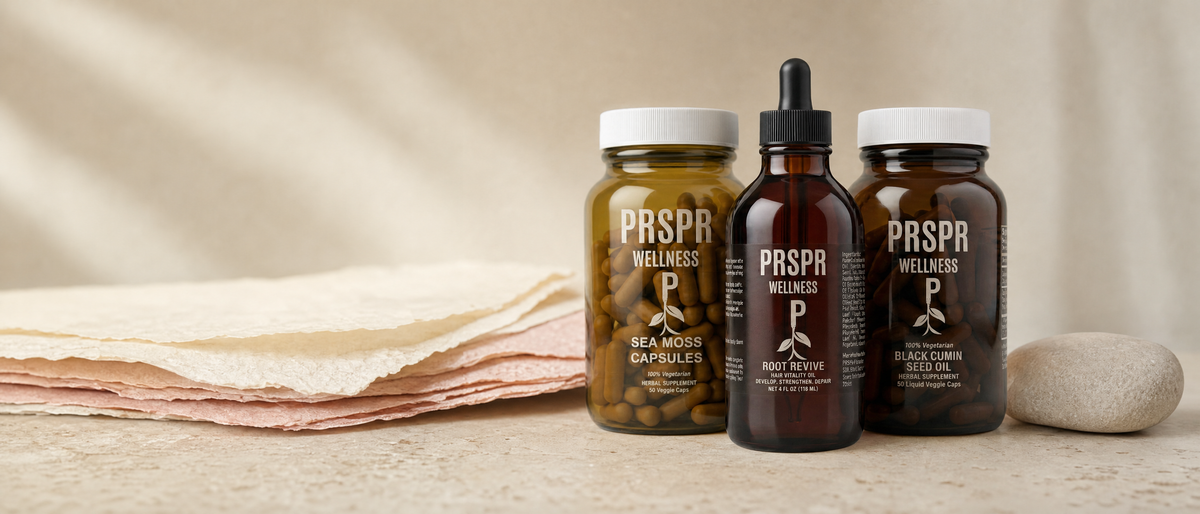
This piece connects to our Hair & Skin Stack through its name. The stack is three products: Root Revive, a topical hair oil; Seamoss Capsules, sea moss capsules; and Black Seed Oil, black seed oil capsules. This article is anatomy vocabulary for the words in that name, not a description of what the stack does.
Like everything we carry, it is made in a GMP-certified facility and third-party batch tested, so what's on the label is what's in the bottle. The stack is listed at $103.80.
To read each label, see the Hair & Skin Stack at PRSPR.
Three, in the standard textbook count: the epidermis, the dermis and the hypodermis. OpenStax notes the epidermis itself has four strata in thin skin and five in the thick skin of the palms and soles.
From the surface inward: epidermis, dermis, hypodermis. The hypodermis is also called the subcutis or subcutaneous layer, per the NCI SEER Training Modules.
Immune cells of the epidermis. OpenStax describes them as dendritic cells in the stratum spinosum that function as macrophages. They are named after Paul Langerhans, a 19th-century German pathologist.
The hypodermis, or subcutaneous layer. OpenStax says it connects the skin to the underlying fascia of the bones and muscles and contains adipose tissue.
Answer all five questions to unlock a clear wellness plan made around your goal, schedule, preferred supplement format, and biggest roadblock.
Get clarity on what matters most right now.
See the product and routine connected to your goal.
Simple next steps you can use right away.
Pick the one you would fix first if you could.
This helps us make the guide easier to follow.
Consistency beats the “perfect” routine you never follow.
Be honest. We’re building something you’ll actually use.
Your guide will include one simple way around it.
Answer two more questions to unlock your product starting point, five-step plan, two-week routine, and one practical tip for your biggest roadblock.
Enter your details to open your five-step plan.
Verified PRSPR customer reviews
Expires when you close this page
*Your personal credit for completing the quiz. It's applied automatically at checkout on one-time purchases and expires when the timer runs out.
View full product detailsEverything in your plan, together — one add to cart.
Expires when you close this page
*Your personal credit for completing the quiz. It's applied automatically at checkout on one-time purchases and expires when the timer runs out.
View full product details Botany
You pick up a fallen leaf on a walk, or you read a product label that says a botanical comes from a leaf, and you realize you do not have the words...
 Food Science
You are fine, you just ate, and then one specific food lands in your head and will not leave. Not food in general. That food. Researchers have a na...
 Fitness Terms
You have heard it from a coach, a gym sign-up form, a friend who just bought a set of dumbbells. Strength training. Resistance training. Hypertroph...