
◎
Get clear
Get clarity on what matters most right now.

The thermometer beeps and shows 97.9. Your first thought is that the "right" number is 98.6, so what does that mean? Before you read anything into the screen, it helps to ask a more basic question: what is body temperature, as a measurement? It is not one fixed number. It is a reading taken at a specific site, with a specific method, at a specific time of day, in a specific unit, and each of those choices changes what you see.
Plenty of people are asking the same thing. In Google Trends data for the US over the past 7 days, top related searches for the seed term "body temperature" were led by "what is body temperature" with a score of 100, followed by "normal body temperature" (54), "human body temperature" (25), "what is normal body temperature" (22), "basal body temperature" (15), "average body temperature" (13), "internal body temperature" (12), "body temperature range" (12), "body temperature fahrenheit" (11), and "core body temperature" (8). Top scores are relative interest scaled so the top term equals 100; they are not search counts. (A rising percentage, when one appears, shows growth compared with the prior period.) The pattern is clear: people want the definition, the famous number, and the units.
Body temperature is the heat level of the body, but where you take the reading matters. The editorial guide published by SNOMED International, the body that maintains a widely used clinical terminology, describes core body temperature as the temperature of the deep tissues and internal organs, including the brain. That is what most people mean by "internal body temperature." The same guide names the pulmonary artery as the reference site for measuring it, which is obviously not where a home thermometer goes.
So everyday readings come from places that are easier to reach. The SNOMED guide notes that peripheral sites, such as under the tongue or the armpit, are commonly used to estimate core temperature, and it treats body surface temperature (skin, for example) as its own separate measurement. Three words, three different things:
MedlinePlus, the consumer health site of the US National Library of Medicine, lists the common places a temperature is taken: the mouth, the rectum, the armpit, the ear, and the forehead. In clinical vocabulary those are oral, rectal, axillary, tympanic and temporal readings. MedlinePlus also gives rough offsets compared with an oral reading, while noting the exact relationship between methods is not clear, so treat these as general guidelines:
| Site | Clinical term | Typical offset vs oral, per MedlinePlus |
|---|---|---|
| Mouth | Oral | Reference point |
| Rectum | Rectal | About 0.5 to 1°F (0.3 to 0.6°C) higher |
| Ear | Tympanic | About 0.5 to 1°F (0.3 to 0.6°C) higher |
| Armpit | Axillary | Usually about 0.5 to 1°F (0.3 to 0.6°C) lower |
| Forehead scanner | Temporal | Usually about 0.5 to 1°F (0.3 to 0.6°C) lower |
MedlinePlus adds a few details about method. An oral probe goes under the tongue and is read after about 3 minutes or at the beep; an armpit reading takes about 5 minutes. It describes plastic forehead strips as the least accurate option, since they measure skin temperature. If the tympanic reading makes you curious about the anatomy involved, our guide to the ear canal covers that structure.
The takeaway is simple. A reading is only comparable to another reading taken the same way.
The famous figure traces to the German physician Carl Reinhold August Wunderlich, who published 37°C (98.6°F) as the normal human body temperature in a book in 1868, according to Stanford Medicine. A 2020 paper in the journal eLife adds that Wunderlich gathered millions of axillary readings from about 25,000 patients in Leipzig. Note the site: armpit, not mouth. That detail matters once you know that the site changes the number.
For more than a century, 98.6 was the number printed in textbooks and repeated at home. Then researchers started checking it.
In 1992, Philip Mackowiak, Steven Wasserman and Myron Levine published "A critical appraisal of 98.6 degrees F" in JAMA. Per the PubMed abstract, they studied 148 healthy men and women aged 18 to 40 and found a mean oral temperature of 36.8°C (98.2°F), not 98.6. They also reported that temperature moved through the day, with the low point around 6 AM and the high point around 4 to 6 PM, and an average swing of about 0.5°C (0.9°F). Their conclusion: 98.6°F as a concept should be abandoned.
In 2020, Myroslava Protsiv, Julie Parsonnet and colleagues at Stanford went further in eLife with "Decreasing human body temperature in the United States since the Industrial Revolution." They compared three groups measured in three eras:
After adjusting for age, height and weight, the authors report that mean body temperature fell by about 0.03°C per birth decade. Stanford Medicine's summary translates that into Fahrenheit: men born in the early to mid-1990s averaged 1.06°F lower than men born in the early 1800s, and women born in that same period averaged 0.58°F lower than women born in the 1890s. Stanford also notes the model confirmed temperature runs higher in younger people, in women, in larger bodies and later in the day, which is why the team did not name one new average for everyone.
So what is normal body temperature today? MedlinePlus still lists 98.6°F (37°C) as the generally accepted average, and notes that some studies put normal readings anywhere from 97°F (36.1°C) to 99°F (37.2°C). In other words, the honest answer to "what is normal body temperature" is a body temperature range, not a single point, and it differs by person, age and time of day.
"Basal" means base level. Cleveland Clinic defines basal body temperature as your body's temperature at complete rest, or your lowest temperature. It describes taking that reading in the morning before you get out of bed, with a basal thermometer, which it says is more sensitive than a standard one. That is the whole definition: a resting, baseline reading, measured with a particular tool at a particular moment.
Searches for "body temperature fahrenheit" are really unit questions. The National Institute of Standards and Technology (NIST) gives the exact conversion:
NIST explains the 1.8: one Celsius degree spans the same interval as 1.8 Fahrenheit degrees. Here are the figures from this article, converted and rounded to two decimals:
| Fahrenheit | Celsius | Where it appears above |
|---|---|---|
| 97.0°F | 36.11°C | Low end of the range MedlinePlus cites |
| 98.2°F | 36.78°C | Mean oral reading, Mackowiak et al., JAMA 1992 |
| 98.6°F | 37.00°C | Wunderlich's figure, 1868 |
| 99.0°F | 37.22°C | High end of the range MedlinePlus cites |
Converting units is the same skill as reading milligrams against grams on a label; our guide to mg to g and mcg conversions covers that side of it.
A temperature reading and a label line have the same anatomy. Each is a number, a unit, and a method behind it. On a label, "500 mg" means little until you know the serving size. On a thermometer, "97.9" means little until you know the site, the time of day, and whether the screen is set to Fahrenheit or Celsius. Wunderlich's 98.6 came from armpits in Leipzig. Mackowiak's 98.2 came from mouths in a modern study. Both are accurate descriptions of what was measured. They just measured different things.
Once you ask "measured how, where and in what unit," most of the confusion around the famous number goes away.
We like this topic because it rewards careful reading. The number everyone memorized has a birthplace, a method and a date, and later researchers checked it with bigger datasets and better tools. That is how a good number should be treated: with its context attached.
We hold labels to the same standard. A figure without its unit, its source and its method is only half a fact. Learn to ask for the other half, on a thermometer or on a panel, and you will read both more clearly.
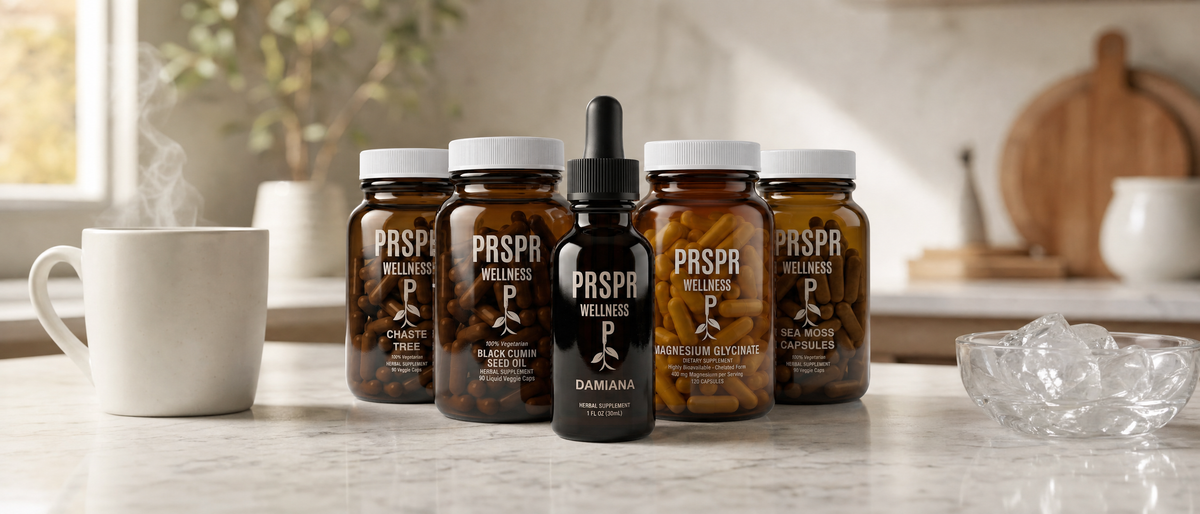
The Menopause & Perimenopause Bundle brings five products together in one order. Here is what the listing states:
It is made in a GMP-certified facility and third-party batch tested. You can see it with our other sets in Bundles.
See the Menopause & Perimenopause Bundle at PRSPR
It is a measurement of the body's heat level, taken at a specific site. SNOMED International's editorial guide describes core body temperature as the temperature of the deep tissues and internal organs; oral, rectal, ear and armpit readings are used to estimate it.
According to Stanford Medicine, the German physician Carl Wunderlich published 37°C (98.6°F) as normal in an 1868 book. A 2020 eLife paper notes his readings were taken in the armpit.
A 1992 JAMA study of 148 healthy adults found a mean oral temperature of 98.2°F (36.8°C). MedlinePlus lists 98.6°F as the generally accepted average and notes studies report normal readings from 97°F to 99°F.
Cleveland Clinic defines it as your body's temperature at complete rest, or your lowest temperature, typically measured in the morning before getting out of bed with a basal thermometer.
Answer all five questions to unlock a clear wellness plan made around your goal, schedule, preferred supplement format, and biggest roadblock.
Get clarity on what matters most right now.
See the product and routine connected to your goal.
Simple next steps you can use right away.
Pick the one you would fix first if you could.
This helps us make the guide easier to follow.
Consistency beats the “perfect” routine you never follow.
Be honest. We’re building something you’ll actually use.
Your guide will include one simple way around it.
Answer two more questions to unlock your product starting point, five-step plan, two-week routine, and one practical tip for your biggest roadblock.
Enter your details to open your five-step plan.
Verified PRSPR customer reviews
Expires when you close this page
*Your personal credit for completing the quiz. It's applied automatically at checkout on one-time purchases and expires when the timer runs out.
View full product detailsEverything in your plan, together — one add to cart.
Expires when you close this page
*Your personal credit for completing the quiz. It's applied automatically at checkout on one-time purchases and expires when the timer runs out.
View full product details Botany
You pick up a fallen leaf on a walk, or you read a product label that says a botanical comes from a leaf, and you realize you do not have the words...
 Food Science
You are fine, you just ate, and then one specific food lands in your head and will not leave. Not food in general. That food. Researchers have a na...
 Fitness Terms
You have heard it from a coach, a gym sign-up form, a friend who just bought a set of dumbbells. Strength training. Resistance training. Hypertroph...