
◎
Get clear
Get clarity on what matters most right now.

Rhodiola rosea root is up about 50 percent in search this week. Around it: rhodiola benefits maxed out at 100, what is rhodiola rosea at 43, rhodiola rosea reviews at 21, rhodiola rosea extract at 20. And rising faster than the root term, up about 140 percent, a phrase that does not look like a supplement search at all.
Rhodiola rosea changed my life.
That is a remarkable thing to find in a keyword list. People do not type magnesium glycinate changed my life, or vitamin d changed my life, at any volume worth measuring. They type what it is, what it does, how much. Somewhere in this one plant's search profile, a testimonial has become a query.
We are not going to repeat that sentiment, endorse it, or offer an anecdote of our own, because a company selling the ingredient is the last party that should be doing any of those things. What is worth examining is the gap it reveals: between how this plant is searched and what its label actually says.
Start with the words that appear on a panel, because they are unusually specific and almost nobody reads them.
Rhodiola rosea is a binomial, so it names a genus and a species. Rhodiola from the Greek for rose; rosea repeating the same idea in Latin. The plant is an arctic and alpine succulent, and the name is descriptive rather than poetic: the cut root is reported to smell faintly of roses, which is also where its common name roseroot comes from. We covered the naming of this plant and its two shelf-mates in three plants, three hard names, and there is no reason to repeat that here.
The word that matters for this article is the third one. Root.
That word is doing more work than it looks like, and it is the reason this plant shares shelf space with things it is otherwise unrelated to. We set out what root names as a botanical part, and why herbal shops group so many unrelated species under it, in why herbal shops sell so many things called root.
Rhodiola rosea root, the rising term, names a plant part, and the part is not incidental. This is a plant whose visible portion is a low rosette of fleshy leaves and yellow flowers, and whose substantial portion is underground. A thick, aromatic rhizome and root system is where a succulent growing on cold, thin, rocky ground keeps its reserves, and it is the part that has historically been dug, dried and used. A panel naming the root is telling you which of two very different parts of the same organism is in the bottle.
Then there is extract, at 20, which is a process word rather than a plant word. An extract is whatever came out of the material using a particular solvent under particular conditions, and two extracts of one root made differently are not the same substance. It is one of the least specific terms on any botanical label, which is exactly why it repays attention. Part and preparation, in that order, are most of what a botanical panel is able to tell you, and we made that argument in full in four ways to buy one plant.
Now the other half. Rank this cluster by what the person typing wants and a pattern appears that is not about botany at all.
Rhodiola benefits, at 100, is a benefit query. Rhodiola rosea reviews, at 21, is a social-proof query. Rhodiola rosea changed my life, the fastest riser, is a testimonial query. Between them those three are asking the same underlying thing: did this work for somebody, and was that somebody like me?
Compare that with how a mineral gets searched. Mineral searches are full of forms, amounts, comparisons and label words, because a mineral is a defined chemical entity and the questions people have about it are specification questions. Nobody asks a mineral for a testimonial.
The difference seems to be that botanicals are harder to evaluate on paper. A binomial and a plant part do not give a shopper anything to compare, the way a compound name and a number do. So the evaluation moves to other people. Reviews, forums, first-person accounts. A testimonial search is what evaluation looks like when the specification is not legible to the person reading it.
There is a second factor, which is that this plant carries a category label attached to a whole class of botanicals, and that label makes an implicit promise that a specification cannot verify. Once a promise is in the air and the panel cannot settle it, the only remaining evidence is somebody else's story. That is the mechanism, and it is worth seeing plainly, because it is exactly the mechanism that makes this cluster unreliable to read.
The practical answer is not to dismiss it. It is to notice what it can and cannot tell you.
A testimonial is a single observation about a single person, reported by that person, with no comparison and no control. That is not a criticism of the person. It is a description of the evidence, and it is the same limitation whether the story is enthusiastic or dismissive. A hundred of them stacked together is a hundred single observations, not a study.
What that means when you are shopping is that reviews are a good source for things reviews are actually good at. Did it arrive. Does the dropper work. Is the taste tolerable. Did the bottle leak. Those are checkable, repeatable, and exactly what a review is for. Rhodiola rosea reviews at 21 will answer all of them well.
What reviews cannot do is tell you whether something will suit you, and that question, the real one behind the testimonial search, is a question for a qualified healthcare professional who knows your history. Rhodiola rosea dosage, up about 110 percent, is the same question wearing a number, and it goes to the same place.
We think the testimonial search is the most human thing in this entire dataset, and also the least reliable.
Somebody typing that phrase is not being credulous. They are doing what a person sensibly does when the available specification is unreadable: looking for someone who has already been there. The failure is not theirs. It is that a panel reading root and extract does not give an ordinary shopper anything to hold on to, so the evaluation has nowhere to go but other people's stories.
Our position is that the fix is to make the panel readable rather than to supply better stories. Learn what the part means. Learn what extract means, and that it is vaguer than it looks. Ask what plant, what part, what preparation. Those three questions turn a botanical label from a name into information, and they work on every botanical you will ever pick up. We would rather hand you that than a testimonial, including our own.
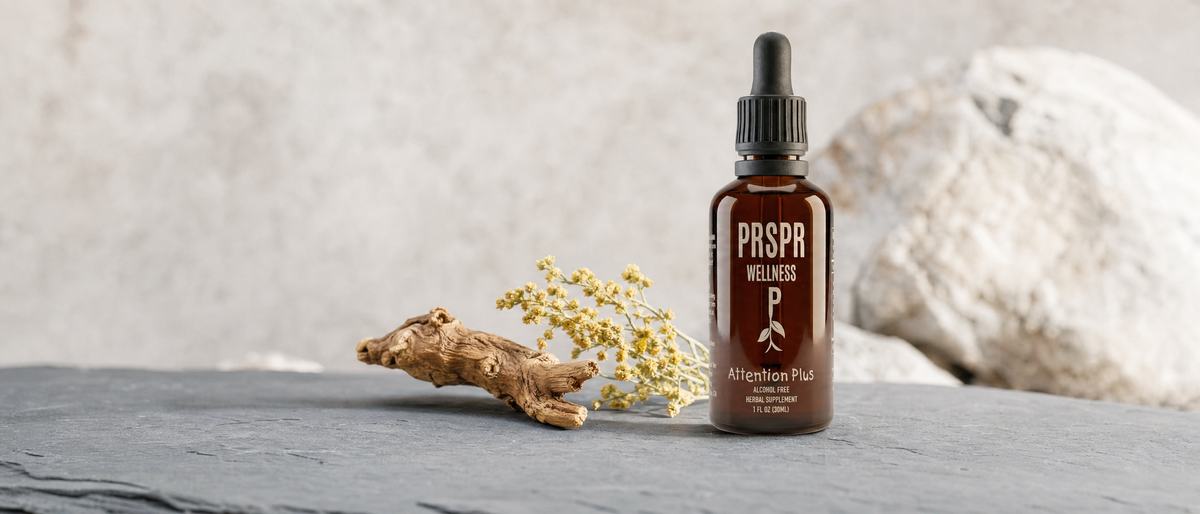
Our Attention Plus is a liquid botanical supplement made with a blend of Ginkgo, Gotu Kola, Rhodiola, Licorice Root, and Lobelia. Five named plants on one panel, which is why the naming and the parts matter more here than on a single-ingredient bottle. Those are composition facts from the live listing.
What we will add in our own voice is the quality story alone. It is made in a GMP-certified facility and third-party batch tested, so what is printed on the label is what is in the bottle. No guessing, no filler.
If the other names on that panel are what you came for, three plants, three hard names covers the first three and the long word on a licorice label covers the fourth. Otherwise open the Attention Plus page and read the panel plant by plant, browse the rest of the women's and children's health collection, or take the build-your-stack quiz.
Answer all five questions to unlock a clear wellness plan made around your goal, schedule, preferred supplement format, and biggest roadblock.
Get clarity on what matters most right now.
See the product and routine connected to your goal.
Simple next steps you can use right away.
Pick the one you would fix first if you could.
This helps us make the guide easier to follow.
Consistency beats the “perfect” routine you never follow.
Be honest. We’re building something you’ll actually use.
Your guide will include one simple way around it.
Answer two more questions to unlock your product starting point, five-step plan, two-week routine, and one practical tip for your biggest roadblock.
Enter your details to open your five-step plan.
Verified PRSPR customer reviews
Expires when you close this page
*Your personal credit for completing the quiz. It's applied automatically at checkout on one-time purchases and expires when the timer runs out.
View full product detailsEverything in your plan, together — one add to cart.
Expires when you close this page
*Your personal credit for completing the quiz. It's applied automatically at checkout on one-time purchases and expires when the timer runs out.
View full product details Mind vocabulary
What is cognition? You have probably seen the word "cognitive" printed on a label, in a headline, or in a product name, and kept scrolling. It is o...
 Biology vocabulary
What is metabolism? You see the word on labels, in gym talk and in nutrition headlines, almost always used as if it were a single setting. Read eno...
 Sleep vocabulary
What are sleep cycles? You hear the phrase on podcasts, see it on sleep trackers, and read it in articles that assume you already know what it mean...