
◎
Get clear
Get clarity on what matters most right now.

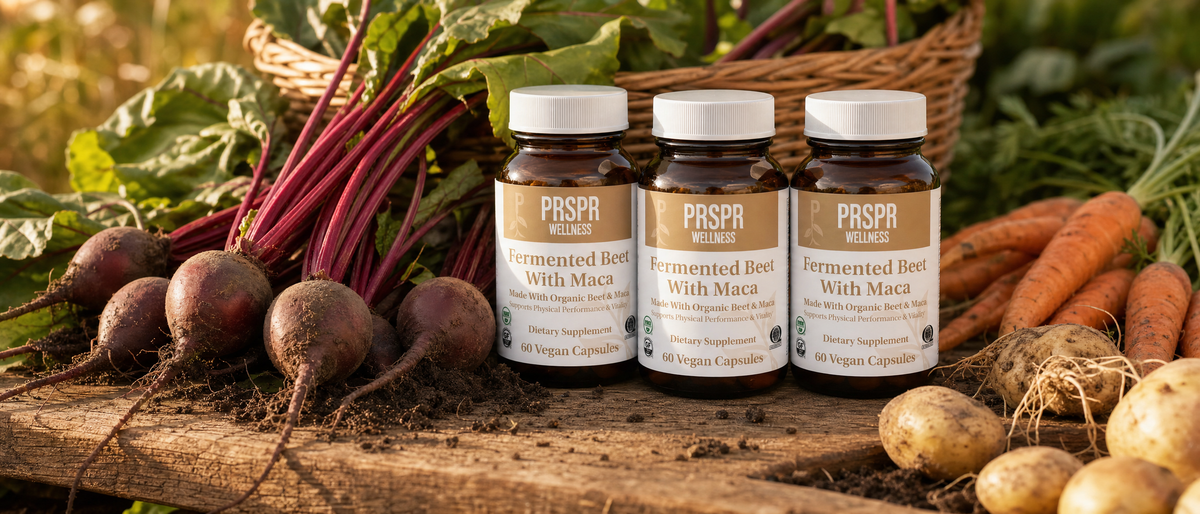
What are root vegetables, exactly? Ask a cook and you get a shopping list: carrots, beets, potatoes, turnips, the things that come out of the ground with soil still on them. Ask a botanist and you get a much shorter list, plus a few awkward corrections. The potato, it turns out, is not a root at all.
A lot of people are asking right now. On Google Trends this week (US, past seven days), "tuber vegetables" is a Breakout search and "what is a root vegetable" is up +50% as a rising query. Among the top searches, "what are root vegetables" carries a relative volume score of 62 out of 100, "root vegetables list" sits at 39, "list of root vegetables" at 16, "are potatoes root vegetables" at 11, "types of root vegetables" at 10 and "examples of root vegetables" at 6.
So this piece is a sorting exercise. We will split the underground aisle into the categories botanists use, answer the potato question directly, and then place two roots we care about, beet and maca, where they belong. It is botany and kitchen vocabulary, nothing more.
In the kitchen, "root vegetable" is a loose label for anything edible that grows underground. In botany, a root is one specific organ, and many of the things we call roots are actually stems or leaves that happen to live below the soil line.
Diane Wright Hirsch, a senior extension educator at UConn Extension, puts the gap plainly: what most of us know as root vegetables may not actually be root vegetables in a botanist's eyes. She also notes that, generally speaking, these crops are still called roots in agriculture and in cooking. Both habits are fine. They just answer different questions.
That gives us a clean answer to "what is a root vegetable" in two versions. The kitchen version: any edible plant part harvested from underground. The botanical version: a plant part that is actually a root, as opposed to a stem, a bulb or something in between.
When people search "types of root vegetables," the useful answer is not a list of names. It is a list of plant parts. Here are the five groups that show up in the underground aisle, with examples drawn from university extension sources.
A taproot is the main root of a plant, growing straight down. According to UConn Extension, taproots include beets, parsnips, carrots, turnips, radishes, rutabaga, jicama, salsify, celeriac and daikon radish. These are the true roots most people picture, and they are the core of any honest root vegetables list.
UConn Extension describes tuberous roots as modified lateral roots, meaning they grow from side roots rather than the main one. It names sweet potatoes and cassava as examples that look just like taproots. The University of Maryland Extension defines a tuberous root as a swollen root used for food storage. These are still true roots, which matters for the potato question below.
Here is where the kitchen and the botany part ways. UConn Extension states that corms, rhizomes and tubers, which are different from tuberous roots, "are really stem structures, not true roots." It describes tubers as formed from thickened underground stems and lists potatoes and some varieties of yams among them.
So when people search "tuber vegetables," they are searching for underground stems. The University of Arkansas Cooperative Extension explains that tubers are modified stems, which is why they have nodes and internodes, just like the stem above ground.
The word itself describes the shape. The Online Etymology Dictionary dates "tuber" in English to the 1660s as a botanical term and traces it to the Latin tuber, meaning "lump, bump, swelling."
The University of Maryland Extension defines a corm as a solid, vertical, underground stem with a bud on top, covered with dry leaf bases. UConn Extension lists Chinese water chestnuts and taro as corms you will find in the produce section.
A true bulb, in the University of Maryland Extension's definition, is a short, flattened stem bearing fleshy leaves that store food. UConn Extension calls garlic and shallots bulbs, not roots. A rhizome, by the same Maryland definition, is a thickened underground stem that grows horizontally. UConn Extension names ginger, ginseng, turmeric and lotus root as rhizomes.
Put the groups side by side and the underground aisle gets much easier to read. This list of root vegetables uses only the examples named by the extension sources above.
| Category | Plant part | Examples of root vegetables in this group |
|---|---|---|
| Taproot | True root | Beet, carrot, parsnip, turnip, radish, rutabaga, jicama, celeriac, daikon |
| Tuberous root | True root | Sweet potato, cassava |
| Tuber | Stem | Potato, some yams |
| Corm | Stem | Taro, Chinese water chestnut |
| Bulb | Stem with fleshy leaves | Garlic, shallot |
| Rhizome | Horizontal stem | Ginger, turmeric, lotus root |
Two of the six rows are true roots. The other four are stems in some form. That is the whole surprise of the category, in one table.
In the kitchen, yes. In botany, no. The potato is a tuber, and a tuber is a stem.
The evidence is on every potato you have ever peeled. The University of Arkansas Cooperative Extension explains that the eyes of a potato represent the nodes of the modified stem, which is why a potato cut into pieces can sprout new plants. Roots do not carry nodes like that. Stems do.
The sweet potato is the useful contrast. Despite the shared name, UConn Extension classes it as a tuberous root, a true root. So the two potatoes on the same shelf come from two different plant organs.
This is the bridge from the produce aisle to our own label. Our bundle is a three-pack of one capsule, and that capsule's listing names two plants: fermented beet root and maca. Both get called root vegetables. Here is where each one sits.
Beet is the easy one. UConn Extension lists beets first among the taproots, alongside carrots and parsnips. The beet is a true root in both the kitchen sense and the botanical sense. If you want the family tree of red, golden and sugar beets, our guide to beet varieties and sugar beets covers it.
Maca is Lepidium meyenii, a plant in the mustard family. In a 2012 review in Evidence-Based Complementary and Alternative Medicine, Gustavo F. Gonzales writes that maca grows exclusively in the central Andes between 4,000 and 4,500 meters of altitude, in Peru.
Its botanical part is more interesting than the beet's. The same review describes the edible part as a radish-like structure that constitutes the hypocotyl and the root of the plant. The glossary of the New York Botanical Garden's Steere Herbarium defines the hypocotyl as the part of the main axis of a seed embryo or young seedling found below the seed-leaf node. So by these sources, maca does not fit neatly in one row of our table: the piece that is harvested is part hypocotyl, part root, sold as one. Our explainer on black, red and yellow maca covers how the harvest is sorted by colour.
In cooking, any edible plant part harvested from underground; in botany, only the parts that are actually roots, such as taproots and tuberous roots.
In the kitchen they are grouped together. Botanically, tubers such as potatoes are underground stems, according to UConn Extension, so they sit outside the true-root group.
Carrots, beets, parsnips, turnips and radishes are taproots, and sweet potatoes and cassava are tuberous roots, per UConn Extension.
We like questions where the kitchen and the textbook disagree, and this is one of the best. Everyone knows what a root vegetable is until someone asks about the potato. Then the category turns out to be six categories wearing one name.
We think both vocabularies are worth keeping. "Root vegetable" is a perfectly good shopping word. "Taproot," "tuber," "corm," "bulb" and "rhizome" are better reading words, because they tell you which part of the plant you are actually holding.
That habit carries over to labels. When a label names a plant, the next useful word is the part. Our piece on why herbal shops sell so many things called root makes the same argument from the supplement shelf. Know the plant, then know the part.
Which brings us to our own bundle. The Fermented Beet Root & Maca 3 Pack Bundle is three bottles of PRSPR Fermented Beet & Maca Capsules, and the listing names its two plants: fermented beet root and maca. One is a textbook taproot. The other, by the source above, is part hypocotyl and part root from the high Andes.
If you want the plain-English version of what that label means, our piece on beets and maca in the same jar walks through it, and our guide to what a three-pack of the same capsule buys you covers the bundle format.
What we will add in our own voice is how it is made. Every product in the Fermented Beet Root & Maca 3 Pack Bundle is manufactured in a GMP-certified facility and third-party batch tested, so what's on the label is what's in the bottle.
To read the full listing for yourself, open the Fermented Beet Root & Maca 3 Pack Bundle product page, browse our vitamins and supplements collection, or take the build-your-stack quiz to see where it fits alongside everything else we carry. Questions about your own health belong with a qualified healthcare professional.
Answer all five questions to unlock a clear wellness plan made around your goal, schedule, preferred supplement format, and biggest roadblock.
Get clarity on what matters most right now.
See the product and routine connected to your goal.
Simple next steps you can use right away.
Pick the one you would fix first if you could.
This helps us make the guide easier to follow.
Consistency beats the “perfect” routine you never follow.
Be honest. We’re building something you’ll actually use.
Your guide will include one simple way around it.
Answer two more questions to unlock your product starting point, five-step plan, two-week routine, and one practical tip for your biggest roadblock.
Enter your details to open your five-step plan.
Verified PRSPR customer reviews
Expires when you close this page
*Your personal credit for completing the quiz. It's applied automatically at checkout on one-time purchases and expires when the timer runs out.
View full product detailsEverything in your plan, together — one add to cart.
Expires when you close this page
*Your personal credit for completing the quiz. It's applied automatically at checkout on one-time purchases and expires when the timer runs out.
View full product details Mind vocabulary
What is cognition? You have probably seen the word "cognitive" printed on a label, in a headline, or in a product name, and kept scrolling. It is o...
 Biology vocabulary
What is metabolism? You see the word on labels, in gym talk and in nutrition headlines, almost always used as if it were a single setting. Read eno...
 Sleep vocabulary
What are sleep cycles? You hear the phrase on podcasts, see it on sleep trackers, and read it in articles that assume you already know what it mean...