
◎
Get clear
Get clarity on what matters most right now.

Lobelia tincture is up 90 percent in search this week. The cluster around it does not look like it belongs to a single plant: blue lobelia carries a volume score of 100, great lobelia 49, lobelia plant 48, lobelia cardinalis 46, lobelia flower 41, what is lobelia 19, cardinal flower 16, lobelia inflata 7, and lobelia meaning 5.
Read that list again. A scarlet wildflower, a blue one, a trailing basket plant, two Latin binomials and a plain request for a definition, all filed under one word. The people typing these are not confused. They are looking at genuinely different plants, and every one of those plants is correctly called lobelia.
That is possible because of what kind of name the word is. We are going to stay on the naming, because naming is what these searches are actually asking about and because it is answerable from the botanical record. What any lobelia does in a body, and whether any preparation of it suits you, are questions for a qualified healthcare professional. We are not going to answer those in either direction.
Lobelia is a genus. That is a rank in the system biologists use to sort plants, and it sits above species. A genus gathers species that are closely related to each other; a species is the individual kind of plant you can point at in a garden bed.
Plants get a two-part scientific name built from those two ranks. The genus comes first and is capitalised. The specific epithet comes second and stays lowercase. Both are italicised. Lobelia cardinalis is one such name: Lobelia is the genus, cardinalis is the epithet, and the two words together identify one species and no other.
The genus belongs to the bellflower family, Campanulaceae. So "lobelia" on its own behaves rather like a surname. It tells you which group a plant belongs to. It does not tell you which member of that group you are holding, any more than a surname on an envelope tells you which person in the house will open it.
This is the answer to the plain search, what is lobelia, and it is also why the results for that search look so scattered. A genus name legitimately returns every species inside it.
Four species account for most of the cluster above. Each is a real lobelia plant, and each is a different one.
Something does unite them, and it is the flower. Across the genus the individual bloom is bilaterally symmetrical, with the corolla tube split down its upper side so the petals fall into a two-lipped shape: two narrow lobes standing up, three broader ones spread below. That shape is why a three-foot scarlet perennial and a blue plant in a garden-centre six-pack read as relatives once you look closely at a single bloom. Anyone searching lobelia plant or lobelia flower and getting back pictures that seem unrelated is comparing height, habit and colour, which differ sharply here. The family resemblance sits in the flower.
Notice what happens to the term blue lobelia once those are laid out. It fits Lobelia siphilitica, whose common name contains it. It also fits the blue-flowered forms of Lobelia erinus that fill garden centres. One shopper means a three-foot native perennial and another means a plant in a six-pack, and the phrase serves both of them without complaint. Lobelia flower has the same looseness for the same reason.
That is the practical cost of a shared genus name. It is a real name doing real work, and it still leaves the most basic question open.
Lobelia meaning is a small search term with a short answer. The genus is named for Matthias de l'Obel, a Flemish botanist whose name also appears in the Latinised form Lobelius. The name commemorates a person. It describes nothing about the plants themselves.
That is worth separating out, because the second half of a botanical name often does describe something. Cardinalis points at a colour. Inflata points at the shape of a ripening capsule. The genus half of the name carries none of that information here. It is a dedication, and dedications tell you about botanical history rather than about what is in front of you.
We have walked this ground from the opposite direction before. Our piece on vitex, chasteberry and chaste tree followed one plant through three names, and our piece on Serenoa repens and the saw palmetto did the same for another. Lobelia is the mirror image: one name spread across several plants.
Here is where this stops being a botany lesson and starts being a label-reading skill.
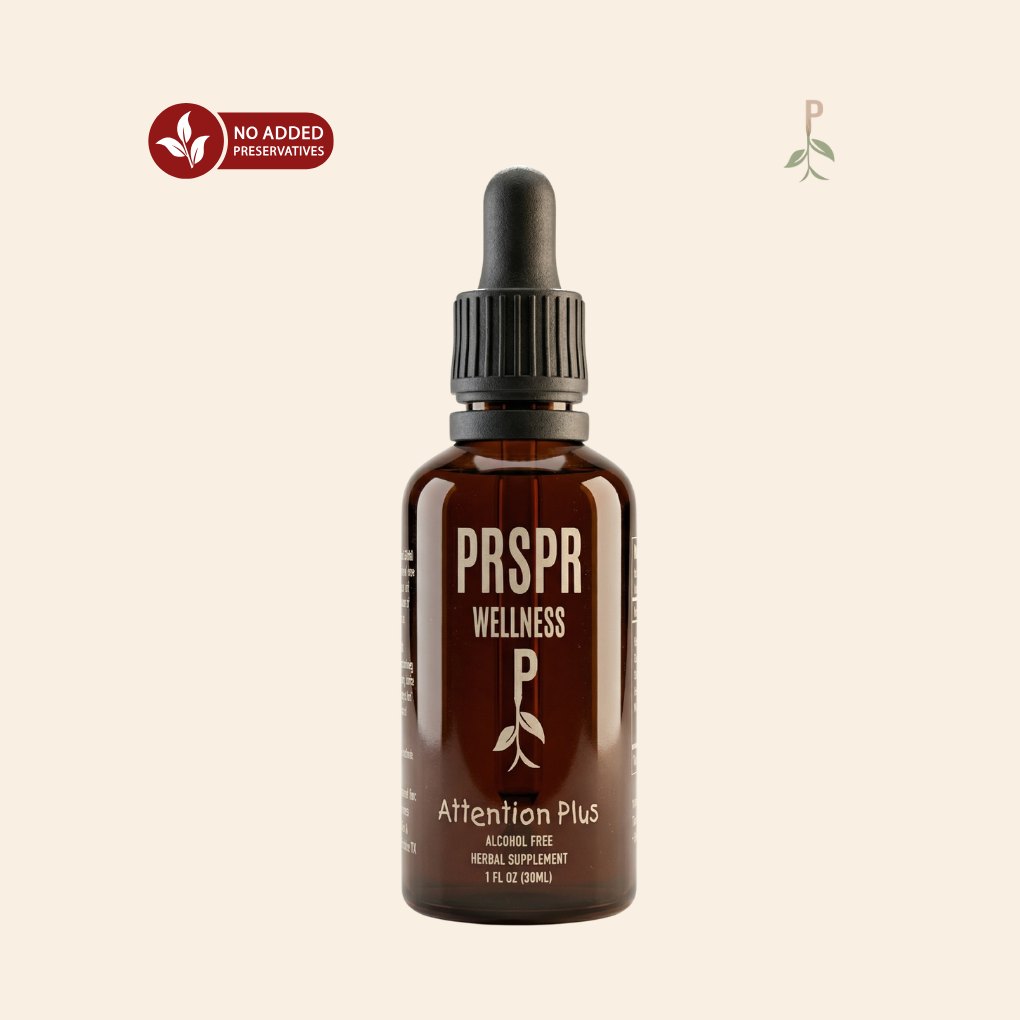
Our own Attention Plus listing names its botanicals as Ginkgo, Gotu Kola, Rhodiola, Licorice Root and Lobelia. That last word is a genus name, printed on its own, with no species beside it.
So read it at its actual size. It tells you the genus. It does not tell you the species, and nothing else on the listing supplies one. We are not going to supply one either, from inference or from what is common elsewhere, because the honest description of that line is that it names a genus and stops there.
The same reading applies to the other rising term on the list. A tincture is a preparation, not a plant: plant material extracted into a solvent, traditionally alcohol or a mix of alcohol and water. The word describes a method of making something. It is silent about which plant went in, which is why lobelia tincture, like the genus name itself, is a phrase that identifies less than it looks like it does. Our own listing describes Attention Plus as a liquid botanical supplement and does not call it a tincture, and those two descriptions are not interchangeable.
Two words, one on a label and one in a search box, and both of them name a category rather than a specific thing. Knowing which is which is most of the skill.
Botanical labels should print binomials. Genus and species, both words, every time.
It costs one extra word and it closes the exact gap this article has spent its length describing. A shopper who reads Lobelia on a panel has no way to reach the species from there, and a shopper who reads Lobelia inflata or Lobelia erinus can go and read about precisely that plant. The second shopper is better served, and nothing about the first situation is protecting anyone.
That applies to our own listing, which prints the genus. We said something close to this in our piece on the three hard plant names on this same product, and it is not more comfortable to write twice. It is still the right standard. We would rather name the gap on our own label than pretend the industry convention is good enough.
Attention Plus is a liquid botanical supplement made with a blend of Ginkgo, Gotu Kola, Rhodiola, Licorice Root and Lobelia, formulated for convenient daily use. That sentence is the listing's own, and it is the whole of what we say the product is.
What we will add in our own voice is how it is made. Attention Plus is manufactured in a GMP-certified facility and third-party batch tested, so what is on the label is what is in the bottle. No guessing, no filler, no cutting corners.
If the naming question matters to you, and for a botanical it usually should, take it to the source. Open the Attention Plus page and read the listing as it is written, browse the rest of the vitamins and supplements collection, or take the build-your-stack quiz. For anything about what a botanical does or whether it belongs in your routine, ask a qualified healthcare professional.
Answer all five questions to unlock a clear wellness plan made around your goal, schedule, preferred supplement format, and biggest roadblock.
Get clarity on what matters most right now.
See the product and routine connected to your goal.
Simple next steps you can use right away.
Pick the one you would fix first if you could.
This helps us make the guide easier to follow.
Consistency beats the “perfect” routine you never follow.
Be honest. We’re building something you’ll actually use.
Your guide will include one simple way around it.
Answer two more questions to unlock your product starting point, five-step plan, two-week routine, and one practical tip for your biggest roadblock.
Enter your details to open your five-step plan.
Verified PRSPR customer reviews
Expires when you close this page
*Your personal credit for completing the quiz. It's applied automatically at checkout on one-time purchases and expires when the timer runs out.
View full product detailsEverything in your plan, together — one add to cart.
Expires when you close this page
*Your personal credit for completing the quiz. It's applied automatically at checkout on one-time purchases and expires when the timer runs out.
View full product details Mind vocabulary
What is cognition? You have probably seen the word "cognitive" printed on a label, in a headline, or in a product name, and kept scrolling. It is o...
 Biology vocabulary
What is metabolism? You see the word on labels, in gym talk and in nutrition headlines, almost always used as if it were a single setting. Read eno...
 Sleep vocabulary
What are sleep cycles? You hear the phrase on podcasts, see it on sleep trackers, and read it in articles that assume you already know what it mean...