
◎
Get clear
Get clarity on what matters most right now.

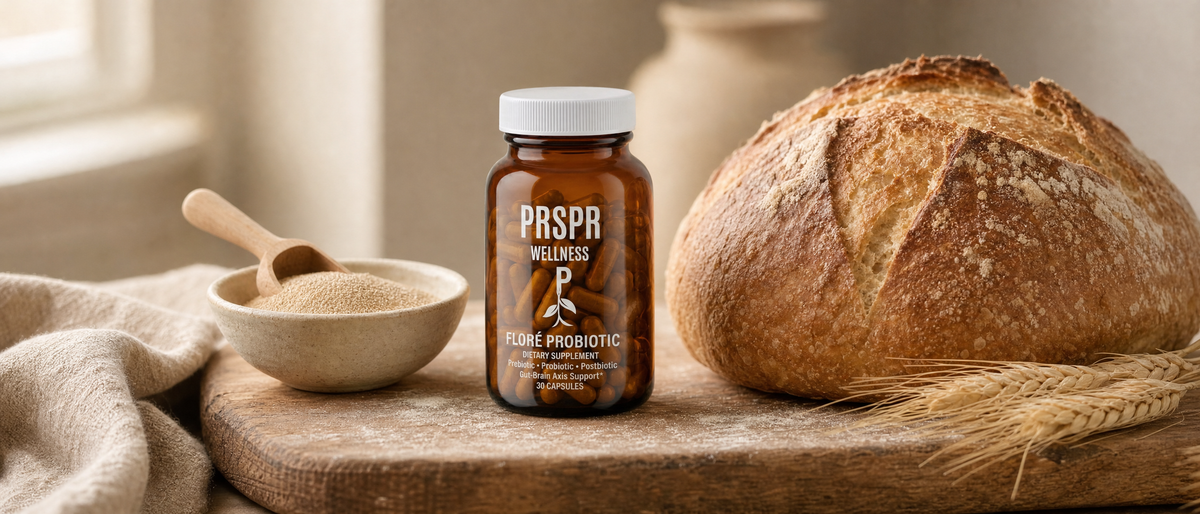
Open a packet of baking yeast and you are looking at dormant living cells. So what is yeast, exactly? It is not a powder, a chemical, or a kind of bacteria. Yeast is a single-celled fungus, a close cousin of molds and mushrooms, and one species of it is behind both risen bread and fermented drinks. The same word also turns up in a place you might not expect: the ingredient list on a probiotic bottle.
In Google Trends data for the US over the past 7 days, related searches for the seed term "yeast" included "what is yeast" with a top score of 17, along with yeast bread (14), dry yeast (8), active yeast (7), nutritional yeast (7), instant yeast (6), active dry yeast (5), and how to make yeast (4). These top scores are relative interest, scaled so the most popular term in a set equals 100; they are not search counts. Rising figures, when they appear, are growth rates rather than volumes, and none of these terms was listed as rising. Put together, people are asking two things at once: what the organism is, and which packet to buy.
According to the Saccharomyces Genome Database wiki page "What are yeast?", yeasts are classified as members of the Kingdom Fungi, the same kingdom as molds and mushrooms. Most of the yeasts people know are single-celled microorganisms.
The key biological distinction is the nucleus. The same SGD page explains that yeast are classified as eukaryotes because their genetic information is held inside a nucleus. Bacteria have no nucleus, which makes them prokaryotes.
SGD also notes that yeast typically multiplies asexually by budding: a small bud forms on a mother cell and enlarges into a daughter cell. The best-known species, Saccharomyces cerevisiae, is the one called baker's yeast.
Chemistry of Cooking by Sorangel Rodriguez-Velazquez (Chemistry LibreTexts, section 5.2, "Yeast") gives a compact kitchen definition that matches: yeast is a microscopic unicellular fungus that multiplies by budding and, under suitable conditions, causes fermentation.
A yeast bread is simply a bread leavened by yeast rather than by baking soda or baking powder. The rise comes from fermentation. Per the SGD wiki, during fermentation yeast converts glucose into carbon dioxide and ethanol. In dough, the carbon dioxide is the part that matters: SGD notes that the gas released by baker's yeast is what makes dough rise.
The ethanol is the same molecule that makes beer and wine alcoholic. SGD names top-fermenting ale yeast as S. cerevisiae, the same species as baker's yeast. The baker keeps the gas; the brewer keeps the alcohol.
If you want the wider picture of fermentation, including how alcoholic fermentation differs from lactic acid fermentation, our explainer on the fermentation process, step by step covers it in full.
Grocery-aisle confusion comes from one species sold in several forms. The differences come down to water content, handling, and whether the yeast is still alive.
Compressed (fresh) yeast. Per Chemistry of Cooking, section 5.2, water makes up 68% to 73% of compressed yeast, and it is sold in blocks.
Active dry yeast. The same source gives active dry yeast a moisture content of about 7% and notes that it is alive and should be refrigerated below 7°C (45°F) in a closed container. It is hydrated before use, for about 15 minutes in water at least four times its weight, at 42°C to 44°C (108°F to 112°F). That is the "active" in active yeast: the cells are living and wake up once they get water.
Instant dry yeast. Chemistry of Cooking lists instant yeast at about 5% moisture, packed in vacuum pouches, and says it can be added directly to dough. Both active dry and instant are dry yeast; the practical difference is whether you rehydrate it first.
Nutritional yeast. This one is not for baking. A University of Washington Nutritional Sciences handout (Laura Tobias, "Nutritional Yeast," 2013) describes nutritional yeast as a deactivated form of yeast, typically derived from strains of S. cerevisiae that are grown on cane or beet molasses, then harvested, washed, and dried. Because it is deactivated, the handout notes, it has no leavening ability. It is sold as flakes or a powder and is used as a seasoning.
Brewers yeast. Feedipedia, a feed-resources program run by INRAE, CIRAD, AFZ and the FAO (Heuzé and colleagues, 2018), describes brewers yeast as a by-product of breweries that use Saccharomyces cerevisiae. It is removed from the batch by centrifugation and washed free of beer, and the yeast is killed, for example by heat treatment at 80°C, before it is used as feed.
| Form | Living cells? | Moisture or form | Typical kitchen role |
|---|---|---|---|
| Compressed (fresh) yeast | Yes | 68% to 73% water, sold in blocks | Leavening bread |
| Active dry yeast | Yes | About 7% moisture, granules | Leavening, rehydrated in warm water first |
| Instant dry yeast | Yes | About 5% moisture, vacuum packed | Leavening, mixed straight into dough |
| Nutritional yeast | No, deactivated | Flakes or powder | Seasoning; cannot leaven |
| Brewers yeast (by-product) | No, killed after collection | Collected and washed after brewing | An ingredient, not a leavener |
People are searching "how to make yeast", and the honest biology answer is that you cannot make yeast from scratch any more than you can make a houseplant from scratch. Yeast comes from other yeast. What home bakers can do is collect wild yeast that is already around them, and that is what a sourdough starter is.
Colorado State University Extension's "Sourdough Starter Best Practices" (Food Smart Colorado) describes a starter as an ecosystem of microscopic yeast and bacteria. Wild yeast is naturally present on flour and in the air. Those wild yeasts sit inactive until, under suitable conditions, water activates them. Lactic acid bacteria in the same mix produce lactic acid. The page notes that building a new starter takes several days of regular feeding with flour and water, and that a ready starter looks bubbly, smells tangy, has a batter-like consistency, and expands.
A Kansas State University piece by Karen Blakeslee, "Making Sourdough Starter," adds that traditional sourdough starter does not use commercial yeast.
Most probiotic labels list bacteria, with two-part names such as Bifidobacterium longum or Lactobacillus plantarum. (If those names look like code, our guide to reading Lactobacillus and Bifidobacterium names breaks them down.) Occasionally a label also names a yeast, such as Saccharomyces boulardii.
Taxonomically, it is a close relative of baker's yeast. In fact, researchers argue it is the same species. In "Genotypic and Physiological Characterization of Saccharomyces boulardii, the Probiotic Strain of Saccharomyces cerevisiae" (Edwards-Ingram and colleagues, Applied and Environmental Microbiology, 2007), the authors report that the genome of S. boulardii is so similar to S. cerevisiae that the two should be classified as the same species. They also report genetic differences between the two. A 2014 draft genome paper in Genome Announcements (Batista and colleagues) uses the name Saccharomyces cerevisiae var. boulardii, treating it as a variety within the species.
So when a probiotic label lists S. boulardii next to a row of bacteria, the plain-biology reading is this: one entry on the list is a eukaryote, a fungus with a nucleus, that those researchers place in the same species as bread yeast. Everything else in that strain list is a prokaryote.
We think yeast is one of the most underrated organisms in the kitchen. A single species can be sold alive in a block, dried into granules, vacuum packed, or deactivated into flakes, and each form behaves differently in your hands.
We also like that the same vocabulary carries over to a supplement label. Once you know that yeast has a nucleus and bacteria do not, a probiotic ingredient list stops being a wall of Latin: you can see which entries are bacteria and which one is a fungus.
Our FLORÉ Probiotic is a good example of a label that names one yeast among bacteria. The label lists Saccharomyces boulardii alongside named bacterial strains: Bifidobacterium longum, Bifidobacterium animalis subsp. lactis, Lactobacillus plantarum, Lactobacillus reuteri, Weizmannia coagulans, and heat-treated Lactobacillus rhamnosus. It also lists a bacteriophage blend (if that word is new, here is what a bacteriophage is and how it is built), plus acacia fiber and saffron stigma extract.
The format is simple: one capsule daily, 30 vegan capsules per bottle, priced at $61.36. FLORÉ is made in a GMP-certified facility and third-party batch tested, so what is listed on the label is what is in the bottle. You can browse it with our other recent launches in New Arrivals.
Yeast is a living single-celled organism, not a mixture. Per the Saccharomyces Genome Database wiki, yeasts belong to the Kingdom Fungi and are eukaryotes, meaning their genetic material sits in a nucleus, unlike bacteria.
Both are dry, living forms of baking yeast. Chemistry of Cooking (Chemistry LibreTexts, section 5.2) lists active dry yeast at about 7% moisture and hydrated in warm water before use, and instant yeast at about 5% moisture, vacuum packed, and added directly to dough.
No. The University of Washington Nutritional Sciences handout (2013) describes nutritional yeast as deactivated, with no leavening ability.
You cannot create yeast from nothing, but you can capture wild yeast. Colorado State University Extension explains that wild yeast is already on flour and in the air, and that a sourdough starter of flour and water, fed regularly over several days, activates it alongside lactic acid bacteria.
Answer all five questions to unlock a clear wellness plan made around your goal, schedule, preferred supplement format, and biggest roadblock.
Get clarity on what matters most right now.
See the product and routine connected to your goal.
Simple next steps you can use right away.
Pick the one you would fix first if you could.
This helps us make the guide easier to follow.
Consistency beats the “perfect” routine you never follow.
Be honest. We’re building something you’ll actually use.
Your guide will include one simple way around it.
Answer two more questions to unlock your product starting point, five-step plan, two-week routine, and one practical tip for your biggest roadblock.
Enter your details to open your five-step plan.
Verified PRSPR customer reviews
Expires when you close this page
*Your personal credit for completing the quiz. It's applied automatically at checkout on one-time purchases and expires when the timer runs out.
View full product detailsEverything in your plan, together — one add to cart.
Expires when you close this page
*Your personal credit for completing the quiz. It's applied automatically at checkout on one-time purchases and expires when the timer runs out.
View full product details Botany
You pick up a fallen leaf on a walk, or you read a product label that says a botanical comes from a leaf, and you realize you do not have the words...
 Food Science
You are fine, you just ate, and then one specific food lands in your head and will not leave. Not food in general. That food. Researchers have a na...
 Fitness Terms
You have heard it from a coach, a gym sign-up form, a friend who just bought a set of dumbbells. Strength training. Resistance training. Hypertroph...