
◎
Get clear
Get clarity on what matters most right now.

When is cold and flu season? A lot of people are typing some version of that question right now, and the searches are stacking up fast. When is cold and flu season carries a volume score of 100 right now, when is flu season 91, is it flu season 49, and when does cold and flu season start 27. The fastest riser of the group is the other end of the calendar: when does cold and flu season end is up +400%.
Read as a set, that list is a calendar question. People are asking when the season opens, whether they are in it, and when it ends.
That is a question with a real, public answer, and it comes from the agency that tracks it. So this piece stays on the calendar. We will walk through how the CDC describes the timing of flu season, where the phrase "cold and flu season" does and does not line up with that timing, and how the season is actually counted, week by week.
What any of this means for a particular person is a different kind of question. Symptoms, risk and what to do about them belong with a qualified healthcare professional or with the CDC's own guidance, not with a supplement brand's blog. We are going to stay on the dates.
The CDC's flu season page puts it plainly: in the United States, flu season usually occurs in the fall and winter. The same page adds that influenza viruses are detected year-round, but that they typically circulate during the fall and winter months.
So the honest short answer to when is flu season is "fall and winter," with a footnote that the CDC detects the viruses year-round.
The CDC gets more specific about the high point. Its flu season page says that most of the time, flu activity peaks between December and February. That window is the part people usually mean when they say the season is "bad right now."
That December to February window is a pattern, not a fixed date. The CDC's flu season page charts the month of peak flu activity for every season from 1982-1983 through 2023-2024. Over that stretch, the CDC reports that activity most often peaked in February (17 seasons), followed by December (7 seasons), January (6 seasons) and March (6 seasons).
Two things stand out in that tally. February is the single most common peak month by a wide margin. And March shows up as often as January does, which is a useful reminder that the season does not politely close at the end of winter just because the calendar page turns.
There is a second, more precise answer to when does cold and flu season start, and it is the one the CDC uses for its own bookkeeping.
The CDC's surveillance overview explains that the reporting period for each influenza season begins during epidemiologic week 40 and ends week 39 of the following year. Epidemiologic weeks, in the CDC's definition, are the sequential numbering of weeks, Sunday through Saturday, across a calendar year.
In other words, the tracking year for flu does not follow January to December. It runs from roughly the start of fall in one year to roughly the start of fall in the next. The same CDC overview gives the current example: the 2025-2026 influenza season begins September 29, 2025, and ends on October 3, 2026.
That is the most literal answer to when does cold and flu season end, and the next reporting season picks up right behind it. If you are reading this in late September, you are standing in the handoff between two tracking years.
It is worth keeping the two answers separate in your head. "Fall and winter" describes when flu viruses typically circulate. "Week 40 to week 39" describes the window the CDC uses to count. One is a pattern. The other is a ledger.
Is it flu season is the most present-tense search on the list, and the answer depends on which of those two calendars you mean.
By the reporting calendar, there is technically always a flu season underway, because one tracking year hands directly to the next. By the circulation pattern, the CDC describes fall and winter as the typical season and December to February as the typical peak.
The way to check the real-time picture is not a rule of thumb. It is the CDC's own weekly data.
The CDC's flu season page says the agency collects, compiles and analyzes information on influenza activity year-round and produces FluView, a weekly surveillance report, along with an interactive version called FluView Interactive. Surveillance data is collected on a reporting week that starts on Sunday and ends the following Saturday, and the CDC says that data is used to update FluView on the following Friday.
The CDC's surveillance overview describes the inputs. Information in four categories is collected from nine data sources: virologic data from public health and clinical laboratories, outpatient illness data from a provider network called ILINet, hospitalization data, and mortality data from death certificates collected by the National Center for Health Statistics.
That is what sits behind a headline saying flu activity is "rising" or "high." It is a weekly count, published on a schedule, from named systems. If you want to know whether the season is picking up, FluView is the primary source, and it updates every week.
Here is the wrinkle in the phrase itself. "Cold and flu season" bundles two things together, but the CDC does not describe them as running on the same clock.
The CDC's common cold page says you can get a cold any time of year. It notes that many respiratory viruses, like influenza and RSV, usually circulate during winter, but that other viruses that can also cause cold symptoms circulate during spring, summer or fall. The same page names rhinoviruses as the most frequent cause of colds in the United States.
So the calendar attached to "cold and flu season" is really the flu's calendar. The cold half of the phrase is along for the ride.
The name itself carries an old idea about where illness came from. The Online Etymology Dictionary dates influenza in English to 1743, borrowed from Italian during an outbreak in Europe. The Italian word meant a visitation or influence, specifically the influence of the stars, from an old notion that illness arrived by astral or atmospheric influence.
This is where the search meets a supplement shelf, and it is worth being clear about what the connection is and is not.
"Cold and flu season" is one of the most reused phrases in wellness marketing, and it tends to appear on product pages each fall as if the calendar itself were a reason to buy something. We think that framing blurs two different kinds of information. The season is a public health calendar, tracked by the CDC in weekly reports. A supplement is a product with a label. One does not tell you anything about the other.
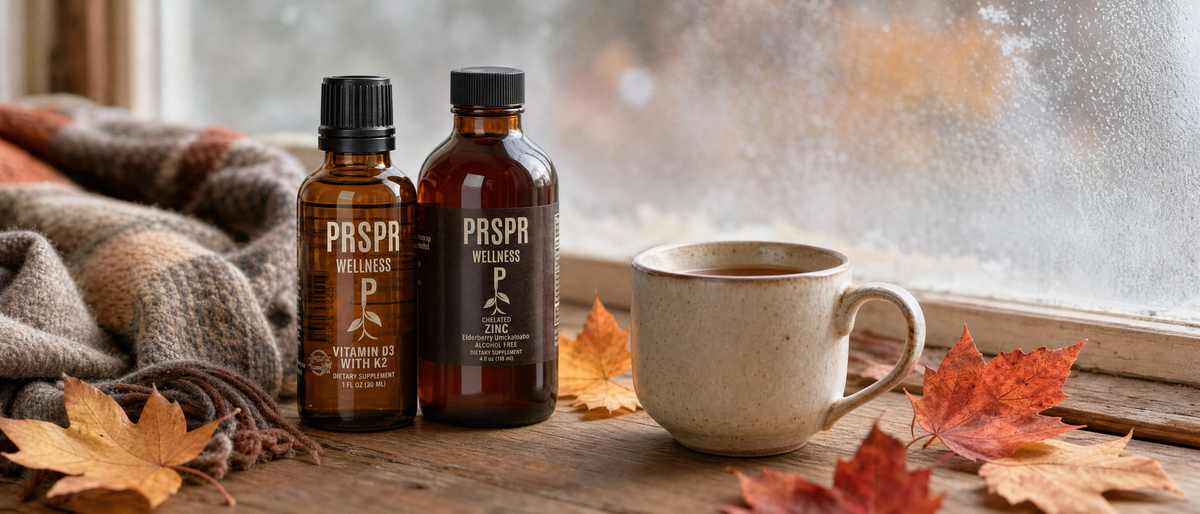
Our own Adult Immunity Bundle is a good test case. It sits in the immune category, and people often find the whole category through searches like these. But nothing on the CDC's calendar changes what is in either bottle, and nothing in either bottle has anything to do with week 40.
So we would rather give you the tools to read each one on its own terms. For the season, that tool is FluView. For the product, it is the label. Our guide to reading immune category supplement labels covers the vocabulary those labels use, and our explainer on what "chelated" means in chelated zinc takes apart the single most technical word on this bundle's front panel. If elderberry is the ingredient you keep seeing in this category, our piece on what elderberry actually is starts with the plant.
When is cold and flu season is a great question, and the best answer to it is not a vibe. It is a date range with a source.
The CDC gives you two of them. Fall and winter for the pattern, December to February for the usual peak. Week 40 to week 39 for the reporting year. Once you know both exist, most of the confusion in the headlines goes away, because you can tell which calendar a sentence is talking about.
We also think "cold and flu season" should be read as a calendar phrase, full stop. When it shows up on a product page, including a page in our own category, treat it as seasonal framing, not as information about the product. Then go read the label.
And when you want to know whether the season is here, skip the rumor and open the weekly report. It is published every Friday, and it is the closest thing to a straight answer anyone has.
The Adult Immunity Bundle is a two-part bundle. It pairs Chelated Zinc + Elderberry, a liquid formula made with organic elderberry, echinacea and umckaloabo root and naturally flavored with elderberry and blackberry juice, with Vitamin D3 + K2 (MK7) in liquid drop form. That is the listing's own description of what is in the box, and it is the whole of what we say the bundle is.
What we will add in our own voice is how the products in it are made. Both are manufactured in a GMP-certified facility and third-party batch tested, so what is on the label is what is in the bottle. No guessing, no filler, no cutting corners.
If you want to read that label for yourself, open the Adult Immunity Bundle page and go through each ingredient list as it is written, browse the rest of our bundles collection, or take the build-your-stack quiz to see where it fits alongside everything else we carry.
Answer all five questions to unlock a clear wellness plan made around your goal, schedule, preferred supplement format, and biggest roadblock.
Get clarity on what matters most right now.
See the product and routine connected to your goal.
Simple next steps you can use right away.
Pick the one you would fix first if you could.
This helps us make the guide easier to follow.
Consistency beats the “perfect” routine you never follow.
Be honest. We’re building something you’ll actually use.
Your guide will include one simple way around it.
Answer two more questions to unlock your product starting point, five-step plan, two-week routine, and one practical tip for your biggest roadblock.
Enter your details to open your five-step plan.
Verified PRSPR customer reviews
Expires when you close this page
*Your personal credit for completing the quiz. It's applied automatically at checkout on one-time purchases and expires when the timer runs out.
View full product detailsEverything in your plan, together — one add to cart.
Expires when you close this page
*Your personal credit for completing the quiz. It's applied automatically at checkout on one-time purchases and expires when the timer runs out.
View full product details Mind vocabulary
What is cognition? You have probably seen the word "cognitive" printed on a label, in a headline, or in a product name, and kept scrolling. It is o...
 Biology vocabulary
What is metabolism? You see the word on labels, in gym talk and in nutrition headlines, almost always used as if it were a single setting. Read eno...
 Sleep vocabulary
What are sleep cycles? You hear the phrase on podcasts, see it on sleep trackers, and read it in articles that assume you already know what it mean...