
◎
Get clear
Get clarity on what matters most right now.

Walk into a barbershop and ask for "a little off the sides" and you will get a guess. Ask for a short boxed beard, or a Balbo, and you will get a shape. That gap is why men beard styles are one of the most-searched grooming topics right now: people know what they want to look like, and they are hunting for the word that says it.
On Google Trends this week (US, past seven days), "men beard styles" leads the top searches with a relative volume score of 100, and "different beard styles" sits at 21. The rising list is where the vocabulary shows up. "Balbo beard" and "mens facial hair styles" are both marked Breakout. "Circle beard" is up +300%, "beard shapes and styles" is up +120%, "short boxed beard" is up +80%, "ducktail beard" is up +60%, "beard shapes" is up +50% and "anchor beard styles" is up +40%.
That list reads like a glossary in waiting. So here it is: the named beard shapes people are searching for, what defines each outline, and how barbers talk about shape and length as two separate things. This is a vocabulary lesson, not a growth guide.
Before the names, one distinction does most of the work. Every beard has a shape and a length, and they are independent of each other.
Shape is the outline. It is decided by where hair is kept and where it is shaved: whether the mustache connects to the chin, whether the cheeks are cleared, whether the sideburns stay, and what the bottom edge looks like from the front.
Length is how far the hair extends from the skin once the outline is set. Two men can wear the same shape at very different lengths and still be wearing the same named style.
Barbers also use a handful of edge words that come up again and again:
Once you have those five or six words, most different beard styles can be described in a single sentence. The names below are shorthand for those sentences.
These are the beard shapes that people are searching this week, plus the two classics every other style is measured against.
The baseline. A full beard keeps hair across the cheeks, jaw, chin and upper lip, with the mustache connected to the rest. The sideburns run straight down into it. Most of the other named styles are a full beard with something taken away.
Strictly speaking, a goatee is hair on the chin only, with the cheeks and upper lip shaved. The Online Etymology Dictionary dates the word "goatee" to 1842 and says it was named for its resemblance to a billy goat's chin tuft. In casual speech, people often use "goatee" for any chin beard paired with a mustache, which is part of why the more specific names below exist.
A circle beard is a mustache connected to a rounded chin beard, so the hair forms a closed ring around the mouth. The cheeks and jaw are shaved. It is sometimes called a "door knocker" for the same reason. The defining feature is the connection: if the mustache floats free, it is no longer a circle.
The Balbo is built from three separate pieces. A mustache sits on its own, disconnected from the rest. Below it, a chin beard extends out along part of the jawline, with no sideburns connecting it to the hairline. A small patch under the lower lip usually bridges the chin section. Think of it as a circle beard that has been cut apart at the corners of the mouth and widened at the bottom.
Anchor beard styles are named for their outline. A pointed chin beard runs a short way along the jaw, and a mustache sits above, so the whole shape suggests a ship's anchor turned upright. Like the Balbo, the anchor has no sideburns and leaves the cheeks clear. The difference is usually in the point: the anchor's chin section tapers to a tip, while the Balbo's bottom edge is often squared or rounded.
A boxed beard is a full beard with hard edges. The cheek line is cut clean and high enough to look deliberate, the neckline is defined, and the overall outline reads as tidy and geometric. The word "boxed" describes the edges, not the length.
A short boxed beard keeps the same crisp outline as a boxed beard but at a shorter length, so the edges do more of the visual work. It is one of the clearest examples of the shape-versus-length rule: same named shape, different length setting.
A ducktail beard is a full beard with the sides kept shorter and the chin left longer and shaped to a point. From the side, the profile narrows toward the tip, which is where the name comes from: it resembles the tail feathers of a duck. The mustache is usually connected, and the cheek line is kept neat.
If the list above feels like a lot, it helps to sort the names into families. Most searches for "beard shapes and styles" are really asking which family a look belongs to.
| Family | What defines it | Named examples |
|---|---|---|
| Full-coverage | Hair on cheeks, jaw, chin and lip, all connected | Full beard, boxed, short boxed, ducktail |
| Chin-and-mustache | Cheeks shaved, sideburns removed, hair around the mouth | Goatee, circle beard |
| Disconnected | Mustache floats separately from a chin or jaw section | Balbo, anchor |
The broader search phrase "mens facial hair styles" covers all three families plus mustache-only looks, which is why it tends to return such a mixed set of pictures. The more specific the name, the more predictable the result.
A name is a compression. "Balbo" packs a whole outline into two syllables: disconnected mustache, jaw extension, no sideburns. A barber who knows the word does not need you to describe each edge.
That is the same reason these terms spike on search. People see a look, want it, and go looking for the word that will get it across the chair. Knowing the vocabulary also makes it easier to ask for a small change, like "keep the anchor but round the point," instead of starting over.
The word "beard" itself is old and plain by comparison. The Online Etymology Dictionary traces it to Old English, from a Proto-Germanic root that also gave German its word Bart. The style names are much newer layers on top of that very old noun.
If you want the matching vocabulary for the hair on your head, our explainer on what stylists mean by hair density versus thickness works the same way: precise words for things most people describe loosely.
Here is where the vocabulary meets the bottle. Every style above is ultimately about edges and outlines, and every outline gets maintained with a small kit: a trimmer, a comb and, for a lot of people, an oil or balm.
Those products have their own vocabulary problem. Oil and balm sound interchangeable and are not; our piece on how beard oil and beard balm differ lays out what each one is and how the formats compare.
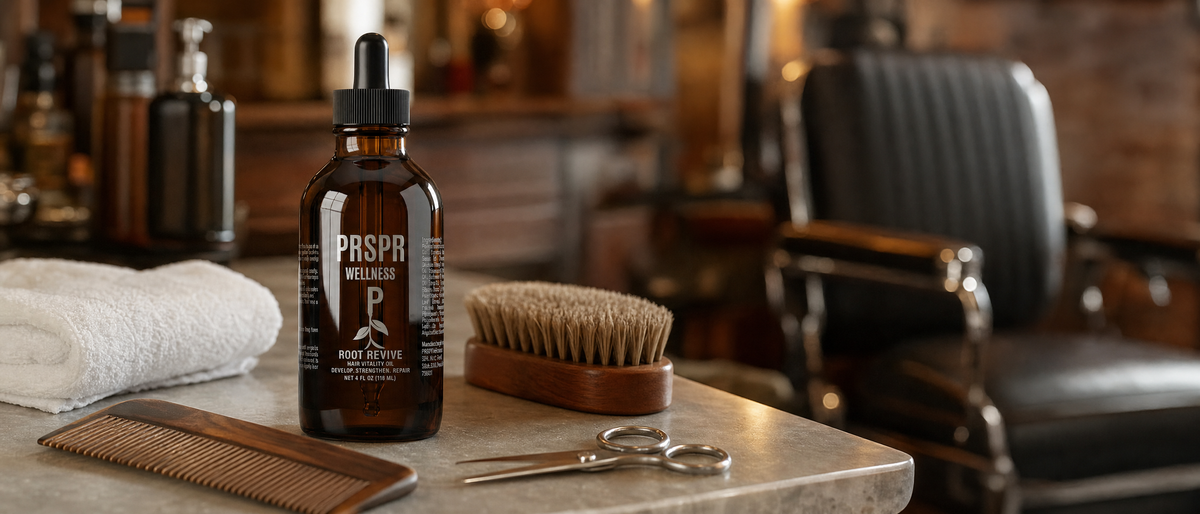
The one product in our Men's Vitality Bundle that touches a beard directly is Root Revive Hair Growth Oil, which the bundle's listing describes as an "all-natural scalp and beard oil." That description is about what the product is and where it goes. What shape you trim it into is still your call and your barber's.
We like search trends that turn out to be vocabulary lessons, and this week's beard list is a good one. Nobody searches "Balbo" by accident. They saw something, and they want the word.
We think the most useful idea here is the split between shape and length. Once you see a boxed beard and a short boxed beard as one outline at two settings, the whole naming system gets simpler. Most men beard styles are a full beard with specific parts removed and specific edges sharpened.
So our advice is plain: learn the six or seven edge words, pick the named shape that matches the outline you want, and bring the name with you. A clear word saves a lot of back and forth.
The Men's Vitality Bundle puts five PRSPR products in one order. The listing names them as Saw Palmetto, Pure Creatine Monohydrate, Root Revive Hair Growth Oil, Beet & Maca Capsules and Seamoss Capsules. Root Revive is the grooming piece of the set, the "scalp and beard oil" in the listing's words, and the other four are capsules and powder.
The listing also carries a short list of label lines: "Vegan & cruelty-free," "Non-GMO, gluten-free," "No artificial colors or preservatives" and "BPA-free, recyclable packaging." If you want those terms spelled out, our explainer on what Non-GMO means on a label and our piece on what BPA-free means each take one line apart.
Every product in the Men's Vitality Bundle is manufactured in a GMP-certified facility and third-party batch tested, so what's on the label is what's in the bottle.
If you have a personal question about any supplement, a qualified healthcare professional is the right person to ask. To read the full listing for yourself, open the Men's Vitality Bundle product page, browse the rest of our bundles collection, or take the build-your-stack quiz to see where it fits alongside everything else we carry.
Answer all five questions to unlock a clear wellness plan made around your goal, schedule, preferred supplement format, and biggest roadblock.
Get clarity on what matters most right now.
See the product and routine connected to your goal.
Simple next steps you can use right away.
Pick the one you would fix first if you could.
This helps us make the guide easier to follow.
Consistency beats the “perfect” routine you never follow.
Be honest. We’re building something you’ll actually use.
Your guide will include one simple way around it.
Answer two more questions to unlock your product starting point, five-step plan, two-week routine, and one practical tip for your biggest roadblock.
Enter your details to open your five-step plan.
Verified PRSPR customer reviews
Expires when you close this page
*Your personal credit for completing the quiz. It's applied automatically at checkout on one-time purchases and expires when the timer runs out.
View full product detailsEverything in your plan, together — one add to cart.
Expires when you close this page
*Your personal credit for completing the quiz. It's applied automatically at checkout on one-time purchases and expires when the timer runs out.
View full product details Mind vocabulary
What is cognition? You have probably seen the word "cognitive" printed on a label, in a headline, or in a product name, and kept scrolling. It is o...
 Biology vocabulary
What is metabolism? You see the word on labels, in gym talk and in nutrition headlines, almost always used as if it were a single setting. Read eno...
 Sleep vocabulary
What are sleep cycles? You hear the phrase on podcasts, see it on sleep trackers, and read it in articles that assume you already know what it mean...