
◎
Get clear
Get clarity on what matters most right now.

You have probably seen it: a grid of twelve little hair swatches, numbered 1 to 4 across and lettered A to C down, with 2B and 3C and 4A sitting in the boxes. That grid is the hair types chart, and it has quietly become the way a lot of people describe their own hair. If you have ever read "3B" in a product review and wondered what it meant, this is your decoder.
The search data says plenty of people are wondering the same thing. On Google Trends this week (US, past seven days), "different hair types" leads related searches with a relative volume score of 100. "All hair types" follows at 71, "hair types curly" at 66, "men hair types" at 40, "black hair types" at 33, "hair types chart" at 24, "hair types women" at 20 and "wavy hair types" at 18. Every one of those is a top search, and together they point at one question: what are the categories, and which one is mine?
So this piece is about vocabulary. What the numbers and letters stand for, what each group is said to look like, and why curl pattern is only one of several ways to describe hair. It is a guide to choosing words, not products.
The chart sorts hair by one thing: the shape a strand takes when it is left alone. Not how much hair you have, not how thick each strand is, not how it drinks up water. Just shape.
According to WebMD, the system was created in the 1990s by a stylist as a way to market hair care products. It stuck because it gave people a shorthand. Instead of "kind of wavy but frizzy at the ends," you can say "2B" and a stylist, a friend or a forum knows roughly what you mean.
The chart has two parts. The number (1 to 4) is the family: straight, wavy, curly or coily. The letter (A to C) is the tightness within that family, running from the loosest pattern at A to the tightest at C.
Here is how WebMD describes each of the four families and their subtypes. Read them as descriptions of shape, nothing more.
WebMD describes Type 1 hair as "totally straight," with no curl or wave unless it is heat styled. Within it, 1A is described as very straight, fine and thin; 1B is still straight but with more texture and body; and 1C is the coarsest of the three.
Type 2 is where the bend starts. WebMD says it falls in a soft "S" shape while staying fairly straight overall. 2A is fine and thin with loose waves. 2B has gentler waves with more volume and some frizz. 2C has thicker waves that stay curly when air-dried. Wavy hair types are often the ones people misfile, because a 2C on a humid day can look a lot like a 3A.
Type 3 is the curly family, and WebMD describes it as ranging from loose curls to tight corkscrews. 3A curls are S-shaped and loose. 3B curls are tighter, like spirals. 3C curls are very tight corkscrews or coils. When people search "hair types curly," this is usually the row they are trying to place themselves in.
Type 4 is the coily family, which WebMD describes as having the tightest and most dense curls. 4A is well-defined, tightly coiled and springy. 4B has more volume and bends in a sharp-angled zigzag, like a "Z." 4C is the smallest and tightest pattern on the whole chart.
| Type | Family | A | B | C |
|---|---|---|---|---|
| 1 | Straight | Fine, very straight | More body | Coarsest straight |
| 2 | Wavy | Loose waves | More volume, some frizz | Thick waves |
| 3 | Curly | Loose S-curls | Tighter spirals | Tight corkscrews |
| 4 | Coily | Springy coils | Z-shaped zigzag | Tightest pattern |
Three of this week's searches add a qualifier: "men hair types," "hair types women" and "black hair types." The chart itself does not have separate versions for any of them. The same twelve boxes apply to anyone with hair, whether it is cropped short or grown past the shoulders. Short hair can make a pattern harder to read, since a curl needs some length to show its full shape, but the pattern is still there.
The same goes for ethnicity. Type 4 is often talked about as if it were a synonym for Black hair, and that shortcut misses a lot. Curl pattern varies from person to person within every group, and many people have more than one pattern on the same head.
Researchers have tried to measure this more precisely. A 2007 study published in the journal Human Biology examined hair from 1,442 people in 18 countries and sorted it into eight categories using three measurements of hair shape (curve diameter, curl index and number of waves), deliberately avoiding classification by ethnicity. The consumer chart and the research method are different tools, but they agree on the basic idea: shape can be described on its own terms.
Here is the part the grid leaves out. A hair types chart tells you the shape of a strand. It does not tell you three other things people often lump in with "type."
There is also the scalp itself, which people describe as oily, dry or somewhere in between. That is a separate description again, because it is about skin, not strands.
Put those together and "what type is my hair?" becomes a longer answer. Someone might be 2C, fine-stranded, high density and low porosity. Someone else might be 4A, coarse, medium density and high porosity. Two people who both say "I'm a 3B" can have very different hair once the other axes are in the sentence.
If you want to place your own hair on the chart, the usual approach is simple. Look at a clean section of hair that has dried without heat, brushing or product. Then ask one question: what shape does it make on its own?
Then pick a letter by tightness, A for looser, C for tighter. Do not be surprised if the crown says one thing and the nape says another. Mixed patterns are common, which is why many people describe themselves with a range, like "2C to 3A."
This is the bridge from the grid to the shelf. Hair care labels lean on a small set of phrases, and "for all hair types" is one of the most common. It is a label phrase, the same way "family size" is a label phrase: a description of who the product is packaged for, not a result.
Once you know the chart, that phrase reads differently. "All hair types" is twelve boxes, times three strand widths, times three densities, times three porosities. That is a lot of hair to cover with three words. The chart does not tell you which product to buy. What it gives you is the vocabulary to describe your own hair precisely, so you can read a label and a listing with a clear picture of whose hair you are actually talking about.
The same habit works for ingredient lists. If you have wondered what the oils on a label are, our piece on what else is in a castor oil bottle reads one botanical ingredient list name by name, and our guide to what a hot oil treatment is describes a familiar oil routine step by step. Questions about your scalp or any change in your hair are worth taking to a qualified healthcare professional.
We like the hair types chart for what it is: a shared vocabulary. Twelve short codes let people compare notes on hair in a way "kind of curly" never could. That is useful.
We also think the chart gets asked to do too much. It measures shape, and only shape. Porosity, density, strand width and scalp are separate words for separate things, and they matter just as much when you describe your hair to a stylist or read a label.
So we treat "2B" or "4A" as the first word in a sentence, not the whole sentence. Know your pattern, then add the rest. The more precisely you can describe your own hair, the more useful every label, listing and conversation becomes.
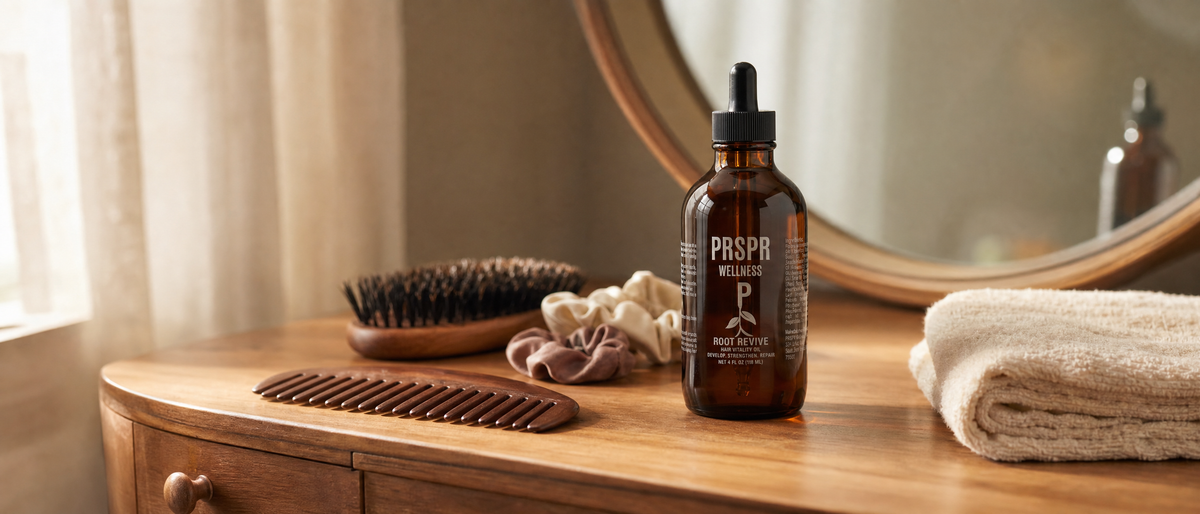
Which brings us to our own bottle. Root Revive Hair Growth Oil is described in its listing as an organic, all-in-one hair oil featuring 13 botanical oils and extracts. That is how the listing describes it, and that is the description we stand behind. The full ingredient list is on the product page, name by name.
What we will add in our own voice is how it is made. Root Revive Hair Growth Oil is manufactured in a GMP-certified facility and third-party batch tested, so what's on the label is what's in the bottle.
To read the full label for yourself, open the Root Revive product page, browse the rest of the hair and skin health collection, or take the build-your-stack quiz to see where it fits alongside everything else we carry.
Answer all five questions to unlock a clear wellness plan made around your goal, schedule, preferred supplement format, and biggest roadblock.
Get clarity on what matters most right now.
See the product and routine connected to your goal.
Simple next steps you can use right away.
Pick the one you would fix first if you could.
This helps us make the guide easier to follow.
Consistency beats the “perfect” routine you never follow.
Be honest. We’re building something you’ll actually use.
Your guide will include one simple way around it.
Answer two more questions to unlock your product starting point, five-step plan, two-week routine, and one practical tip for your biggest roadblock.
Enter your details to open your five-step plan.
Verified PRSPR customer reviews
Expires when you close this page
*Your personal credit for completing the quiz. It's applied automatically at checkout on one-time purchases and expires when the timer runs out.
View full product detailsEverything in your plan, together — one add to cart.
Expires when you close this page
*Your personal credit for completing the quiz. It's applied automatically at checkout on one-time purchases and expires when the timer runs out.
View full product details Mind vocabulary
What is cognition? You have probably seen the word "cognitive" printed on a label, in a headline, or in a product name, and kept scrolling. It is o...
 Biology vocabulary
What is metabolism? You see the word on labels, in gym talk and in nutrition headlines, almost always used as if it were a single setting. Read eno...
 Sleep vocabulary
What are sleep cycles? You hear the phrase on podcasts, see it on sleep trackers, and read it in articles that assume you already know what it mean...