
◎
Get clear
Get clarity on what matters most right now.

What is a chloroplast? If you have ever read a label that says chlorophyll, you have already met the molecule. The chloroplast is its address. It is the small, green compartment inside a plant cell where chlorophyll actually sits, and this week a lot of people want to know exactly what it is and where to find it.
On Google Trends this week (US, past seven days), "where is the chloroplast located in a plant cell" is a rising search at +90%, and "how many membranes surround a chloroplast" is rising at +50%. Among the top searches, "what is chloroplast" carries a relative volume score of 75 out of 100, "what is the chloroplast" sits at 62, "what is a chloroplast" at 50, "plant cell chloroplast" at 46, "chloroplast function" at 43, "chloroplast in plant cell" at 34, "function of chloroplast" at 29 and "chloroplast structure" at 25.
That is a biology class's worth of questions, and they share one shape: people want the parts list. So this piece is a cell-biology tour. What the word means, where the chloroplast sits, how it is built layer by layer, and why that structure is the reason a leaf looks green. We stop at the door of the chemistry and point you to our other piece for that part.
A chloroplast is an organelle, a specialized compartment inside a cell. The OpenStax textbook Biology 2e describes chloroplasts as "plant cell organelles," and notes that many algae have them too.
The same textbook points out something unusual: chloroplasts carry their own DNA and ribosomes, separate from the rest of the cell. Biology 2e explains that scientists believe chloroplasts began as free-living bacteria, specifically cyanobacteria, that were taken in by a host cell and ended up living inside it permanently. That idea is called endosymbiosis, and it is why a chloroplast behaves a little like a cell within a cell.
The name is a compact description. The Online Etymology Dictionary dates "chloroplast" in English to 1887, borrowed from a German term coined in 1884 by the botanist Eduard Strasburger. It is built from the Greek khlōros, "greenish-yellow," and plastos, "formed, molded." Read literally, a chloroplast is a small formed green body. The same dictionary notes that the German word was itself shortened from an earlier term, chloroplastid, used by Andreas Franz Wilhelm Schimper in 1883.
That "chloro-" is the same one at the front of chlorophyll. The pigment and its container share a root because they share a color.
Start with the whole plant, then zoom in. According to the OpenStax textbook Concepts of Biology, the work that chloroplasts do happens "not on the surface layers of the leaf, but rather in a middle layer called the mesophyll." So the outer skin of a leaf is mostly a cover. The green working cells sit just underneath it.
Now zoom into one of those mesophyll cells. A plant cell chloroplast floats inside the cell, in the fluid-filled interior that surrounds the cell's other compartments. It is not part of the outer wall and not part of the cell's control center. It is its own separate body, sealed off by its own membranes.
That is the short answer to the most-searched question of the week. A chloroplast in a plant cell sits inside the cell's interior, and in a leaf, the green working cells that hold them sit in the middle layer.
Chloroplast structure is easiest to picture from the outside in. Think of it as a sealed bag, with a second bag inside it, holding stacks of flattened sacs.
The outside of a chloroplast is a double membrane. Concepts of Biology puts it plainly: "Chloroplasts have a double (inner and outer) membrane." Biologists often call this pair the envelope.
Inside the envelope is a third membrane system, folded into flat, disc-shaped sacs called thylakoids. Nature Education's Scitable describes these membranes as looking "like stacks of coins" in electron micrographs, which is a useful mental image.
Those thylakoids pile up. According to Concepts of Biology, "A stack of thylakoids is called a granum." The plural is grana. Biology 2e adds that the stacks are interconnected, so a chloroplast is not a loose pile of coins but a linked network of them.
The fluid that fills the chloroplast around the grana is called the stroma. Biology 2e describes it as the fluid enclosed by the inner membrane that surrounds the grana. The Online Etymology Dictionary traces the word to the Greek strōma, a covering or anything spread out to lie on, which fits a substance that everything else rests in.
| Part | What it is |
|---|---|
| Envelope | The double outer and inner membrane around the whole chloroplast |
| Thylakoid | A flat membrane sac inside the chloroplast |
| Granum (grana) | A stack of thylakoids |
| Stroma | The fluid surrounding the stacks, inside the inner membrane |
Here is where the address matters. Chlorophyll is not spread evenly through a leaf. It is packed into one place. Scitable states that "The green pigment chlorophyll is located within the thylakoid membrane," and Concepts of Biology describes chlorophyll molecules as embedded in that membrane.
So the basic function of chloroplast structure is organization. The envelope seals the compartment. The thylakoid membranes hold the chlorophyll. The grana stack those membranes so a lot of them fit in a small space. The stroma surrounds it all. If you want the chemistry that happens next, our explainer on chlorophyll, chlorophyllin and photosynthesis picks up exactly where this one stops.
The color is the part you can see without a microscope. Scitable explains that chlorophyll reflects green light and absorbs red and blue light, and Concepts of Biology states that chlorophyll is responsible for the green color of plants. Put the pieces together: a leaf looks green because its middle layer is packed with cells, those cells are packed with chloroplasts, and those chloroplasts are packed with a pigment that bounces green light back at your eye.
This is where the cell biology meets the shelf. When a label says chlorophyll, it is naming the pigment, not the compartment that held it. The chloroplast is the green body inside the leaf cell. Chlorophyll is the molecule that sat inside its thylakoid membranes. Those are two different words for two different things, and knowing which is which makes a label easier to read.
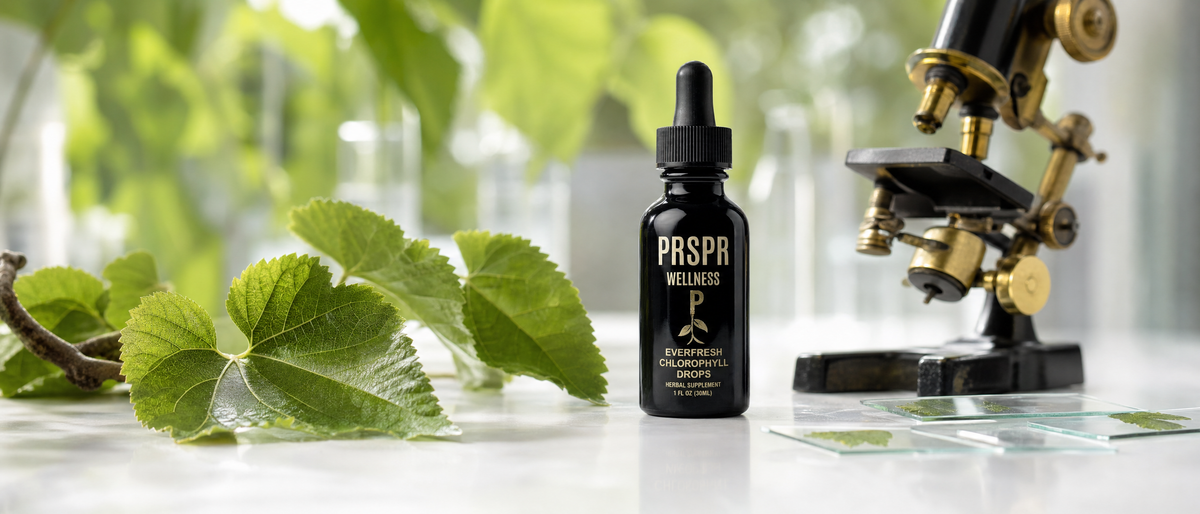
Our Everfresh listing names its source plainly: chlorophyll derived from mulberry leaves. A mulberry leaf is green for exactly the reason described above. Its mesophyll cells are full of chloroplasts, and those chloroplasts are full of chlorophyll. If you want to know more about the plant itself, our piece on the white mulberry leaf covers the tree, the species names and why the leaf is farmed at scale.
So the useful habit is the same one we recommend for every ingredient line. Read the source plant, then read the word for what was taken from it. The leaf is the source. The chloroplast is where the pigment lived. Chlorophyll is the name on the label.
It is a green, membrane-bound organelle inside plant and algal cells that holds the pigment chlorophyll in its internal thylakoid membranes.
Two. According to Concepts of Biology, a chloroplast has a double membrane, an outer one and an inner one. Inside those sits a third membrane system, the thylakoids, but that one is inside the chloroplast rather than surrounding it.
From Greek, by way of German. The Online Etymology Dictionary traces it to khlōros, "greenish-yellow," and plastos, "formed, molded," and credits the German term to Eduard Strasburger in 1884.
No. The chloroplast is the compartment. Chlorophyll is the pigment inside it. They share the Greek root for green, which is why they are so easy to mix up.
We like questions that have an address. "What is chlorophyll" is a good question, but "where does chlorophyll live" is a better one, because the answer is a real place you can draw: a leaf, a middle layer, a cell, a double-walled green body, a stack of flat sacs, a membrane.
We also think the chloroplast is one of the best reminders that label words point back to something physical. The green in the bottle's name started as green in a leaf, and the green in the leaf is the result of structure, not decoration. That makes the word chlorophyll a lot less abstract.
And we would rather you learn the parts list than memorize a slogan. Envelope, thylakoid, granum, stroma. Four words, and you can read a biology diagram and a label with the same confidence. Questions about what any supplement might mean for your own health belong with a qualified healthcare professional.
Which brings us to our own bottle. Everfresh Chlorophyll drops are, in the listing's own words, "a liquid dietary supplement made with chlorophyll derived from mulberry leaves and naturally flavored with peppermint oil." That is how the listing describes it, and that is the description we stand behind.
If you are curious about how a liquid chlorophyll is usually taken, our piece on chlorophyll in water covers the drink format, and our guide to peppermint oil versus peppermint extract reads the flavor line on the label.
What we will add in our own voice is how it is made. Everfresh Chlorophyll drops are manufactured in a GMP-certified facility and third-party batch tested, so what's on the label is what's in the bottle.
To read the full label for yourself, open the Everfresh Chlorophyll drops product page, browse the rest of our vitamins and supplements collection, or take the build-your-stack quiz to see where it fits alongside everything else we carry.
Answer all five questions to unlock a clear wellness plan made around your goal, schedule, preferred supplement format, and biggest roadblock.
Get clarity on what matters most right now.
See the product and routine connected to your goal.
Simple next steps you can use right away.
Pick the one you would fix first if you could.
This helps us make the guide easier to follow.
Consistency beats the “perfect” routine you never follow.
Be honest. We’re building something you’ll actually use.
Your guide will include one simple way around it.
Answer two more questions to unlock your product starting point, five-step plan, two-week routine, and one practical tip for your biggest roadblock.
Enter your details to open your five-step plan.
Verified PRSPR customer reviews
Expires when you close this page
*Your personal credit for completing the quiz. It's applied automatically at checkout on one-time purchases and expires when the timer runs out.
View full product detailsEverything in your plan, together — one add to cart.
Expires when you close this page
*Your personal credit for completing the quiz. It's applied automatically at checkout on one-time purchases and expires when the timer runs out.
View full product details Mind vocabulary
What is cognition? You have probably seen the word "cognitive" printed on a label, in a headline, or in a product name, and kept scrolling. It is o...
 Biology vocabulary
What is metabolism? You see the word on labels, in gym talk and in nutrition headlines, almost always used as if it were a single setting. Read eno...
 Sleep vocabulary
What are sleep cycles? You hear the phrase on podcasts, see it on sleep trackers, and read it in articles that assume you already know what it mean...