
◎
Get clear
Get clarity on what matters most right now.

You have seen it a hundred times: the letter O in a box on a classroom periodic table, the "O2" on a science diagram, the word oxygen in a sentence about air. So what is oxygen, exactly? It is a chemical element, one of the basic building blocks chemists list on the periodic table, and it shows up in three very different forms depending on whether you mean a single atom, a pair of atoms, or the gas in the air around you. Sort those forms out and most of the vocabulary falls into place.
In Google Trends data for the US over the past 7 days, related searches for the seed term "oxygen" included "absence of oxygen" as a rising term at +50%. The top related searches were led by "what is oxygen" with a score of 100, followed by "carbon dioxide" (23), "oxygen gas" (20), "oxygen molecule" (12), "cellular respiration" (10), "oxygen mass" (10), "oxygen atom" (9), "oxygen element" (9), and "o2" (8). A rising percentage shows growth in searches compared with the prior period; Google labels very large growth "Breakout." Top scores are relative interest, scaled so the most popular term in the set equals 100; they are not search counts. The pattern is plain: people want the definition first, then the difference between the atom, the molecule, and the gas.
Start with the box on the chart. According to the Jefferson Lab "It's Elemental" periodic table, oxygen has the symbol O, atomic number 8, and an atomic weight of 15.9994. Atomic number 8 means every oxygen atom has 8 protons in its nucleus. That number is what makes an atom oxygen and not something else.
The same Jefferson Lab entry places the oxygen element in group 16, a column of the periodic table also called the chalcogens. Elements in one column share a family resemblance in how they bond. Sulfur sits directly in that column too: Jefferson Lab lists sulfur as atomic number 16, group number 16. If you want to meet oxygen's closest neighbor in the family, our explainer on what sulfur is as an element walks through it.
Jefferson Lab describes oxygen as a highly reactive nonmetal that combines with most other elements. At room temperature it is a gas. Its melting point is 54.36 K and its boiling point is 90.20 K, per the same source. Kelvin starts at absolute zero, so those numbers sit far below any temperature you will meet outdoors, which is why you encounter oxygen as a gas in daily life.
Here is where most confusion comes from. "Oxygen" can mean three different things, and science writing switches between them without warning.
Same element, different arrangements. That is a useful idea to hold onto, because it shows that a substance is defined by both which atoms it contains and how many of them are joined. A molecule built from atoms of more than one element is a compound, which is a separate category with its own rules. Our piece on what a chemical compound is covers that distinction, and carbon dioxide (CO2), one carbon atom plus two oxygen atoms, is a classic example.
NASA's Aura page also notes where ozone sits: 90% of the ozone in the atmosphere is in the stratosphere, and about 10% is in the troposphere, the lowest layer. The Jefferson Lab entry describes the stratospheric ozone as a thin layer that shields Earth's surface from ultraviolet radiation.
The "oxygen mass" searches usually come from one of two questions: how heavy is an oxygen atom or molecule, and how much of the planet is oxygen. Both have clean answers.
For atoms and molecules, chemists use relative mass on a standard scale. The National Institute of Standards and Technology (NIST) Chemistry WebBook lists these molecular weights:
| Substance | Formula | Atoms | Molecular weight (NIST) |
|---|---|---|---|
| Oxygen gas | O2 | 2 oxygen | 31.9988 |
| Ozone | O3 | 3 oxygen | 47.9982 |
| Carbon dioxide | CO2 | 1 carbon, 2 oxygen | 44.0095 |
Notice the pattern. The O2 value is twice oxygen's atomic weight, and O3 is three times it. Add up the atoms and you get the molecule. That simple arithmetic is how chemists build every molecular weight.
For the planet, Jefferson Lab says oxygen accounts for nearly half of the mass of Earth's crust and nine tenths of the mass of water. Jefferson Lab also lists oxygen as the third most abundant element in the universe.
About a fifth. NOAA's JetStream page on the atmosphere gives the makeup of air excluding water vapor: nitrogen (N2) at 78.084%, oxygen (O2) at 20.946%, argon at 0.934%, and carbon dioxide at 0.042%. The same NOAA table lists ozone at about 0.07 parts per million. NOAA notes these figures describe dry air; real air also holds a variable amount of water vapor.
So when you hear that air is roughly 21% oxygen by volume, that is the rounded version of NOAA's 20.946%. It also tells you something about form: the oxygen in air is overwhelmingly the two-atom molecule, O2, not single atoms floating around.
Credit is shared, and the story is a good lesson in how science names things. Per Jefferson Lab, Joseph Priestley and Carl Wilhelm Scheele discovered oxygen independently, with the discovery dated to 1774, and Priestley is usually the one credited. Both produced it by heating mercuric oxide. Priestley called the gas "dephlogisticated air," and Scheele called it "fire air."
The name we use came from Antoine Lavoisier. Jefferson Lab explains that he coined "oxygen" from Greek roots meaning "acid forming," because he believed, incorrectly, that oxygen was needed to form all acids. The name stuck even after that idea was set aside. The American Chemical Society marks the history with a National Historic Chemical Landmark titled "Joseph Priestley and the Discovery of Oxygen."
Biology textbooks bring oxygen into one of their central reactions. OpenStax Concepts of Biology (section 4.1) summarizes it as C6H12O6 + 6O2 → 6H2O + 6CO2: one glucose molecule and six oxygen molecules become six water molecules and six carbon dioxide molecules. In that reaction, the textbook says, oxygen is consumed and carbon dioxide is released as a waste product. OpenStax describes it as the reverse of the photosynthesis reaction.
The textbook name for the full set of pathways is cellular respiration. OpenStax Biology 2e (chapter 7) describes it as a series of metabolic pathways that extract the stored chemical bond content of glucose, with ATP as the product cells use. Two textbook details are worth knowing:
And the rising search, "absence of oxygen"? That phrase has a textbook home too. OpenStax Biology 2e (section 7.5) uses the term anaerobic for methods organisms carry out in the absence of oxygen. In aerobic respiration, by contrast, the final electron acceptor is an oxygen molecule, O2. Some organisms use an inorganic molecule instead, which OpenStax calls anaerobic cellular respiration, and processes that use an organic molecule for that step are grouped as fermentation.
We think oxygen is the best possible starting point for chemistry vocabulary. One element gives you the atom, the molecule, ozone, a compound like carbon dioxide, and a reaction balanced with plain counting. Learn to read O, O2, O3, and CO2 and you already know how chemical names and formulas work.
We also like that the history is honest about credit. Two people found it, a third named it, and the name rests on an idea that turned out wrong. Words in science carry their history with them, and knowing that makes them easier to remember.
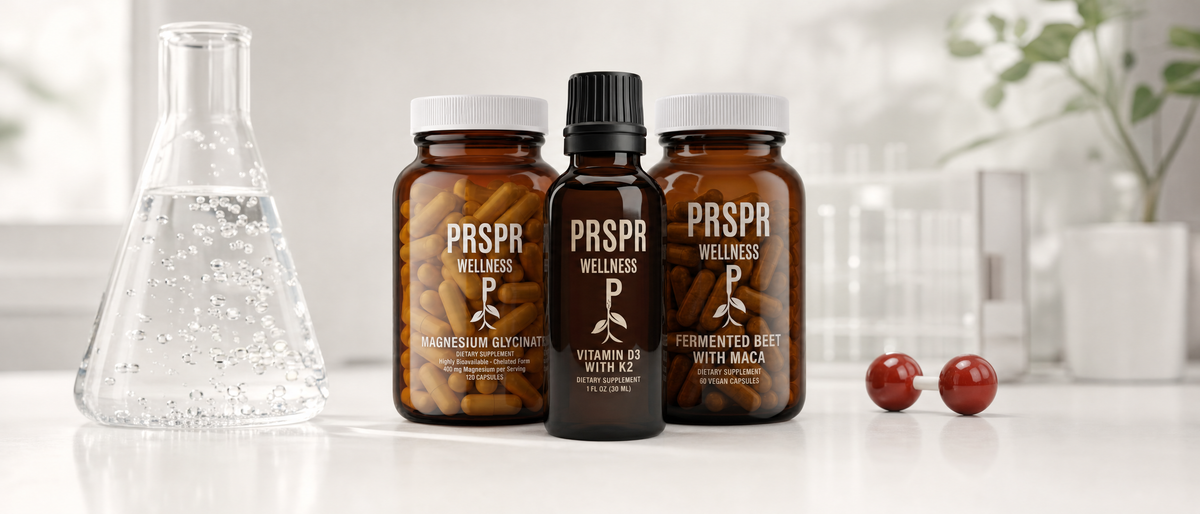
Oxygen is an element, and so is magnesium. A supplement label is a list of names for elements and compounds, so reading one well is the same chemistry vocabulary this article covers: knowing what each name refers to. The Wellness Foundation Stack is three separate products, each with its own label you can read for yourself.
That is two capsule products and one liquid drop format in a single stack, priced at $99.00. Each product is made in a GMP-certified facility and third-party batch tested, so what is listed on the label is what is in the bottle. You can compare it with our other sets in Bundles.
See the Wellness Foundation Stack at PRSPR
Oxygen is a chemical element with the symbol O and atomic number 8, in group 16 of the periodic table, per Jefferson Lab's "It's Elemental" periodic table. At room temperature it is a gas.
An oxygen atom is a single atom, O. An oxygen molecule is two oxygen atoms bonded together, O2, with a molecular weight of 31.9988 per the NIST Chemistry WebBook. Ozone, O3, is three oxygen atoms bonded together, per NASA.
NOAA lists oxygen (O2) at 20.946% of dry air, with nitrogen at 78.084%. That is the source of the familiar "about 21%" figure.
It describes anaerobic processes. OpenStax Biology 2e (section 7.5) uses anaerobic for methods organisms carry out in the absence of oxygen, as opposed to aerobic respiration, where O2 is the final electron acceptor.
Answer all five questions to unlock a clear wellness plan made around your goal, schedule, preferred supplement format, and biggest roadblock.
Get clarity on what matters most right now.
See the product and routine connected to your goal.
Simple next steps you can use right away.
Pick the one you would fix first if you could.
This helps us make the guide easier to follow.
Consistency beats the “perfect” routine you never follow.
Be honest. We’re building something you’ll actually use.
Your guide will include one simple way around it.
Answer two more questions to unlock your product starting point, five-step plan, two-week routine, and one practical tip for your biggest roadblock.
Enter your details to open your five-step plan.
Verified PRSPR customer reviews
Expires when you close this page
*Your personal credit for completing the quiz. It's applied automatically at checkout on one-time purchases and expires when the timer runs out.
View full product detailsEverything in your plan, together — one add to cart.
Expires when you close this page
*Your personal credit for completing the quiz. It's applied automatically at checkout on one-time purchases and expires when the timer runs out.
View full product details Anatomy
You see an anatomy chart on a classroom wall, a model in a doctor's office, or a diagram in a textbook: a long coiled tube packed into the middle o...
 Chemistry
You are reading a label, and the word "betaine" shows up. Maybe it is on the back of a shampoo bottle as part of a long ingredient list. Maybe it i...
 Botany
You see it in a Mediterranean travel photo: a squat, twisted trunk, silvery leaves, and a branch heavy with small green fruit. Or you see it at the...