
◎
Get clear
Get clarity on what matters most right now.

Your eyebrows are two narrow strips of hair sitting on a ridge of bone above your eyes. Most of the time you forget they exist. Yet if you have ever wondered what are eyebrows for, you are asking a question that anatomists, evolutionary biologists, and face-perception researchers have all taken seriously. The short answer is that eyebrows do two jobs at once: they sit in the path of anything running down your forehead, and they move. That second job turns out to matter a lot more than it sounds.
Plenty of people are asking right now. In Google Trends data for the US over the past 7 days, for the seed term "eyebrows," the query "why do humans have eyebrows" was rising at +70%. Among top related queries, "eyebrow" scored 100, "long eyebrows" 86, "thick eyebrows" 32, "thin eyebrows" 29, "big eyebrows" 27, "eyebrows shape" 23, and "what are eyebrows for" 18. Top scores are relative interest scaled so the most searched term equals 100, and the rising figure is a growth rate. Neither one is a count of searches.
The textbook answer comes first. OpenStax Anatomy and Physiology 2e, section 5.2 ("Accessory Structures of the Skin"), lists the functions of hair in general as protection, sensory input, thermoregulation, and communication. For the brows specifically, it says the hair of the eyebrows keeps sweat and other particles from dripping into and bothering the eyes.
The forehead is a broad, sloped surface, and sweat or rain that collects there runs downward toward the brow. Dermatologists Betty Nguyen, Jamie Katy Hu, and Antonella Tosti, in a 2022 review in the American Journal of Clinical Dermatology, describe human eyebrows as short, obliquely set hairs arranged in arches above the eye sockets. Picture that arch of slanted hairs drawn across the bottom of the forehead and the textbook description is easy to see.
That same review notes that the eyebrows shield the eye from outside material and are also important for expressing emotion and for nonverbal communication. Which brings us to the second job.
The more surprising part of the story is evolutionary. In 2018, researchers Ricardo Miguel Godinho, Penny Spikins, and Paul O'Higgins at the University of York published "Supraorbital morphology and social dynamics in human evolution" in Nature Ecology and Evolution. As the University of York's news release on the study explains, they built a 3D model of Kabwe 1, a fossil skull of Homo heidelbergensis, a species that lived between 600,000 and 200,000 years ago, and tested ideas about why that species had such a heavy brow ridge.
Per the University of York release, virtually shaving back the ridge showed it offered no spatial advantage, and simulated biting showed it was not needed to stabilize the skull. The team also noted that keeping sweat or hair out of the eyes had already been discounted as an explanation for the bony ridge itself. Their proposal was that social signaling was a plausible contributing explanation.
Then the face changed. The release describes modern human foreheads as having developed as a side effect of faces gradually becoming smaller over the past 100,000 years. A flatter, smoother forehead gave the brows room to move freely. The researchers argue that mobile eyebrows allowed people to express subtler feelings, and the release gives three examples:
Here is a fact people rarely think about: eyebrow hair and scalp hair come from the same kind of structure. Both grow from follicles, the small pockets in the skin we cover in our guide to the parts of a hair follicle. Per OpenStax section 5.2, the visible hair is completely dead and made entirely of keratin, the structural protein explained in our piece on what keratin actually is.
What differs is timing. Every follicle cycles through three phases. OpenStax describes them this way for hair in general:
The length of that first phase is the big variable.
| Phase | Scalp hair | Eyebrow hair |
|---|---|---|
| Anagen (growth) | 2 to 7 years (OpenStax); 2 to 8 years (Nguyen, Hu, and Tosti, 2022) | 2 to 3 months (Nguyen, Hu, and Tosti, 2022) |
| Catagen (transition) | 2 to 3 weeks (OpenStax) | 2 to 3 weeks (Nguyen, Hu, and Tosti, 2022) |
| Telogen (rest) | About 2 to 4 months (OpenStax) | 2 to 3 months (Nguyen, Hu, and Tosti, 2022) |
Scalp follicles stay in growth mode for years. Brow follicles stay there for a couple of months. The 2022 review states that eyebrow length is believed to be limited by that short anagen phase. In plain terms, a brow hair stops getting longer because its follicle moves on to the next phase long before a scalp hair would.
People describe brows in a handful of ordinary words, and each one points to a slightly different feature.
These differences are a normal part of how faces vary. Nguyen, Hu, and Tosti note that the number of eyebrow hairs varies between people. Genetics plays a part too. In a 2016 genome-wide study in Nature Communications, Kaustubh Adhikari and colleagues analyzed volunteers from Brazil, Colombia, Chile, Mexico, and Peru, scoring eyebrow thickness as low, medium, or high in men. They reported that eyebrow thickness showed a genome-wide significant association with a region on chromosome 3 overlapping a gene called FOXL2, and that monobrow, where the brows meet in the middle, was associated with a separate region on chromosome 2.
Put the pieces together and the eyebrow looks like a neat piece of design. It uses the same basic follicle biology as the hair on your head: the same keratin, the same three-phase cycle. The only real difference is the clock. A short growth phase keeps brow hairs short. To us, that fits a strip of hair that sits right above your line of sight.
And that short strip of hair sits on one of the most expressive parts of the face. The same tissue that diverts a drop of sweat also delivers a greeting across a room.
We think eyebrows are one of the best examples of how much there is to learn from the parts of the body people overlook. They are easy to dismiss as decoration. Look closer and you find a textbook function, an open evolutionary question, a clean lesson in follicle timing, and a genetics story still being written.
We also like that the answer to "what are eyebrows for" is not a single answer. A body part can earn its place in more than one way, and the most interesting explanations usually involve both physics and people.
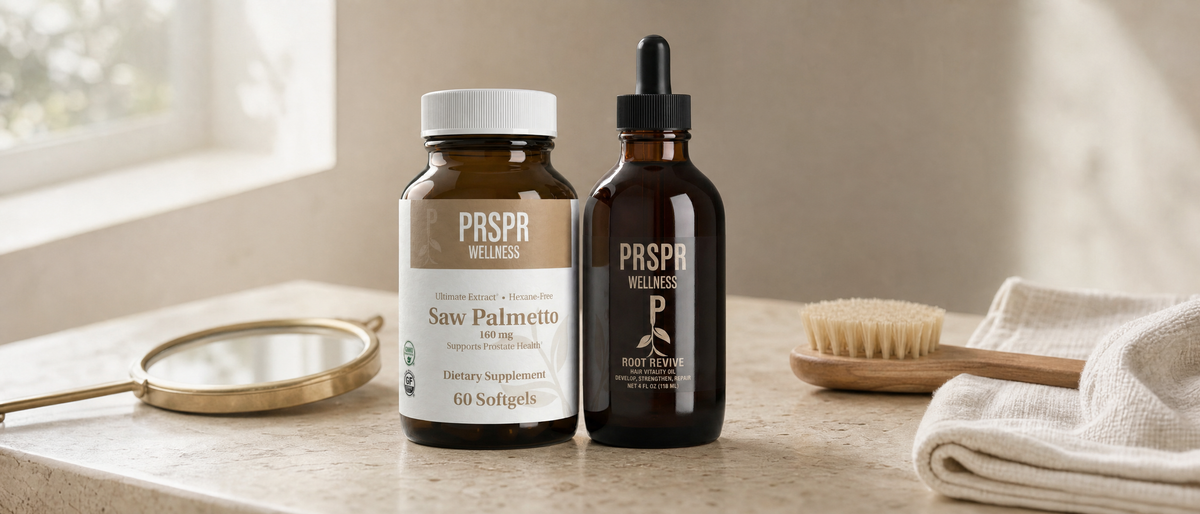
If this article has you thinking about hair as biology rather than just appearance, you are our kind of reader. Our Hair Harmony Kit is a two-product set: Root Revive hair oil in a 4 fl oz amber dropper bottle, and Saw Palmetto softgels, 60 per bottle. It is priced at $94.99.
What matters to us is how it is made. Both products are made in a GMP-certified facility and third-party batch tested, so what's on the label is what's in the bottle. If you like to compare sets side by side, our full range of bundles is in one place.
People are searching this question more than usual. Two explanations appear in the sources. OpenStax Anatomy and Physiology 2e describes eyebrow hair as keeping sweat and other particles from dripping into the eyes. Researchers at the University of York, in a 2018 Nature Ecology and Evolution study, argue that mobile brows on a smoother forehead became important for social communication, such as the eyebrow flash of recognition.
Brow follicles spend far less time in the growth phase. A 2022 review in the American Journal of Clinical Dermatology gives eyebrow anagen as 2 to 3 months, compared with 2 to 8 years for scalp follicles, and states that brow length is believed to be limited by that short phase.
Yes. Both grow from follicles, and per OpenStax Anatomy and Physiology 2e, the visible hair is dead tissue made entirely of keratin. The difference is in the timing of the growth cycle, not the material.
Brow thickness is natural variation between people, and genes are part of it. A 2016 Nature Communications study led by Kaustubh Adhikari found that eyebrow thickness was associated with a region of chromosome 3 overlapping the FOXL2 gene.
Answer all five questions to unlock a clear wellness plan made around your goal, schedule, preferred supplement format, and biggest roadblock.
Get clarity on what matters most right now.
See the product and routine connected to your goal.
Simple next steps you can use right away.
Pick the one you would fix first if you could.
This helps us make the guide easier to follow.
Consistency beats the “perfect” routine you never follow.
Be honest. We’re building something you’ll actually use.
Your guide will include one simple way around it.
Answer two more questions to unlock your product starting point, five-step plan, two-week routine, and one practical tip for your biggest roadblock.
Enter your details to open your five-step plan.
Verified PRSPR customer reviews
Expires when you close this page
*Your personal credit for completing the quiz. It's applied automatically at checkout on one-time purchases and expires when the timer runs out.
View full product detailsEverything in your plan, together — one add to cart.
Expires when you close this page
*Your personal credit for completing the quiz. It's applied automatically at checkout on one-time purchases and expires when the timer runs out.
View full product details Botany
You read "geranium" on a plant tag at a garden center, then read it again on an ingredient label, and the two plants look nothing alike. One is a b...
 Anatomy
You reach for a cup, stand up from a chair, or take a breath without thinking about it. Each of those moments runs on the muscular system, and if y...
 Botany
You run a hand over a green carpet on a shaded rock, pick up a bag of peat moss at the garden center, or walk under oaks draped in gray Spanish mos...